

Table of contents:
Electric utilities do not choose technology partners the same way most businesses buy equipment. Their decisions affect infrastructure that is expected to operate for many years, support growing electricity demand, and remain reliable as regulations, customer expectations, and grid requirements continue to evolve.
For that reason, utilities look beyond charging speed or hardware specifications. They want technology that integrates with existing systems, performs consistently under real operating conditions, and can adapt as their networks expand. A trusted partner is one that helps utilities manage charging as part of the wider energy system, not as a standalone product.
Understanding these priorities makes it easier to see why trust has become one of the most important factors in building modern EV charging infrastructure.
We remind you that you can purchase home and commercial charging stations in our store, as well as use public charging stations ECOFACTOR located throughout Ukraine. For convenient access to charging infrastructure, we recommend using our mobile app, available on iOS and Android.
Why Utilities Choose Partners Differently
Utilities are responsible for infrastructure that millions of people rely on every day. Unlike many commercial projects, investments in electricity networks are expected to deliver value over decades rather than just a few years. Every decision has to balance today’s requirements with future demand, regulatory changes, and operational stability.
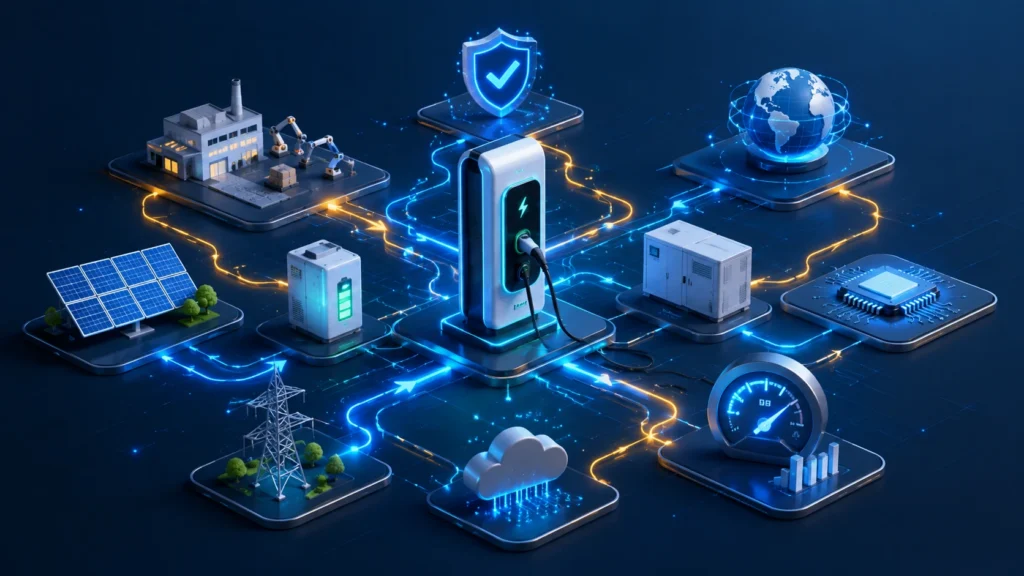
EV charging has become part of that equation. Charging stations are no longer viewed as standalone electrical devices. They interact with transformers, distribution networks, energy management systems, and software platforms that monitor and control electricity across an entire service area.
That is why utilities spend as much time evaluating the company behind the technology as they do evaluating the technology itself. A charger may look impressive on paper, but utilities also want to know how the platform will evolve, how support will be provided, and whether the solution will still meet their needs as the network grows. Trust is built through long-term reliability, transparency, and consistent performance. Those qualities are often far more valuable than having the longest feature list.
What Utilities Evaluate Before Making a Decision
Choosing a technology partner is rarely about finding a single product that checks every box. Utilities usually assess how well an entire solution fits into their long-term strategy. Hardware, software, support, and future development all play a role in that decision.
Supporting Future Growth
Utilities do not build charging infrastructure only for today’s demand. As EV adoption increases, charging networks expand, fleets grow, and new locations are added. Technology that works well at the beginning should continue performing just as effectively several years later.
That is why scalability is one of the first topics utilities discuss with potential technology partners. They want confidence that the network can grow without replacing existing hardware or moving to an entirely new management platform. A scalable solution should make it possible to expand the charging network without replacing existing infrastructure, support both AC and DC charging, add new locations with minimal disruption, manage the entire network through one platform, and stay compatible with future standards and software updates.
Scalability also applies to software. Whether operators manage fifty chargers or several thousand, they should have the same visibility, control, and operational simplicity. Technology partners with a clear product roadmap give utilities greater confidence that the platform will continue evolving alongside their business.
Fitting Existing Systems
Charging infrastructure should work with the systems utilities already rely on every day. Distribution management platforms, SCADA, GIS, billing software, and asset management systems all play a role in daily operations. EV charging should become part of that ecosystem rather than another standalone platform.
This is where interoperability becomes essential. Open communication standards and well-documented APIs allow charging infrastructure to exchange data with existing utility software while making future integrations much easier. The result is smoother day-to-day operations, less manual work, and better visibility across the entire charging network. Utilities also recognise that their digital environments will continue evolving. Technology that integrates easily today is far more likely to remain useful as new systems, services, and operational requirements emerge.
Delivering Reliable Performance
Reliable charging depends on much more than durable hardware. Once charging stations are deployed across multiple locations, software, monitoring, and technical support become equally important for keeping the network available.
Utilities therefore evaluate the entire charging ecosystem rather than individual chargers. They look for technology that provides continuous visibility into network performance, allows issues to be identified remotely, and supports proactive maintenance before small problems become service interruptions. A dependable charging ecosystem typically includes commercial-grade charging hardware, remote monitoring and diagnostics, secure firmware updates, performance reporting and analytics, clear maintenance procedures, and responsive technical support.
For utilities, reliability is measured over years rather than months. The strongest technology partners combine dependable hardware with software and services that help the charging network remain stable, efficient, and easy to manage throughout its lifecycle.

Partner With ECOFACTOR for EV Infrastructure
Technology partners play an important role in the development of reliable charging infrastructure. Alongside charging stations, ECOFACTOR supports utilities and charging projects with hybrid inverters, battery systems, and solar panels, alongside digital tools available through its iOS and Android app and charging station map.
ECOFACTOR can support infrastructure development with:
- Solutions for commercial and utility charging projects
- Energy technologies for integrated charging systems
- Tools that improve access to charging network information
- Cables and accessories for installation and maintenance
Contact ECOFACTOR to discuss solutions for your next EV charging project.
Managing Charging Instead of Simply Installing Chargers
Choosing the right technology partner is only part of the process. Once charging infrastructure is in place, utilities face a different challenge: managing how that infrastructure interacts with the electricity network every day.
As the number of electric vehicles grows, charging demand becomes less predictable. Residential charging often peaks in the evening, workplace chargers are busiest during business hours, and fleet depots may charge dozens of vehicles overnight. If every charger draws maximum power at the same time, local grid assets can come under unnecessary pressure even when enough energy is available overall.
This is why utilities increasingly focus on charging management rather than charging hardware alone. They want platforms that provide visibility into network activity and allow operators to adjust charging behaviour as conditions change. For utilities, this approach creates long-term operational value. Charging stations become connected energy assets that contribute to a more flexible and resilient electricity system rather than functioning as isolated pieces of equipment.
What Long-Term Support Really Means
Installing charging infrastructure is only the first stage of a much longer partnership. Utilities expect charging networks to remain operational for many years, which means technology partners need to provide ongoing support long after commissioning is complete.
Long-term support goes far beyond routine maintenance. Software continues to evolve, cybersecurity risks change, regulations are updated, and charging networks expand. A reliable technology partner helps utilities adapt to those changes without disrupting day-to-day operations.
Several areas deserve particular attention during the evaluation process. Software updates keep the platform stable, improve functionality, and introduce support for new features without replacing existing hardware. Cybersecurity protects charging infrastructure, operational data, and communication between chargers and management systems as new threats emerge. Spare parts availability reduces downtime by ensuring replacement components remain accessible throughout the product lifecycle. Technical support gives operators access to specialists who can diagnose issues quickly and help resolve problems remotely whenever possible. Regulatory compliance becomes easier when technology partners update their platforms to reflect new technical standards or market requirements. A clear product roadmap demonstrates that the platform will continue developing instead of becoming outdated after deployment.
Utilities often evaluate these areas just as carefully as charger specifications because they directly affect the total cost of ownership and the long-term reliability of the network. A useful question during procurement is not simply “Will this solution work today?” but “How will this solution be supported five or ten years from now?” The answer often reveals whether a company is supplying equipment or building a genuine long-term partnership.
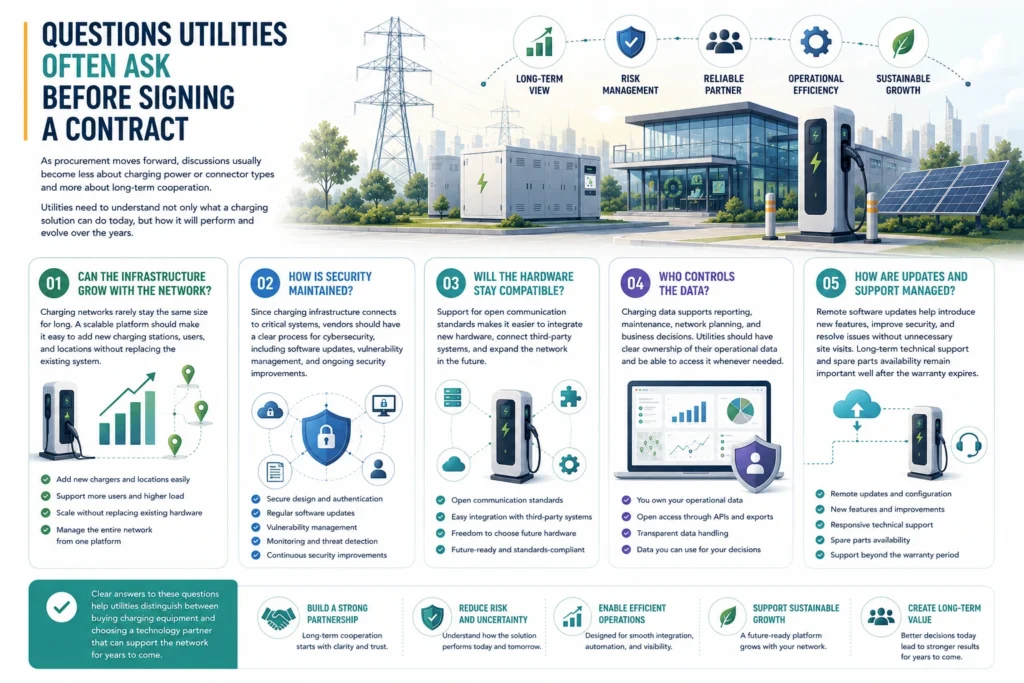
Questions Utilities Often Ask Before Signing a Contract
As procurement moves forward, discussions usually become less about charging power or connector types and more about long-term cooperation. Utilities need to understand not only what a charging solution can do today, but how it will perform and evolve over the years.
Can the Infrastructure Grow with the Network?
Charging networks rarely stay the same size for long. A scalable platform should make it easy to add new charging stations, users, and locations without replacing the existing system.
How Is Security Maintained?
Since charging infrastructure connects to critical systems, vendors should have a clear process for cybersecurity, including software updates, vulnerability management, and ongoing security improvements.
Will the Hardware Stay Compatible?
Support for open communication standards makes it easier to integrate new hardware, connect third-party systems, and expand the network in the future.
Who Controls the Data?
Charging data supports reporting, maintenance, network planning, and business decisions. Utilities should have clear ownership of their operational data and be able to access it whenever needed.
How Are Updates and Support Managed?
Remote software updates help introduce new features, improve security, and resolve issues without unnecessary site visits. Long-term technical support and spare parts availability remain important well after the warranty expires. Clear answers to these questions help utilities distinguish between buying charging equipment and choosing a technology partner that can support the network for years to come.
Comparing Technology Partners Beyond Price
Price will always be part of the evaluation, but utilities rarely make decisions based on the lowest quotation alone. Charging infrastructure is expected to remain in operation for many years, so long-term value usually outweighs short-term savings. Looking at the complete picture helps organisations reduce operational risk and choose solutions that continue delivering value as their networks expand.
| Evaluation Area | Why It Matters |
|---|---|
| Reliability | Reduces operational risk and minimizes downtime |
| Software | Provides better network visibility and operational control |
| Integration | Simplifies deployment and connects with existing utility systems |
| Scalability | Supports future network growth without major redesigns |
| Support | Enables faster issue resolution and smoother day-to-day operations |
| Cybersecurity | Protects charging infrastructure, communications, and operational data |
| Experience | Reduces project risk through proven deployments and industry knowledge |
No single category determines the final decision. Utilities typically assess how these elements work together to create infrastructure that remains reliable, secure, and easy to manage throughout its lifecycle.
Frequently Asked Questions
Why do utilities care so much about the technology partner, not just the charging hardware?
Charging stations become part of the electricity network, so utilities need a partner that can provide reliable software, long-term support, and solutions that continue working as the network grows.
What makes a charging platform scalable?
A scalable platform allows utilities to add new charging stations, support different charger types, and expand into new locations without replacing existing infrastructure or changing management systems.
Why is integration important for utility charging projects?
Charging infrastructure needs to work with the systems utilities already use, from energy management and billing to asset monitoring. Good integration reduces manual work and gives operators a clearer view of the entire network.
How does smart charging help utilities?
Smart charging allows utilities to manage when and how vehicles charge based on grid conditions. This helps reduce peak demand, balance available capacity, and make better use of existing infrastructure.
What should utilities expect after the charging network is installed?
The partnership should continue well beyond installation. Regular software updates, cybersecurity improvements, technical support, and access to replacement parts all help keep the network reliable over the long term.
Is the lowest-cost solution always the best choice?
Not necessarily. A lower upfront price can lead to higher operating costs if the system is difficult to expand, lacks integration capabilities, or requires frequent maintenance. Utilities usually focus on long-term value rather than the initial purchase price.
Conclusion
As EV charging becomes a permanent part of modern electricity infrastructure, the relationship between utilities and technology providers continues to evolve. Success depends on much more than delivering charging stations on schedule. It requires reliable hardware, intelligent software, open integration, ongoing support, and a shared commitment to continuous improvement.
Utilities rarely choose the cheapest solution. They choose technology partners that reduce operational risk, fit into long-term infrastructure planning, and continue supporting the network as it grows. The strongest partnerships are built on transparency, consistent performance, and a clear understanding that charging infrastructure is not a one-time project but a system that will continue evolving for many years.
When technology, support, and long-term planning come together, utilities gain more than a charging network. They gain confidence that their infrastructure is ready to support the next stage of electric mobility, whatever the future brings.