


Table of contents:
If you’ve looked at Chinese electric cars before, the name BYD Qin Plus has definitely appeared in the news. This electric sedan is often presented as an entry point for those who are switching to electric propulsion for the first time. But is it really as versatile as it seems from the descriptions? There will be no loud statements or idealised characteristics here. We will look at the model as a person who is going to drive it every day — with traffic jams, parking, winter weather and everyday needs.
Below, we will analyse everything factually: what’s under the hood, what the interior looks like, what it looks like in person, and where its limits are. Without embellishment and without fear of saying that there are compromises somewhere.
We remind you that you can purchase home and commercial charging stations, and also use ECOFACTOR public charging stations located throughout Ukraine.
What sets BYD Qin Plus apart?
There are many big names on the Chinese electric car market right now. But BYD Qin Plus is constantly appearing on lists of suitable first electric cars. And for good reason. This is a car that is not scary to buy, even if you have only driven petrol until now. There is nothing super complicated here, but there is enough to not feel limited.
For some, Qin Plus is a way to test an electric car in the city, while for others it is an opportunity to save money on daily trips without sacrificing comfort. And at the same time, the price is relatively affordable.
Trim levels and range: no more confusion
This review focuses on the Qin Plus EV, rather than the DM-i plug-in hybrid. The earlier EV versions discussed here have three main battery options; specifications vary by model year:
- 400 km NEDC: Basic version with a 47.5 kWh battery. It has a simpler configuration, minimal electronics, but all the essentials are there.
- 500 km NEDC: Two versions with a 57 kWh battery. Technically identical, but with different levels of equipment.
- 600 km NEDC: Top-of-the-line model with a 71.7 kWh battery and a more powerful electric motor.
The smaller battery can suit city use, while larger batteries provide more flexibility for longer trips. NEDC figures are laboratory ratings, not a guarantee of real-world range.
Chassis and drivetrain
All versions are front-wheel drive. The electric motor is mounted on the front axle. The standard version produces 100 kW (136 hp), while the top version has 135 kW (approximately 184 hp). Acceleration to 100 km/h in the most powerful version is about 9 seconds. It’s not a racing car, but its performance is suitable for everyday driving.
The front suspension is a classic MacPherson, while the rear suspension is multi-link. This is already a hint that the ride will be not only soft but also predictable. Ventilated brakes in the front and disc brakes in the rear are standard, but it’s nice that there are no simplifications even in the base.
Design, interior and practicality: what to look for
While some people look at the numbers and acceleration charts, most people start their acquaintance with the car from the exterior and interior. And here, BYD Qin Plus is calm: no attempts to surprise, but with the feeling that everything was done with an understanding of who this car is for.
Appearance without unnecessary tricks
Qin Plus doesn’t try to catch the eye at every intersection. But it’s not exactly grey either. Instead of a classic radiator grille, there is a closed-off front end that immediately hints that this is not just a BYD, but an electric car. Headlights with a narrow squint and daytime running lights in the style of “dragon claws” add character, but do not turn the car into a showroom on wheels.
Behind it is a familiar element: a solid red line connecting the brake lights. It looks appropriate, it doesn’t look like an attempt to be fashionable. In higher trim levels, there are automatic headlights — a thing that you don’t notice until you return to the car without it.
Briefly on the exterior:
- Fully enclosed front bumper (no grille),
- Headlights in the Dragon Face corporate style,
- Daytime lights in the shape of claws,
- Rear lights with an LED strip,
- A restrained roofline without unnecessary aerodynamic experiments.
Inside — without luxury, but with comfort
Inside, the Qin Plus does not pretend to be something “premium”. And this, to be honest, is even a plus. No lacquered wood, gloss for half a metre or neon light from every crack. Everything looks simple, clear and functional. The eco-leather on the seats and inserts looks decent, without any chemical sheen. It’s nice that in light-coloured interiors, frequently touched areas are trimmed with darker materials — it’s practical.
The central multimedia screen can rotate between portrait and landscape orientations and responds quickly. It works with GPS, climate, display settings, and even has a karaoke function for those who sometimes stand in traffic for too long. The dashboard is small but easy to read. The menu is simple, you can find what you need intuitively.
And one more thing: double glazing in the front and factory tinted rear windows provide a good level of noise insulation. At speeds up to 90 km/h, it’s quiet inside, you don’t feel like you’re sitting in a tin can with acoustics.
Practicality of the rear row and boot
If you are taller than 180 cm, the rear seat may be a little cramped. The ceiling is not very high and knee room is limited. This is a consequence of the compact architecture, which is more oriented towards the city than long-distance travel for five.
But the boot itself was a pleasant surprise. It is wide, with upholstered walls and a rubber mat. There is a place for charging cables, a repair kit and all the little things that usually lie loose in the boot. Everything is in its place, nothing rattles.
Charging: convenient for the city
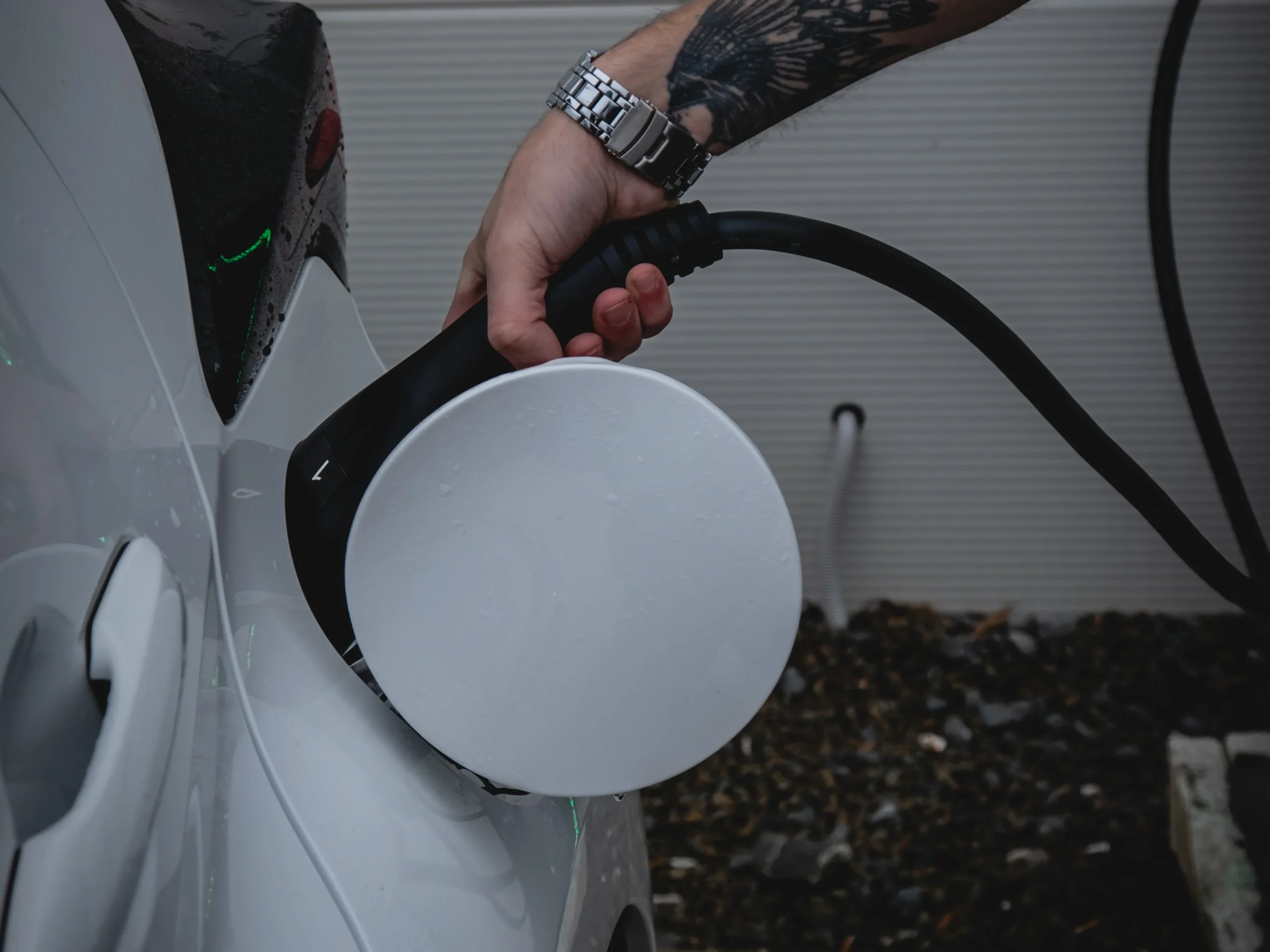
Home charging time depends on battery capacity, the starting charge level and the power available from both the charger and the car’s onboard charger. An overnight charge may be sufficient, but 8–10 hours is not a universal full-charge time, especially from a low-power household socket. DC charging times also depend on the starting charge level, battery temperature and station power; check the figures for the specific version.
Of course, the lack of all-wheel drive and the 150 km/h limit do not make the Qin Plus a universal vehicle for the highways. But if you live in a city and go further afield once or twice a week, it’s enough.
How we charge: our experience, our stations, our approach
We are well aware that an electric car is not just about the battery and the range. It’s also about how and where to charge it every day. That’s why we at ECOFACTOR have created a full range of solutions for electric car drivers in Ukraine — from charging at home to integrated solutions for businesses and public charging networks.
We do not just produce charging stations. We design, test, and adapt them to our climate and technical conditions. The models include mobile solutions and AC stations up to 44 kW and DC stations with a power output of up to 420 kW — suitable for slow night charging at home and for quick stops on the road.
To make it easier to use, we have developed our own mobile app for iOS and Android that lets you:
- Find the nearest station on the interactive map,
- See its status in real time,
- Book a port,
- Pay for charging directly in the app.
For business, we have created a separate SaaS platform with full control over the network: statistics, user management, tariffs, technical support — all in one account. This allows you to build a full-fledged network with flexible management rather than just installing stations.
We have a separate online shop with a wide range of accessories, charging equipment and inverters. It’s easy to find adapters, wall mounts or even a mobile charger there. We often use them ourselves, so we know what we’re selling.

Safety and driver-assistance systems
Depending on the model year and trim, safety equipment includes:
- ABS and EBD,
- Traction control,
- ESP stabilisation system,
- Front and rear parking sensors,
- Rear view camera.
Higher trim levels may also include:
- All-round view system (4 cameras),
- Blind-spot monitoring,
- Adaptive cruise control,
- Automatic braking.
That is, the safety here is not for show, but real. And it’s good that it’s not reserved only for the most expensive version.
Comfort for everyday use
Depending on the trim level, comfort features include:
- An electrically adjustable driver’s seat.
- Bluetooth, USB front and rear.
- Sunroof and heated mirrors.
- Smart key and keyless entry.
These are the little things that are felt on the second day of use. Not all of these are necessary, but it’s nice to have these features included in the chosen trim.
Who is this car for?
Here are some typical scenarios where BYD Qin Plus can be a really good choice:
City + suburbs
It is ideal for daily commuting to work, school or the shops. The car easily fits into the city rhythm, and a charge can cover several days of short trips without the need to look for an outlet every night. Manoeuvrability, a small turning radius and easy parking make it convenient in built-up areas.
A first electric car
For those who are just getting to know electric traction, Qin Plus will be a good start. The interface is not confusing, the behaviour on the road is predictable, there are no complicated electronics or bells and whistles that make you “learn” something. You just drive, and you understand how it works.
A family with a second car
As a second car for the family, Qin Plus covers all household tasks: dropping off children, shopping, and giving someone a lift to the train station. Electric traction allows you to save money, and maintenance is minimal. Plus, it’s not scary to leave it in the yard, because it’s not a show car.
Taxis or delivery services
The mid-range version is particularly beneficial for commercial use. It has a long range on a single charge, a simple interior, inexpensive components and no expensive maintenance. The battery holds steady, and electricity costs are several times lower than fuel costs.
Pros and cons (in human terms)
We have collected the main practical advantages and compromises. Not an advertising brochure, but something you really notice in everyday life.
Pros:
- Affordable price with good equipment
- Different battery options
- Simple architecture that is easy to maintain
- User-friendly touchscreen multimedia system
- Safety and driver-assistance features
Cons:
- The rear row is not for tall passengers
- No all-wheel drive, even in the top trim
- Modest acceleration on the motorway
- Limited top speed
Conclusions
BYD Qin Plus doesn’t pretend to be a premium car. And this is perhaps the best thing about it. This is a practical car that offers what it promises. You won’t get a wow effect from the design or acceleration, but you will get a reliable daily assistant. For many people, that’s exactly what they need from their first electric car.
It doesn’t push you to the limit, but it doesn’t require sacrifice either. You just get in and drive. And if you look at it from this point of view, it is a sensible option.
Frequently asked questions
How realistic is the range of the BYD Qin Plus in everyday use?
Real-world range depends on speed, temperature, heating or air-conditioning use, and battery condition. The NEDC figures should not be treated as a guaranteed distance. Allow a larger charging reserve for motorway trips and winter driving, and assess the range of the specific car before planning a long journey.
Is the Qin Plus EV a suitable first electric car?
Yes, this is exactly what it is designed for. Simple operation, familiar interior, no intimidating interface or functionality. You just get in and drive. If you don’t want to jump right into premium or smart systems with learning, Qin Plus gives you the classic car experience, but without the petrol.
How long does it take to charge at home?
Charging time depends on battery capacity, the starting charge level and the power available from the home charger and the car’s onboard charger. An overnight charge may be sufficient, but a low-power household socket can take considerably longer than 8–10 hours. Use charging equipment and an electrical installation suitable for the required continuous load.
Is it difficult to find a workshop for servicing?
The Qin Plus EV does not need petrol-engine oil changes, but it still requires scheduled maintenance. Follow the manual for checks and replacement intervals for items such as brake fluid, cabin filters, tyres and cooling-system components. Before buying an imported car, confirm that a local workshop can diagnose the specific version and source suitable parts.
How to connect BYD Qin Plus to the Ukrainian charging network?
Use the ECOFACTOR app to find a station, check its connector type and availability, and pay for charging. Confirm the charging standard fitted to your particular car before connecting. A vehicle with a GB/T port cannot plug directly into a CCS2 charger; a compatible DC adapter may be required. AC charging requires its own compatible connector or cable. The app does not replace the physical charging connection.
Is there enough space in the cabin for a family with children?
In front — no question. In the back, it will be comfortable for children or not very tall passengers. Taller adults may find it a bit cramped, especially in the legs. But if your family usually drives in the city and doesn’t plan long journeys with the whole family, it’s fine.
Which trim level offers the best balance?
The 500 km version looks like a happy medium. The battery is not the smallest, the equipment already comes with all the basic comfort, and you don’t have to pay for the maximum, which is often not used in real life. But this is a matter of taste and budget.