


Table of contents:
The Kia e-Niro has quickly become one of the most popular electric vehicles in Ukraine thanks to its excellent balance of price, quality and range. In 2021, 8,500 electric cars (BEVs) were added to the Ukrainian vehicle fleet, and by the end of 2024, the market for new and used electric vehicles had shown significantly higher growth rates (over 37,000 in 2023 alone).
But e-Niro owners are constantly faced with one key question: how and where should they charge their electric crossover? A home socket or a fast-charging station? How long does it actually take?
This guide will cover all the charging methods for the Kia Niro EV, actual charging times under Ukrainian conditions, types of connectors, a map of charging stations, and the hidden details that dealers often fail to mention.
We remind you that you can purchase home and commercial charging stations in our online storeand also use the public charging stations ECOFACTORcharging points located throughout Ukraine. For convenient access to charging infrastructure, we recommend using our mobile applicationwhich is available on iOS and Android.
Technical specifications of the Kia e-Niro battery
The KIA Niro electric crossover is available with two variants of NMC lithium-ion batteries: a compact 39.2 kWh version and a more powerful 64 kWh version. These batteries provide a range of up to 289 km and 455 km respectively under the WLTP cycle (for the first-generation e-Niro).
The reality on Ukrainian roads is somewhat different. Tests show that the version with a 64.8 kW·h battery achieves a range of 300–350 km in the combined cycle, depending on the load, driving style and weather conditions. In cities such as Kyiv or Lviv, the figures are better — up to 380–400 km with a careful driving style.
The 2025–2026 model is fitted with a 64.8 kWh battery, offering an official range of 460–463 km under the WLTP cycle. The electric motor delivers 204 k.s., enabling acceleration from 0 to 100 km/h in a respectable 7.8 seconds.
| Parameter. | Battery. 39.2 kWh | Battery. 64 kWh |
|---|---|---|
| WLTP range | up to 350 km | up to 455 km (407 km for 2025–2026) |
| Actual range (Ukraine) | 220–280 km | 300–350 km |
| Engine power | 136 k.s. | 204 k.s. |
| Max. speed DC charging | up to 50 kW (actual) | up to 77 kW |
User.i from X shares their experience: “From Kyiv to Vinnytsia — 320 km with luggage, and 20% battery remaining.” This confirms that the actual figures are close to the stated ones, but require an understanding of the operating conditions.
Charging types for Kia Niro EV
The Kia e-Niro supports three main types of charging, each of which has its own advantages and limitations. Understanding these options is crucial for planning journeys and day-to-day use.
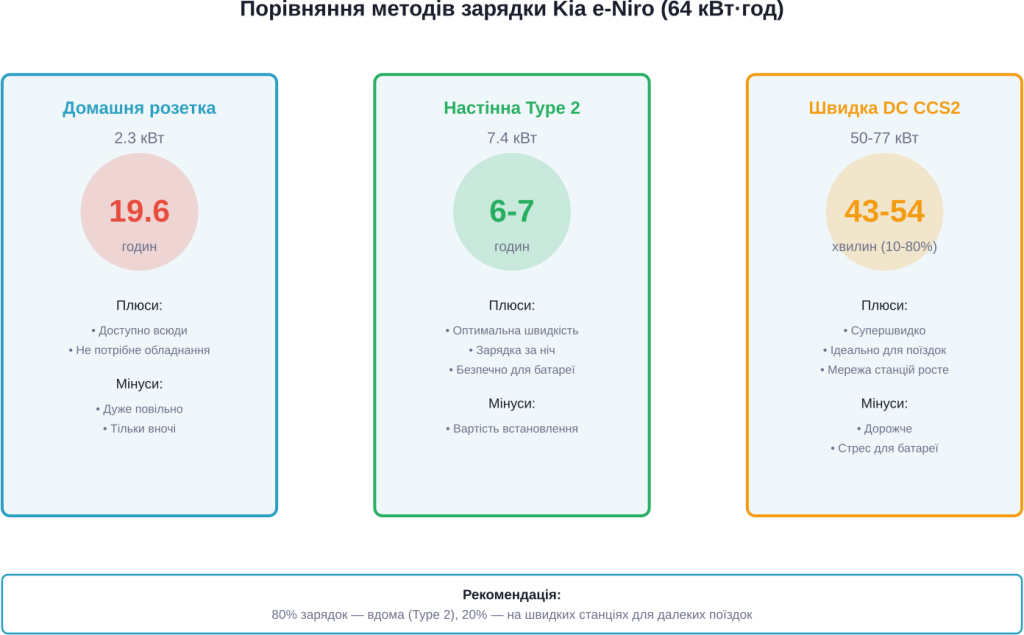
Home exercise from an ordinary socket (2.3 kW)
The slowest, but most affordable method. It’s suitable for those who park at home and can leave their car there overnight.
For a 64 kWh battery, a full charge takes around 19 hours and 36 minutes. Charging to 80 per cent (the recommended level for daily use) will take approximately 15–16 hours.
For the version with a 39 kWh battery, the charging time is reduced to 11 hours and 52 minutes until fully charged.
Look, it’s not the quickest option. But if you charge your car every night and drive 50–100 km a day, a standard socket is perfectly adequate.
Wall-mounted AC Type 2 charger (3.6–7.4 kW)
The most popular option for domestic use. Wall-mounted charging stations (wallboxes) are installed in private homes, garages or in the car parks of blocks of flats.
At a charging power of 3.6 kW, charging the 64 kWh battery to 80 per cent takes around 15+ hours (according to competitors’ figures, around 10–12 hours is stated for models with lower power ratings). This means that a fully discharged Niro can be charged overnight or in two nights under standard conditions.
If you set up a single-phase charging station rated at 7.2–7.4 kW or a three-phase one rated at 11 kW (which is supported by the updated e-Niro models), the charging time will be between 7 and 10 hours, depending on the power output of the on-board inverter.
An important point to note: Kia e-Niro models from different model years have different charging ports. The 2019 models were often fitted with a single-phase Type 2 charger, whilst the 2020–2021 versions were equipped with a three-phase port, which speeds up home charging.
Fast DC charging (CCS2, 50–77 kW)
This is a game-changer for long-distance journeys. Public fast-charging stations with a CCS2 (Combined Charging System) connector allow you to charge the e-Niro from 10% to 80% in just 43–54 minutes.
The version with a 64 kWh battery supports a maximum charging rate of up to 77 kW, although most charging stations in Ukraine as of 2026 offer 50 kW. At maximum charging speed, it takes around 50 minutes for the large battery and is reduced to around 30 minutes for the 39 kWh version.
Let’s be honest: you shouldn’t charge your car to 100% too often at fast-charging stations. This can lead to premature battery degradation. And although a single charge to 100% doesn’t have a significant impact, it’s better to keep the charge level between 20% and 80% to ensure the battery’s longevity.
Where is the charging port on the Kia e-Niro?
The Kia e-Niro has a charging port at the front of the car, located directly within the radiator grille (decorative panel).
Hidden beneath a single cover are two connectors: a Type 2 port for slow AC charging and a CCS2 (Combo) connector for fast DC charging. This design allows you to use any type of charging station without the need for additional adaptors.
An important point for owners of 2019–2020 models: check whether your e-Niro has a single-phase or three-phase Type 2 charger. You can determine this from the sticker near the charging port or in the technical documentation. The three-phase charger allows charging at a power of up to 11 kW, whilst the single-phase charger is limited to 7.4 kW.
Charging infrastructure in Ukraine: where to charge the e-Niro
As of 2026, the situation regarding charging stations in Ukraine had improved significantly compared with 2021–2022. Major cities and the routes between them are served by a sufficient number of charging points.
Public charging stations
There are several large networks of charging stations operating in Ukraine, covering the most popular routes.
Most public charging stations offer a charging capacity of 50 kW, although stations with capacities of 100–150 kW are starting to appear in major cities (the Kia e-Niro is limited to a maximum of 77 kW, so it will not be able to make full use of such stations).
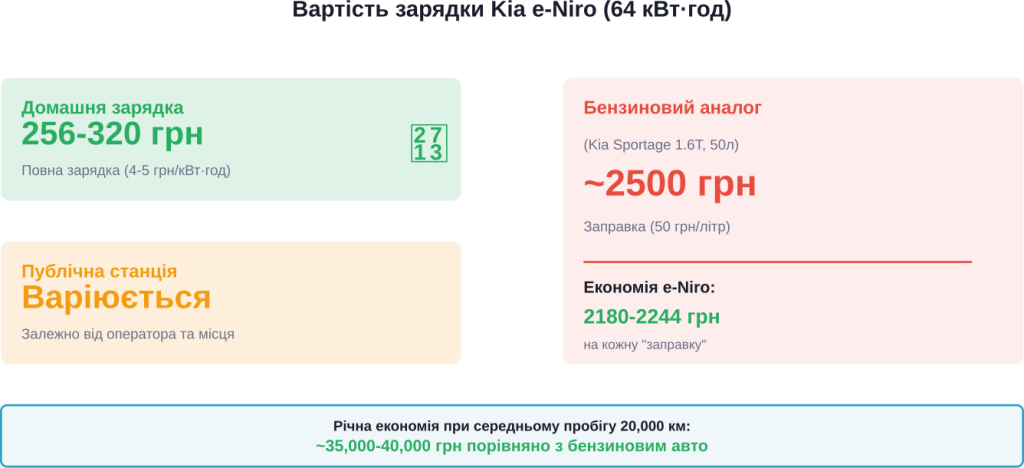
The cost of charging at public stations in Ukraine varies depending on the operator and location. A full charge for a 64 kWh battery will cost different amounts depending on the station chosen.
ECOFACTOR and the day-to-day reality of charges in Ukraine
When it comes to charging the Kia e-Niro on a daily basis in Ukraine, the biggest challenge is usually not ‘what to charge it with’, but ‘where exactly and whether there’ll be a charging point’. This is precisely where we at ECOFACTOR rely on a simple approach: open the map, view the charging points, and choose the one that’s suitable for your connector and on your route. In our mobile app for Android and iOS, you can find charging stations, check their current status and plan your charging without any unnecessary steps, whilst the charging map helps you find your way around quickly if you’re searching for a station on your laptop or simply don’t want to install any additional apps.
On the hardware side, we cover a range of charging scenarios and offer various charging stations — from mobile devices to fixed AC stations (we have a range up to 44 kW) and fast DC stations (up to 420 kW). This is convenient because the e-Niro is designed for the real world: today you might be charging at home or in a car park using AC, and tomorrow you might be looking for a DC station on the motorway to get back on the road quickly. Plus, we have an online shop where you can pick up charging accessories to suit your needs — cables, inverters, adaptors and other bits and bobs that you usually only remember when you realise, ‘Oh, I’ve forgotten!’
We also work directly with businesses: we provide a platform for operators and venue owners to manage their network of charging stations and monitor the status of equipment and usage in one place. In short, we don’t treat ‘stations’ and ‘service’ as separate entities — it’s important to us that drivers know where to charge, and that site owners know how to maintain and monitor everything properly.
Home exercise: savings and convenience
The most cost-effective option is charging at home. The cost of electricity for domestic consumers in Ukraine in 2024–2025 was around 4–5 UAH per kWh (actual tariffs for 2026 may vary).
A full charge of the 64 kWh battery will cost between 256 and 320 UAH. Compare this with a petrol car: 50 litres of A-95 petrol at 50 UAH per litre comes to 2,500 UAH. The savings are obvious.
To install a wall-mounted charging station at home, it is recommended that you contact qualified installers. The cost of the equipment and installation of a wall-mounted charging station varies depending on its power output and functionality (smart control, app integration, etc.).
The best charging strategy: how to extend your battery’s lifespan
Not all charging methods are equally beneficial for battery life. Here’s what you need to know to maximise the battery life of your e-Niro.
The 20–80% rule
The most important tip: keep the charge level between 20% and 80% for everyday use. Lithium-ion batteries last longest when they are not constantly at extreme charge levels.
Charging to 100% is only necessary for long journeys. For everyday journeys around town, a 60–70 per cent charge is more than enough and is much better for the battery.
Limit fast charging
Fast DC charging is convenient, but it puts additional strain on the battery due to the high temperatures involved. Use fast-charging stations only for long-distance journeys when time is of the essence.
For everyday use, slow or medium AC charging at home or at work is ideal. This extends the battery’s service life by years.
Avoid extreme temperatures
Lithium-ion batteries do not cope well with extreme temperatures. In cold weather (below -10°C), the range may be reduced by 20–30 per cent, and charging will be slower.
The Kia e-Niro is fitted with a battery thermal management system, but it is best to park the car in a warm garage in winter and in the shade in summer. If you charge it in freezing conditions, the battery will warm up first, which increases the overall charging time.
| Condition | Effect on range | Recommendation. |
|---|---|---|
| Temperature: +20°C | Optimal (100%) | Standard charging mode |
| Temperature: -10°C | 20–25% reduction | Warming up before a journey, parking in a garage |
| Temperature: +35°C | Reduction of 10–15% | Park in the shade; avoid leaving the car fully exposed to the sun |
| Aggressive driving | Reduction of 25–30% | Mode: Eco, smooth acceleration |
| Speed 130 km/h | Reduction of 35–40% | Speed 90–110 km/h (optimal) |
Kia Connect and smart charging management
The 2020 e-Niro and later models are fitted with the Kia Connect system (formerly UVO), which allows you to remotely monitor and manage the charging process via a mobile app.
Main functions:
- Remote start and stop of charges.
- Installation. Target charge level (e.g. 80 per cent).
- Charging schedule for the night-time tariff.
- Heating or cooling the passenger compartment whilst charging.
- Viewing the remaining charge and range.
- Find the nearest charging stations with navigation.
These features are particularly useful in winter: you can programme the car to finish charging and warm up the cabin 10–15 minutes before you set off. The car will be warm, and the battery will be at the optimum temperature for maximum range.
Real-life experiences: what e-Niro owners in Ukraine have to say
Discussions within the electric vehicle community provide valuable insights into real-world driving conditions. Here’s what owners are saying.
One user writes: “Kyiv–Vinnytsia, 320 km with a full boot and three passengers — I set off with 20% battery charge. Set off with 95%, temperature +18°C, speed 110–120 km/h. It’s perfectly feasible and comfortable.”
Another owner notes: “In winter, at -15°C, the range drops to 250–280 km in real-world conditions. But if you park in a heated car park and don’t set the heating to full, you get 300–320 km.”
Regarding charging: “I’ve installed a 7.4 kW wallbox at home. I charge it at night using the off-peak tariff — it costs next to nothing. After a year of use, the battery’s SOH (state of health) has only dropped by 2%, which is fine.”
The hidden details that car dealers don’t mention
There are a few important points you should be aware of before buying or whilst using the e-Niro:
- Battery warranty: Kia offers a 7-year or 150,000 km battery warranty covering degradation of up to 30 per cent. However, it is important to understand the terms and conditions: the warranty covers manufacturing defects, not natural wear and tear resulting from improper use.
- Charging station certification: Not all public charging stations in Ukraine maintain a stable power output. At some ‘50 kW’ stations, the actual power output does not exceed 35–40 kW, particularly when several cars are charging at the same time.
- Versions for different markets: the e-Niro for the European market differs from the Korean or American versions in terms of its BMS (battery management system) settings and maximum charging power. Check the region of origin when buying a used car.
What to expect in 2026–2027
The electric vehicle market in Ukraine continues to grow rapidly. According to data from Ukravtoprom, 9,274 electric vehicles were imported into Ukraine in August 2025 — more than double the figure for the same month the previous year.
The charging infrastructure is expanding. Operators plan to increase the number of fast-charging stations on major routes and in cities. By the end of 2026, new stations with a capacity of 150–350 kW are expected to be launched, although the Kia e-Niro will not be able to utilise them to their full potential due to its 77 kW limit.
Electricity prices remain more stable than fuel prices, making electric vehicles cost-effective to run even as tariffs rise.
Conclusion: The Kia e-Niro and charging in Ukraine
Charging a Kia e-Niro in Ukraine is no longer a problem, but rather a question of choosing the best strategy. Home charging using Type 2 wall-mounted stations meets 80–90 per cent of most owners’ needs, providing a full charge overnight at minimal cost.
DC CCS2 fast-charging stations are the perfect addition to the system for long-distance journeys, allowing you to charge the battery from 10% to 80% in 43–54 minutes — just enough time for a coffee and a snack.
With a real-world range of 300–350 km on Ukrainian roads, the e-Niro is the ideal choice for city and commuter journeys. And the right charging strategy (20–80 per cent, prioritising AC over DC) ensures the battery will last for years of use.
The growing number of electric vehicles in Ukraine and the expansion of the charging infrastructure make 2026 one of the best years for switching to electric transport. The Kia e-Niro, with its optimal balance of price, quality and practicality, remains one of the smartest choices on the market.
Ready to switch to an electric car? Check availability of the Kia e-Niro at authorised dealers, find out about installing a home charging station, and join Ukraine’s electric vehicle community. The future is already here — and it’s charging faster than you think.
Frequently asked questions
How much does it cost to fully charge a Kia e-Niro in Ukraine?
At home, at a rate of 4–5 UAH/kWh, a full charge of a 64 kWh battery costs 256–320 UAH. At public charging stations, the cost varies depending on the operator and location. By way of comparison, filling up a petrol-powered equivalent would cost around 2,500 UAH.
How long does it take to fully charge the device from a domestic socket?
Using a standard 220V socket (2.3 kW), it takes around 19–20 hours to fully charge a 64 kWh battery. Using a 7.4 kW Type 2 wall-mounted charging station, it takes 6–7 hours. At a DC CCS2 fast-charging station, charging from 10% to 80% takes 43–54 minutes.
Do you often use fast charging?
It is possible, but it is not recommended to do this all the time. Fast DC charging puts additional strain on the battery due to the higher temperature. Ideally, you should only use fast charging for long journeys, and charge at home using AC charging points for everyday use.
What is the best strategy for maximising battery life?
Keep the charge level between 20% and 80% for everyday use. Only charge to 100% before long journeys. Opt for slow AC charging at home rather than fast DC charging at charging stations. Avoid charging in freezing temperatures or extreme heat — this reduces efficiency and can shorten the battery’s lifespan.
How many fast-charging stations are there in Ukraine for the e-Niro?
As of 2026, there are hundreds of public charging stations in Ukraine that support CCS2, which is required for the e-Niro. The highest concentration of stations is in Kyiv, Lviv, Odesa, Dnipro and Kharkiv, as well as along the main inter-city routes. To find the latest stations, use apps and interactive maps.
Does the range decrease in winter?
For example, at temperatures below -10°C, the range can be reduced by 20–30% compared with optimal conditions. This is due to the energy required to heat the cabin and the reduced efficiency of the battery in cold weather. To minimise this loss, park your car in a warm garage, use the seat heating rather than the full cabin heating, and let the car warm up whilst charging.
What is the difference between the 2019 and 2021 e-Niro models in terms of charging?
The main difference lies in the power output of the AC chargers. The 2019 models had a single-phase charger with a maximum output of 7.4 kW, whilst from late 2019 (model year 2020) a three-phase on-board charger with an output of 10.5–11 kW became available.