

Table of contents:
Quick Summary: In 2026, the Ukrainian electric truck market offers modern models from DAF, Scania, Mercedes-Benz, and Volvo. Range reaches 300-500 km, charging time to 80% — from 30 to 140 minutes, making electric trucks an economically viable solution for business.
Electric trucks have ceased to be a futuristic dream — they are here and now. When diesel at gas stations costs 90 UAH per liter, and European environmental standards become increasingly stringent, businesses are reviewing their commercial vehicle procurement strategy.
According to the International Energy Agency, the share of electric vehicles globally exceeded 20% of all cars sold in 2024. In 2022, this figure was about 14%. Heavy electric trucks continue to catch up — but the gap is closing rapidly.
This review will help you find the optimal model, understand real characteristics, and determine whether Ukrainian business is ready for the transition to electric drive.
We remind you that you can purchase home and commercial charging stations in our online store, as well as use public charging stations ECOFACTOR located throughout Ukraine. For convenient access to charging infrastructure, we recommend using our mobile app, available on iOS and Android.
Why 2026 Is a Turning Point for Electric Trucks
The commercial electric transport market has reached critical mass. Battery technologies have become more reliable, charging infrastructure has expanded, and manufacturers have finally offered models with real range for daily routes.
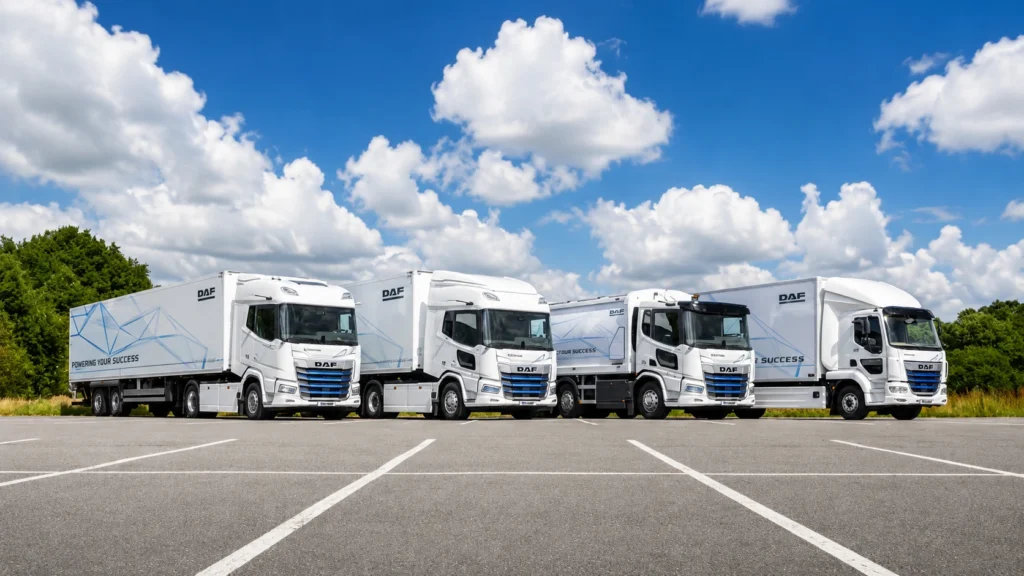
In November 2025, at the Solutrans exhibition in Lyon, the title “International Truck of the Year 2026” was awarded to two electric models at once — DAF XD Electric and XF Electric. This is the first time electric trucks have won the industry’s top award.
Top 5 Electric Trucks for the Ukrainian Market
DAF XD Electric and XF Electric: Winners of the Year
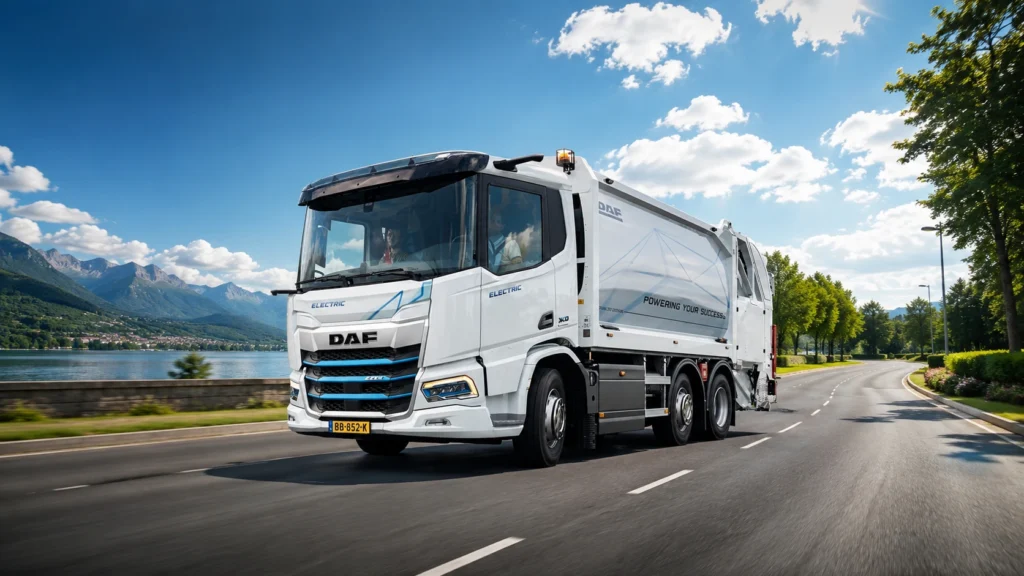
The Dutch manufacturer DAF presented two models that became the industry benchmark. XD Electric is for regional transportation, XF Electric is for intercity routes.
According to the stated characteristics, both models offer a range of up to 500 km. Charging time from 20% to 80% is about 45 minutes at a powerful station, although exact parameters vary depending on the type of charging station.
Manufacturers of electric trucks (such as MAN) are expanding their service center networks for electric vehicle maintenance, planning full network readiness in the coming years.
Scania MCS: Fast Charging for Intensive Work
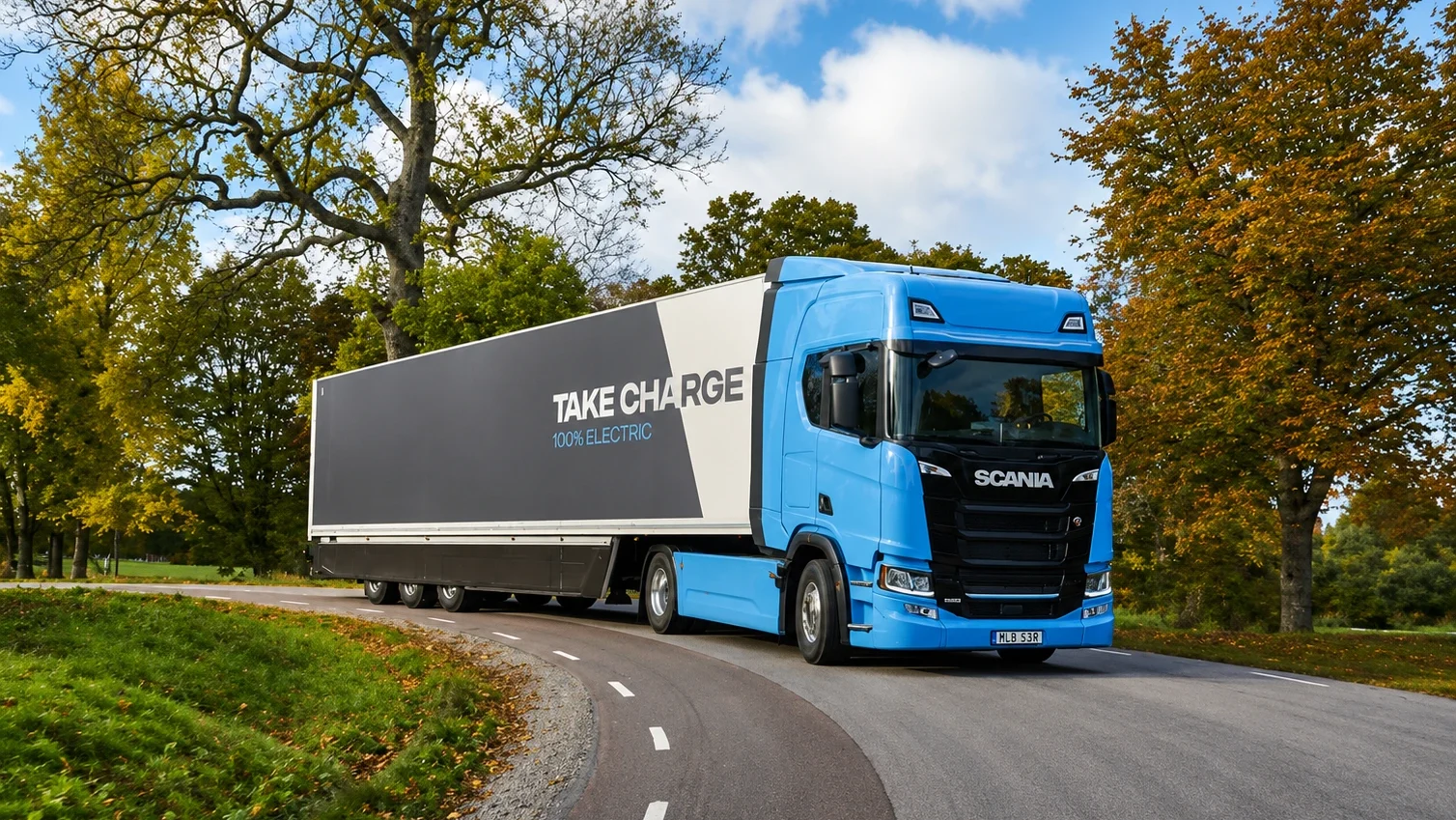
Scania is betting on Megawatt Charging System (MCS) technology, which allows charging time to be reduced to a minimum. For businesses where every hour of downtime costs money, this is a critical parameter.
The model is focused on urban deliveries and regional routes with the ability to quickly recharge during lunch breaks.
Volvo FL Electric: Reliability and Ecology
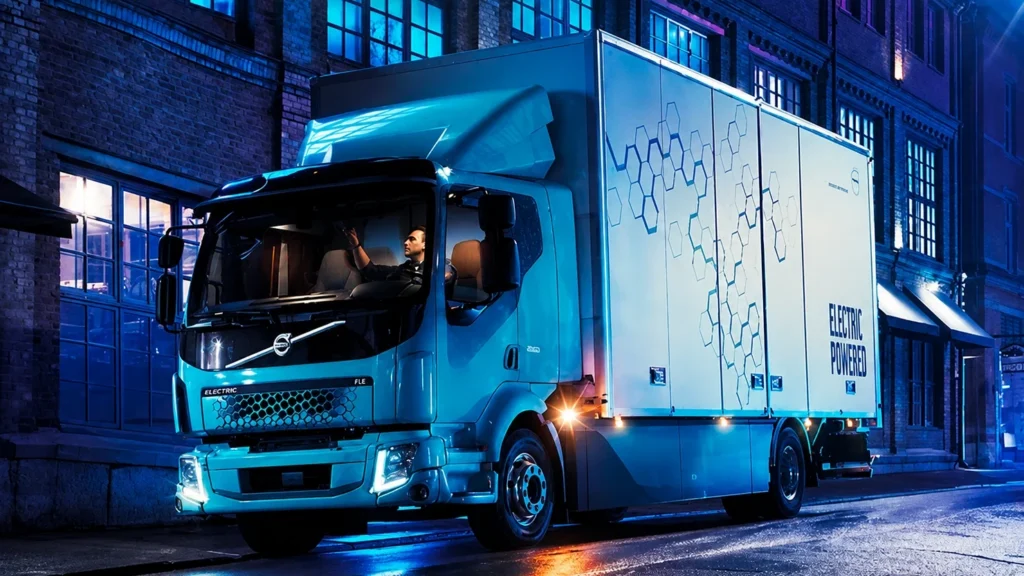
Volvo FL Electric provides 100% zero-emission operation, making it ideal for companies with an environmental focus. For businesses operating in city centers with emission restrictions, this is the optimal choice.
Charging time to 80% at a 150 kW station is 140 minutes. This is longer than competitors, but the model compensates with reliability and low maintenance costs.
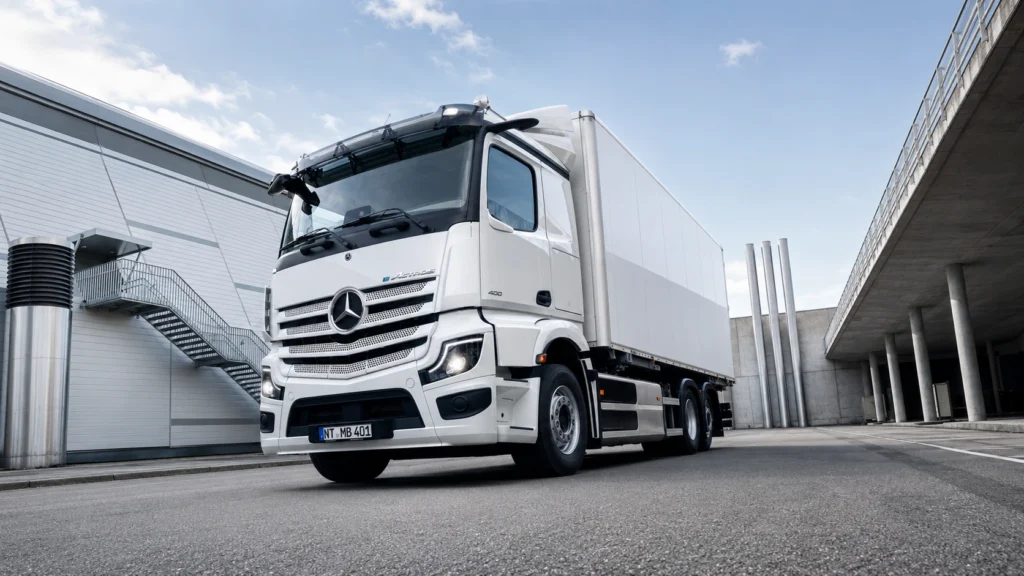
Mercedes-Benz eActros: Premium Segment
The German manufacturer offers a solution for companies that value driver comfort and brand prestige. The eActros is focused on intercity transportation with well-developed charging infrastructure.
The model integrates with Mercedes fleet management systems and offers advanced telematics.
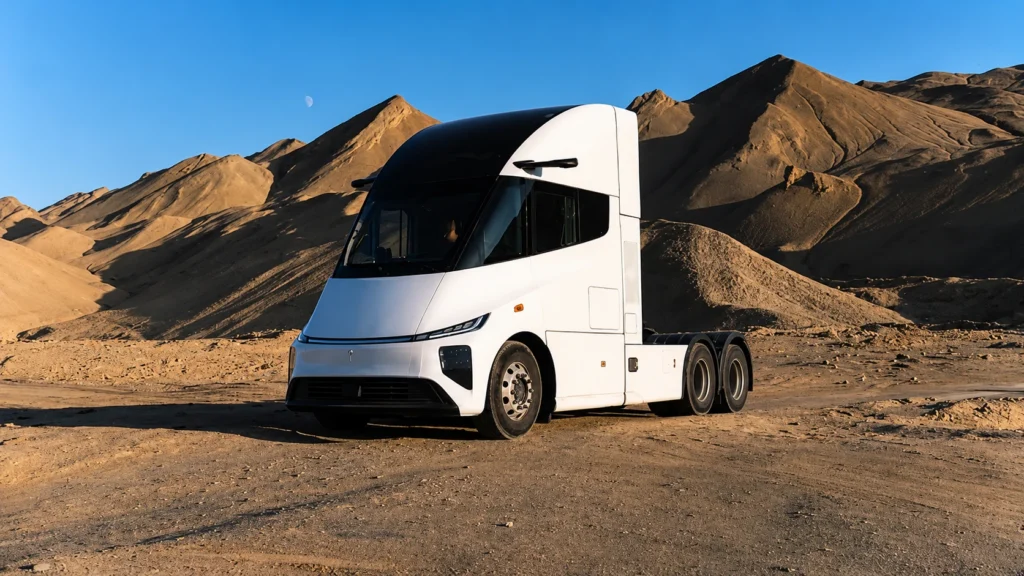
Tesla Semi: American Innovation
Although the Tesla Semi is not officially presented in Ukraine, the model is worth attention due to its revolutionary charging time — only 40 minutes to 80% on its own Supercharger network.
The Tesla Semi range is up to 500 miles (about 800 km) in the top version and 300 miles (about 480 km) in the base version.
Comparative Specifications Table
| Model | Range (km) | Charging Time to 80% | Charging Type |
|---|---|---|---|
| Tesla Semi | 800 | 40 minutes | Proprietary Network |
| DAF XD/XF Electric | 500 | 45 minutes | CCS/MCS |
| MAN eTGX/eTGS | 400-500 | 30 minutes | MCS 670-1000A |
| Nikola Tre BEV | 450 | 90 minutes | 350 kW System |
| Volvo FL Electric | 300 | 140 minutes | 150 kW Station |
| Scania MCS | 350 | Less than 45 minutes | MCS |
How to Choose an Electric Truck for Business
Calculate Real Daily Mileage
Add 25-30% reserve to the typical route. If the truck rarely exceeds 150 km per day, most modern models will cope without problems.
But if routes are unpredictable or include long trips, you need a model with a range of 400+ km or access to fast charging stations.
Evaluate Charging Infrastructure
The ideal scenario is overnight charging at your own depot. This is the cheapest and most convenient solution. Installing a charging station at the depot pays for itself within 2-3 years with intensive operation of a fleet of several trucks.
If you have to rely on public stations, check route availability through MAN SmartRoute or similar planning services.
Calculate Total Cost of Ownership
An electric truck costs more to purchase, but variable costs are significantly lower. According to MAN, the total cost of ownership of an electric truck can reach parity with diesel counterparts, taking into account operating costs for electricity and maintenance.
Consider savings on fuel, maintenance (electric motors are simpler), tax benefits, and possible subsidies.
| Parameter | Diesel Truck | Electric Truck |
|---|---|---|
| Fuel/Electricity Cost (100 km) | ~900 UAH (10 l × 90 UAH) | ~700 to 1,200 UAH (at commercial rate 7-12 UAH per kWh) |
| Maintenance (year) | 80,000-120,000 UAH | 40,000-60,000 UAH |
| Initial Price | Lower | Higher by 40-50% |

Organize Charging for Electric Trucks for Your Fleet
For commercial transportation, charging directly affects schedules, costs, and the operation of the entire fleet. ECOFACTOR allows you to build this part without fragmented solutions — from network access to equipment selection tailored to your specific operating conditions.
Get a Solution for Fleet, Base, and Routes
ECOFACTOR offers solutions for transport, facilities, and business so that everything works as one system:
- Mobile App for Android and iOS and Charging Station Map for trip control
- Online store where you can buy accessories, cables, and mobile chargers
- Charging Station Configurator to choose AC or DC station for the fleet
- Operator Platform and white-label solution for launching and managing your own network
- Energy-Efficient Solutions for optimizing charging costs
Contact ECOFACTOR and discuss how to organize charging for your fleet and real operating routes.
Prospects of the Electric Truck Market in Ukraine
The Ukrainian commercial vehicle market shows some recovery in business activity. March LCV statistics indicate growing interest in trucks with a gross weight of up to 3.5 tons.
According to the International Energy Agency, the global electric vehicle fleet continues to grow, displacing significant volumes of oil consumption.
In Europe and globally, there is dynamic growth in the share of electric vehicles in total sales, with accelerating rates in recent years. Heavy trucks are still catching up, but the dynamics are impressive.
Real talk: businesses are switching to electric drive not for the sake of ecology (although this is a nice bonus), but for the sake of economics. When the difference in fuel costs reaches 600 UAH per 100 km, the decision becomes obvious.
Frequently Asked Questions
What Real Range Is Needed for City Deliveries?
For city routes, 200-250 km of real-world range is sufficient. Add 25-30% reserve for unforeseen situations — you will need a model with a declared range of 300 km. Most modern electric trucks easily cover this need.
How Much Does It Cost to Install a Charging Station at the Depot?
The cost of installing a charging station depends on power and local conditions and requires individual calculation, taking into account the supply of electrical power. Payback is 2-3 years with intensive operation of a fleet of 3-5 trucks. More powerful MCS stations will cost more but will reduce downtime.
Can an Electric Truck Be Charged from a Regular Network?
Technically possible, but impractical. Charging from a 220V household network will take 20-30 hours for a full charge. For commercial transportation, a three-phase 380V network and specialized equipment with a minimum power of 50 kW are required.
How Do Electric Trucks Behave in Winter?
At low temperatures, the range decreases by 15-25%. Modern models are equipped with battery heating systems that partially compensate for losses. Pre-heating during charging at the depot before departure is critically important.
When Does an Electric Truck Become More Profitable Than a Diesel One?
According to manufacturers, parity in total cost of ownership occurs after four years. But for businesses with large daily mileages (200+ km per day) and their own charging infrastructure, payback can be reduced to 2.5-3 years thanks to fuel savings.
Which Models Have the Fastest Charging?
MAN eTGX/eTGS can charge at MCS (Megawatt Charging System) stations with power up to 375 kW (for eTGX/eTGS) and 250 kW (for eTGL), providing a significant reduction in charging time. Tesla Semi offers 40 minutes on its own Supercharger network. DAF XD/XF Electric provide about 45 minutes at compatible stations.
Conclusion: Electric Trucks Have Become a Reality
The 2026 electric truck rating shows: the technology has matured. A range of 400-500 km, charging time up to 30 minutes, a developed service network — all this is no longer promises, but reality.
DAF XD and XF Electric received the title “Truck of the Year” for a reason. European manufacturers have achieved a balance between reliability, performance, and operating economy.
Switch to electric drive consciously: calculate the real mileage, assess charging capabilities, and calculate the total cost of ownership. If the numbers match — 2026 will be your year of transition to commercial electric transport.