

Table of contents:
Electric vehicle charging has changed quickly over the past few years. The conversation used to focus on installing more chargers and expanding coverage. While that still matters, many operators are now facing a different challenge: keeping growing charging networks reliable every day.
This is where the energy sector offers valuable lessons. Power grids have long been designed around availability, resilience, remote monitoring, and long-term maintenance. As EV charging becomes part of everyday transport, many of the same principles are becoming just as important. Building more charging stations is only one step. Building infrastructure that people can depend on for years is what will define the next stage of the industry.
We remind you that you can purchase home and commercial charging stations in our store, as well as use public charging stations ECOFACTOR located throughout Ukraine. For convenient access to charging infrastructure, we recommend using our mobile app, available on iOS and Android.
EV Charging Is No Longer Just a Charger Business
Not long ago, the biggest challenge in the EV industry was simple: install more charging stations. Governments introduced incentives, businesses added chargers to their parking areas, and Charge Point Operators focused on expanding network coverage. Growth was measured by how many new locations appeared on the map. That is no longer enough.
As more drivers switch to electric vehicles, charging infrastructure becomes part of everyday life. People rely on it to get to work, complete deliveries, travel between cities, or charge while shopping. When a charger is unavailable, the problem extends beyond one interrupted charging session. It affects schedules, business operations, and confidence in the network.
This shift changes what success looks like. Instead of asking how quickly a charging network can grow, operators increasingly ask whether it can remain reliable as it grows. Can new charging stations be added without rebuilding the platform? Can faults be detected before drivers report them? Can software, payments, and energy management continue working smoothly as the network expands?
These are familiar questions in the energy sector. Electricity networks have never been judged only by how many substations or power lines exist. Their value comes from delivering electricity safely and consistently every day. Maintenance, monitoring, cybersecurity, and long-term planning are all considered part of the infrastructure, not optional extras.
EV charging is beginning to follow the same path. A charging station is no longer just a piece of hardware connected to the grid. It is part of a much larger system that includes software, communications, payment services, energy management, and ongoing technical support. Like any other infrastructure people depend on, it needs to keep working long after the installation team has left the site.
What the Energy Sector Already Understands
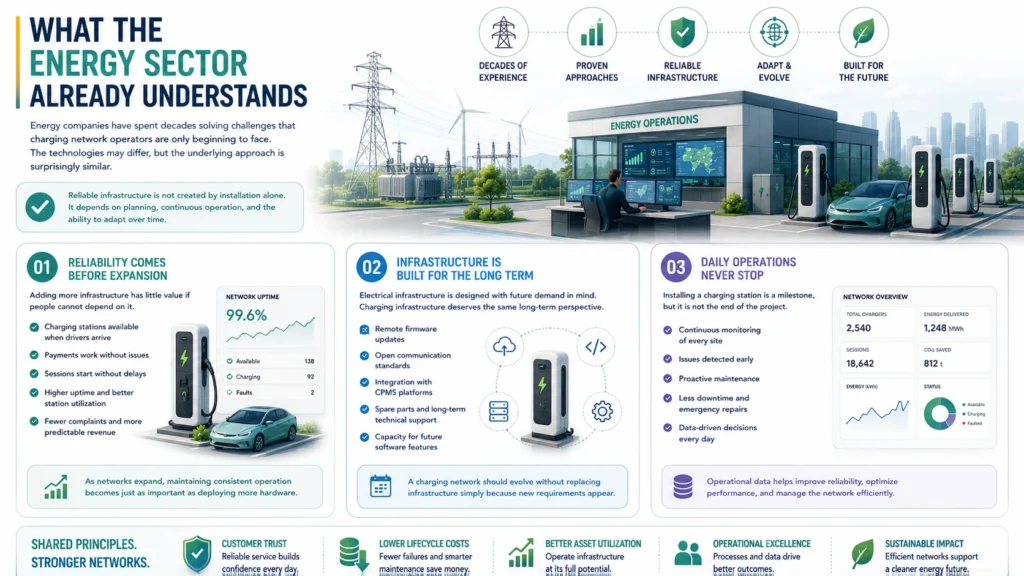
Energy companies have spent decades solving challenges that charging network operators are only beginning to face. They manage thousands of distributed assets, balance changing electricity demand, monitor equipment remotely, and maintain systems expected to operate for many years. The technologies may differ, but the underlying approach is surprisingly similar. Reliable infrastructure is not created by installation alone. It depends on planning, continuous operation, and the ability to adapt over time.
Reliability Comes Before Expansion
Adding more infrastructure has little value if people cannot depend on it. Electric utilities understand this well. Customers rarely think about the power grid when everything works normally, but even a short outage quickly becomes noticeable. The same expectation is developing around EV charging.
Drivers do not judge a charging network only by the number of locations it offers. They expect charging stations to be available when they arrive, payments to work without issues, and charging sessions to start without unnecessary delays. For Charge Point Operators, reliability directly affects daily business. Higher uptime means better station utilization, fewer customer complaints, and more predictable revenue. As charging infrastructure expands, maintaining consistent operation becomes just as important as deploying additional hardware.
Infrastructure Is Built for the Long Term
Electrical infrastructure is designed with future demand in mind. Utilities know that replacing transformers, switchgear, or distribution equipment every few years would be both expensive and disruptive. Charging infrastructure deserves the same long-term perspective.
Selecting charging equipment should involve more than connector types or maximum charging power. Businesses should consider whether the system will continue meeting operational needs several years from now. That includes support for remote firmware updates, compatibility with open communication standards, integration with Charge Point Management Systems, spare parts and long-term technical support, and capacity to support future software features. A charging network should be able to evolve without requiring large sections of installed infrastructure to be replaced simply because new requirements appear.
Daily Operations Never Stop
Installing a charging station is a milestone, but it is not the end of the project. Energy companies treat every asset as part of an ongoing operational process. Equipment is monitored, inspected, updated, and maintained throughout its service life. Small issues are identified before they become larger failures, helping maintain reliable service while reducing emergency repairs.
Charging networks benefit from exactly the same approach. Modern charging infrastructure generates valuable operational data every day. Station availability, charging sessions, energy consumption, fault history, and software status all help operators understand how the network is performing. The more information operators have, the easier it becomes to schedule maintenance, identify recurring issues, and improve overall network reliability without unnecessary site visits.
Building Charging Networks That Stay Reliable
Reliable charging networks do not happen by accident. They are the result of thousands of small operational decisions made long after the equipment has been installed. This is another area where the energy sector offers valuable experience. Utilities have learned that responding to problems after customers notice them is expensive and inefficient. Instead, they invest in systems that provide constant visibility into the condition of their infrastructure. Charging networks are increasingly adopting the same approach.
See Problems Before Drivers Do
A charging station can appear to be online while still having issues that affect the user experience. A payment service may stop responding, communication with the management platform may fail, or a connector may develop a fault before it becomes completely unusable.
Without remote monitoring, operators often learn about these problems only after a driver reports them. Modern Charge Point Management Systems continuously collect information from charging stations. This allows operators to monitor availability, detect abnormal behavior, and respond more quickly when something changes. Typical remote management capabilities include real-time charger status monitoring, automatic fault notifications, remote restart of charging stations, remote firmware deployment, charging session history and diagnostics, and energy consumption reporting. Not every technical issue can be resolved remotely, but many can. Even when a technician needs to visit the site, having detailed diagnostic information beforehand reduces troubleshooting time and helps maintenance teams arrive with the right replacement parts.
Keep Future Options Open
Energy infrastructure is built to remain operational for many years, even as technology changes around it. That is one reason utilities avoid unnecessary dependence on proprietary systems whenever possible. The same principle increasingly applies to EV charging.
A charging network consists of hardware, management software, payment systems, mobile applications, monitoring tools, and sometimes energy management platforms. If every component depends on a single vendor, future upgrades become more complicated. Open communication standards make expansion much easier. The most widely adopted example is the Open Charge Point Protocol (OCPP), which allows charging stations and Charge Point Management Systems from different providers to communicate with one another.
For businesses investing in charging infrastructure, this flexibility offers several practical advantages: greater freedom when selecting software platforms, easier integration with new business systems, reduced dependence on a single supplier, simpler hardware replacement when required, and better support for long-term network growth.
Support Every Charging Session
When people think about charging infrastructure, they usually picture the charger itself. In reality, every charging session depends on a continuous exchange of information between several systems.
A typical session involves driver authentication, communication with the management platform, payment authorization, charging session monitoring, remote control of the charger, billing, and reporting. Without stable connectivity, many of these functions become unreliable or stop working altogether.
This is becoming more important as charging networks expand across cities and countries. Planning connectivity as part of the infrastructure, rather than treating it as a secondary component, gives operators greater flexibility throughout the lifetime of their charging assets. Reliable communications help keep chargers visible, manageable, and available, even when networks continue growing.

Strengthen EV Infrastructure With ECOFACTOR
As EV charging becomes a more important part of the energy landscape, infrastructure planning and reliable equipment become increasingly important. Alongside charging stations, ECOFACTOR provides hybrid inverters, battery systems, and solar panels, while its iOS and Android app and charging station map help drivers access charging locations more easily.
ECOFACTOR can help support critical infrastructure through:
- Charging solutions for commercial and public networks
- Energy equipment for integrated infrastructure projects
- Technologies that support long-term operation
- Cables and accessories for everyday site support
Contact ECOFACTOR to discuss infrastructure solutions for reliable EV charging networks.
Managing Electricity Like Utilities Do
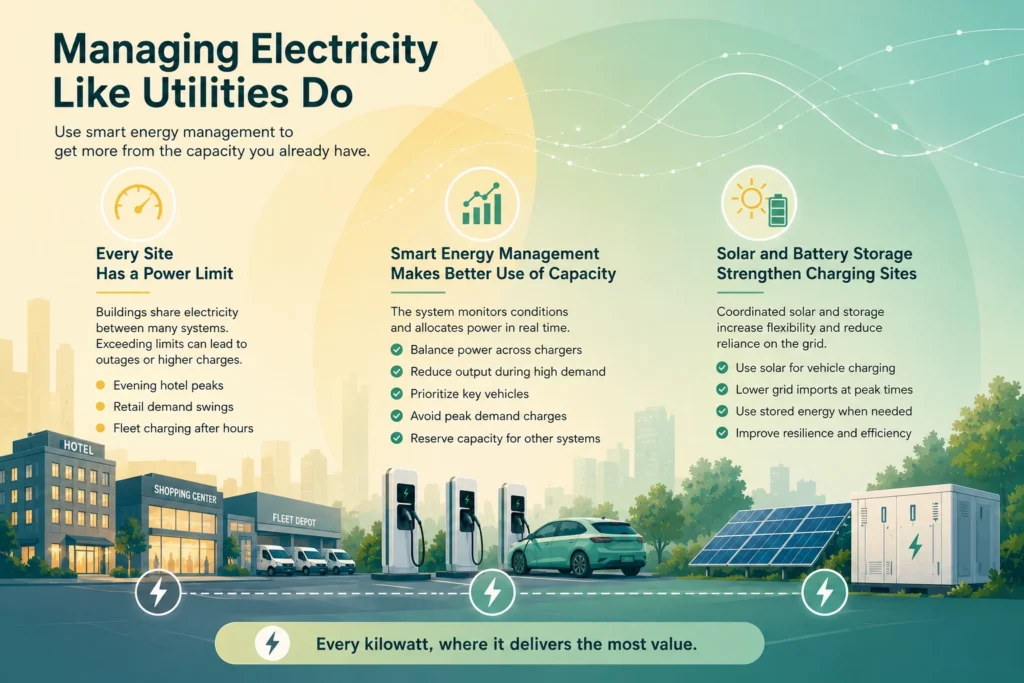
Reliable operation depends on more than software and connectivity. Every charging site also has to work within the limits of its electrical infrastructure. Utilities have always balanced electricity supply and demand across the grid. Charging sites face the same challenge on a smaller scale. They rarely serve only EV chargers. Most locations share available power with lighting, heating and cooling systems, elevators, refrigeration, manufacturing equipment, or other building loads. Treating charging as part of the site’s overall energy strategy helps businesses make better use of the capacity they already have.
Every Site Has a Power Limit
Adding more chargers does not automatically mean adding more available electricity. A hotel may experience its highest demand during the evening when guests return and begin charging their vehicles. A shopping center sees changing electricity use throughout the day as stores, restaurants, and charging stations all draw power at different times. Fleet depots often charge multiple vehicles simultaneously after business hours.
If every charger operates at maximum output regardless of site conditions, the installation may exceed its available capacity or trigger higher demand charges. This is why utilities carefully monitor electricity demand instead of assuming consumption will always remain the same. Charging infrastructure increasingly benefits from the same approach.
Smart Energy Management Makes Better Use of Capacity
Smart energy management allows charging stations to respond to actual conditions instead of operating at fixed settings. Rather than treating every charger independently, the system continuously evaluates available power and distributes it where it is needed most.
Depending on the site, this may include balancing power across multiple charging stations, reducing charging output during periods of high building demand, prioritizing selected vehicles such as fleet or service vehicles, avoiding unnecessary peak demand charges, and reserving electrical capacity for other building systems. This approach often allows businesses to expand charging infrastructure without immediately upgrading the electrical connection.
Solar and Battery Storage Strengthen Charging Sites
Charging infrastructure is increasingly being combined with on-site renewable energy and battery storage. Solar panels generate electricity during daylight hours, while battery systems store excess energy for later use. On their own, these technologies already improve energy efficiency. When coordinated through an energy management system, they become even more valuable.
For example, a site can prioritize solar energy for vehicle charging, reduce grid imports during expensive peak periods, or use stored battery energy when building demand temporarily increases. For businesses in Ukraine, where efficient use of electrical capacity has become an important consideration, combining charging infrastructure with intelligent energy management can improve both operational flexibility and long-term resilience. The objective is not simply to generate renewable energy. It is to ensure that every available kilowatt is used where it delivers the greatest value.
What This Means for Charging Projects in Ukraine
Ukraine’s charging infrastructure continues to expand alongside the growing number of electric vehicles, but many projects are being developed in an environment where electrical capacity, operating costs, and long-term resilience all require careful planning. That makes the lessons from the energy sector particularly relevant.
For businesses, installing charging stations is often only the first stage. Over the following years, they may add more parking spaces, increase charging power, electrify company vehicles, or integrate renewable energy systems. Infrastructure that cannot adapt to these changes may require costly upgrades long before its expected service life ends.
This is why many new charging projects are moving beyond hardware specifications alone. Businesses increasingly evaluate how the entire system will operate over time, including software, energy management, maintenance, and technical support. For Charge Point Operators, property owners, utilities, and fleet managers, reliable operation has become just as important as adding new charging locations. Drivers rarely notice a charging network that works well, but they remember one that does not.
Details to Evaluate Before Choosing Charging Infrastructure
The charging station itself is only one part of the investment. The software platform, communications, maintenance strategy, and energy management capabilities all influence how the infrastructure performs over the next several years.
Before selecting a charging solution, it is worth checking whether it provides support for open communication standards such as OCPP, remote monitoring and diagnostics, remote firmware updates, smart load management, integration with solar panels and battery storage, flexible connectivity for long-term operation, clear technical support and software maintenance, and strong cybersecurity practices. These questions often reveal more about the future performance of a charging network than connector types or maximum charging power alone. Infrastructure designed with long-term operation in mind is usually easier to expand, maintain, and integrate as business needs evolve.
Frequently Asked Questions
Why is EV charging increasingly described as critical infrastructure?
Because people rely on it every day. As electric vehicles become more common, charging stations support commuting, logistics, public transport, and business operations. That means they need to deliver consistent service, much like electricity, telecommunications, or payment systems.
What can the EV charging industry learn from energy companies?
Energy companies focus on long-term operation, not just installation. They monitor equipment remotely, plan for future demand, maintain infrastructure throughout its lifecycle, and design systems that remain reliable as they grow. The same approach helps charging networks operate more efficiently.
Why are open standards like OCPP important?
OCPP allows charging stations and management platforms from different providers to work together. This gives operators more flexibility when expanding their networks, changing software, or replacing hardware, without being tied to a single vendor.
How does smart energy management improve EV charging?
Smart energy management adjusts charging power based on real electricity demand at the site. It helps balance multiple chargers, avoid exceeding available capacity, reduce peak demand charges, and integrate solar panels or battery storage when available.
Why is remote monitoring valuable for charging networks?
Remote monitoring lets operators see the status of charging stations in real time, receive fault alerts, and resolve many issues without visiting the site. This reduces downtime, lowers maintenance costs, and helps keep chargers available for drivers.
What should businesses look for when investing in EV charging infrastructure?
Look beyond charging speed. A strong long-term solution should support remote management, open communication standards, smart load balancing, firmware updates, reliable connectivity, and ongoing technical support. These features make the infrastructure easier to operate and expand over time.
Conclusion
The energy sector has spent decades building systems that people depend on every day. Those systems are designed to remain available, adapt to changing demand, and continue operating long after the initial installation is complete.
EV charging is entering the same stage. As charging networks grow, success will depend less on how many stations are installed and more on how reliably they operate. Hardware, software, connectivity, energy management, and ongoing support all play a role in that reliability. When these elements are designed to work together, businesses gain infrastructure that is easier to manage today and better prepared for tomorrow.