

Table of contents:
Building an EV charging site today is about much more than choosing the right charger. Every project has to balance technical safety, user experience, energy management, and a growing list of regulatory requirements. Getting those decisions right from the start can save time, reduce future upgrade costs, and make expansion much easier.
Across Europe, policies such as AFIR are setting common expectations for charging infrastructure, while national authorities like Poland’s UDT oversee technical compliance and safe operation before charging stations are put into service. Together, these frameworks encourage charging networks that are not only safe and reliable, but ready for smarter communication, better interoperability, and long-term growth.
In this guide, we look at how EV charging infrastructure can be planned to support both UDT requirements and wider EU energy policy, along with the design choices that help operators build charging networks that remain practical and compliant as the market evolves.
We remind you that you can purchase home and commercial charging stations in our store, as well as use public charging stations ECOFACTOR located throughout Ukraine. For convenient access to charging infrastructure, we recommend using our mobile app, available on iOS and Android.
Why Compliance Starts Before Installation
Installing an EV charger is only one part of the job. Before the first cable is connected, developers, Charge Point Operators, and site owners need to think about safety, communication standards, energy management, accessibility, and the rules that apply both nationally and across Europe. Those early decisions shape how the charging site performs over the next ten or fifteen years.
This has become increasingly important as the European charging market grows. Regulations no longer focus only on adding more charging points. They encourage infrastructure that works consistently across different vehicles, supports modern charging features, and can adapt as new technologies become available. A charging station that meets today’s minimum requirements but cannot support future standards may require expensive upgrades much sooner than expected.
For businesses in Ukraine, these changes are worth watching even when projects are built outside the EU. Ukrainian manufacturers, installers, and CPOs increasingly work with European partners, export charging equipment, or prepare infrastructure that follows European technical expectations. Building with those standards in mind makes future expansion much easier.
UDT and EU Policy Work Toward the Same Goal
Although they work at different levels, UDT and EU energy policy complement each other.
The EU establishes common rules that improve interoperability, user experience, communication between vehicles and charging stations, and long-term compatibility across member states. Regulations such as AFIR encourage charging infrastructure that supports technologies like ISO 15118, digital communication, and smarter energy use.
National authorities then apply technical oversight within their own countries. In Poland, for example, the Office of Technical Inspection (UDT – Urząd Dozoru Technicznego) reviews technical documentation for charging stations and carries out inspections before stations enter service, as well as after major repairs or upgrades. The goal is straightforward: charging infrastructure should not only include the right technology but should also operate safely throughout its lifetime.
Looking at both perspectives gives a clearer picture of modern charging infrastructure. One defines what future-ready charging should achieve, while the other verifies that installations meet technical and safety requirements in practice.
Standards That Shape Modern EV Charging
Charging infrastructure relies on a wide range of technical standards. Some define how electricity is delivered, others describe communication between the vehicle and the charger, while several focus on electrical safety or equipment protection.
For most Charge Point Operators, installers, and manufacturers, it is not necessary to memorize every document. It is far more useful to understand what each standard influences in practice and why it matters when designing a charging site.
| Standard | Covers | Why it matters |
|---|---|---|
| IEC 61851 | Conductive EV charging systems | Defines how AC and DC charging systems operate and communicate during charging. |
| IEC 62196 | Charging connectors and vehicle inlets | Ensures compatible plugs, sockets, and connectors across supported vehicles and charging equipment. |
| ISO 15118 | Vehicle-to-charger communication | Enables Plug & Charge, Smart Charging, and prepares infrastructure for future bidirectional charging. |
| OCPP | Charger to management platform communication | Allows charging stations to connect with different Charge Point Management Systems instead of being locked into one platform. |
| IEEE 1547 | Grid interconnection | Supports reliable integration between distributed energy resources and the electrical grid. |
| IEC 60529 | IP protection ratings | Defines enclosure protection against dust, water, and environmental conditions. |
No single standard covers every aspect of charging infrastructure. Instead, they work together to create a charging ecosystem where vehicles, charging stations, software platforms, and electrical networks can communicate safely and consistently. That combination becomes increasingly valuable as charging networks expand across different countries and hardware manufacturers.
Planning Infrastructure Around Long-Term Compliance
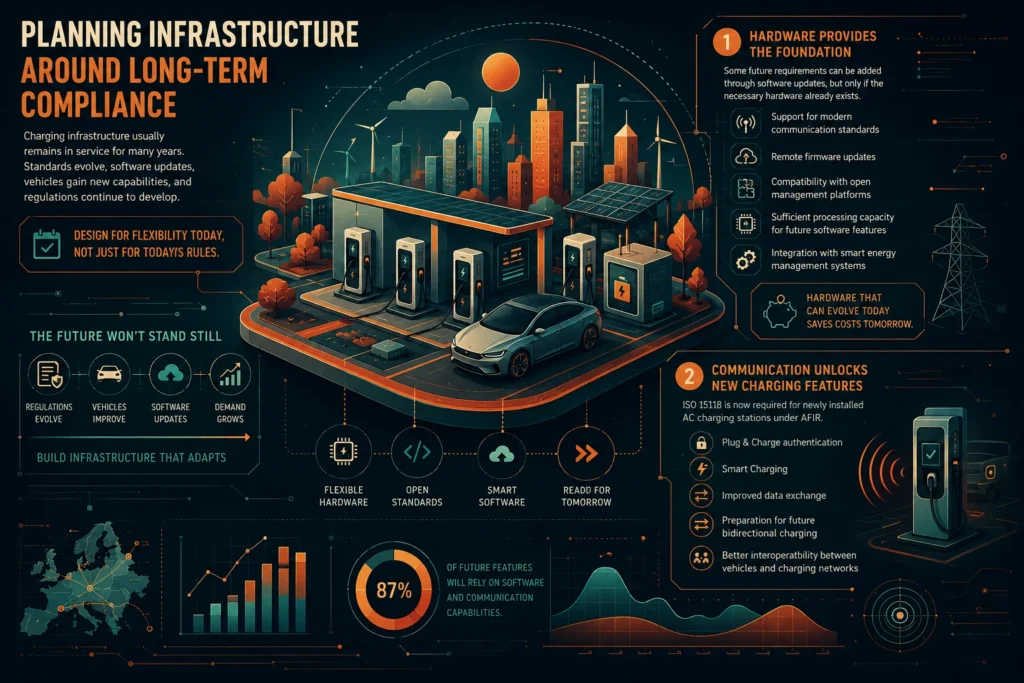
Charging infrastructure usually remains in service for many years. During that time, communication standards evolve, software receives updates, vehicles introduce new capabilities, and regulations continue to develop. Designing a charging site with only today’s requirements in mind can create unnecessary limitations later. That is why long-term planning increasingly focuses on flexibility rather than fixed specifications.
Hardware Provides the Foundation
Modern charging stations are no longer standalone electrical devices. They combine power electronics, communication hardware, firmware, network connectivity, and cloud-based management systems.
Some future requirements can be added through software updates, but only if the necessary hardware already exists. A good example is Power Line Communication (PLC), which supports higher-level communication between the charger and the vehicle. Without compatible hardware, introducing features such as Plug & Charge may require replacing components instead of simply updating software.
When selecting charging equipment, it is worth considering whether it offers support for modern communication standards, remote firmware updates, compatibility with open management platforms, sufficient processing capacity for future software features, and integration with smart energy management systems. Choosing hardware that can evolve often costs less over the lifetime of the installation than replacing equipment a few years later.
Communication Unlocks New Charging Features
Until recently, many AC charging installations relied mainly on basic communication between the vehicle and the charger. That is changing. European regulations now require support for ISO 15118 on newly installed AC charging stations according to the AFIR implementation timeline. The standard introduces secure digital communication that supports functions well beyond simply starting a charging session.
These include Plug & Charge authentication, Smart Charging, improved data exchange, preparation for future bidirectional charging, and better interoperability between vehicles and charging networks. For operators, this means compliance is closely connected with long-term usability. Infrastructure designed around modern communication standards will be better prepared as more vehicle manufacturers expand support for these technologies.
Building Charging Sites That Meet Modern User Expectations
Reliable charging depends on more than electrical performance. Drivers notice how easy it is to reach the charger, whether payment takes a few seconds or a few minutes, and if the information on the screen actually helps. Small details can make the difference between a charging station that feels intuitive and one that creates unnecessary frustration.
Recent European guidance reflects this shift. Charging infrastructure is increasingly viewed as a complete service that combines hardware, software, site design, and user interaction.
Accessible Charging Starts With Good Design
Accessibility should not be treated as an optional feature added at the end of a project. It influences where chargers are placed, how users move around the site, and whether different drivers can use the equipment comfortably.
A practical charging location should consider both the charging unit and the surrounding environment. Good planning usually includes enough space around the vehicle for safe movement, stable level surfaces without unnecessary obstacles, controls and payment terminals positioned within comfortable reach, clear lighting for evening and night use, charging cables that do not create trip hazards, and visible emergency controls and support information. These decisions improve usability for everyone, not only for drivers with reduced mobility.
Clear Information Makes Charging Easier
Drivers should not have to guess how to start a charging session or search online for basic information after arriving. A charging station should clearly communicate connector type and charging power, current availability, pricing, supported payment methods, customer support contact details, and charging status during the session.
Payment flexibility is becoming equally important. Mobile applications remain popular, but they should not become the only access method. Many public charging networks now combine several options, allowing drivers to choose the one that works best for them.
| Payment method | Typical use |
|---|---|
| Contactless bank card | Quick public charging without registration |
| Mobile app | Network members and frequent users |
| RFID card | Fleet and subscription charging |
| QR code | Occasional users and visitors |
| Plug & Charge | Automatic authentication on compatible vehicles |
Offering multiple payment options makes public charging more accessible, particularly for international drivers and people using a charging network for the first time.
Good Site Planning Improves Safety
Even the most advanced charging station cannot compensate for poor site planning. The location should allow vehicles to enter, park, connect, and leave without creating conflicts with pedestrians or nearby traffic. Charging cables should not stretch across walkways, and equipment should remain easy to access throughout the year, including during rain or snow.
Site planning should take into account future growth as well. A parking area designed for four charging spaces today may eventually need eight or twelve. Reserving space for additional electrical infrastructure during the first construction phase is usually far less expensive than rebuilding the site later.
A practical layout often considers several systems together instead of treating them as separate projects. Electrical distribution, chargers, lighting, drainage, communication networks, and energy management all influence one another. Looking at the complete picture helps create charging sites that remain efficient long after installation.

Plan and Build Your Charging Infrastructure With ECOFACTOR
Well-planned charging infrastructure should support both operational needs and future development goals. Alongside charging stations, ECOFACTOR offers hybrid inverters, battery systems, and solar panels, while its iOS and Android app and charging station map help improve access to charging locations for drivers.
ECOFACTOR can help support charging infrastructure through:
- Integrated charging and energy solutions
- Equipment for commercial and public charging sites
- Technologies that support long-term infrastructure planning
- Cables and accessories for installation and maintenance
Contact ECOFACTOR to discuss charging solutions for your next infrastructure project.
Design Decisions That Prevent Expensive Rework
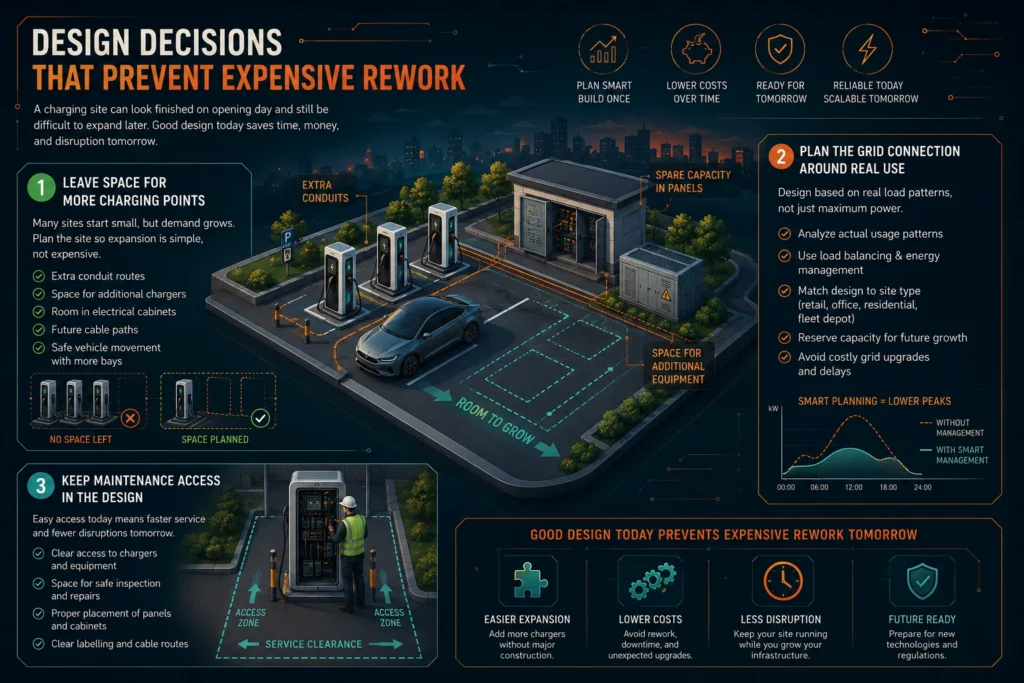
A charging site can look finished on opening day and still be difficult to expand later. The problem is usually not the charger itself. It is the decisions made around it: where cables run, how much electrical capacity is reserved, whether the site has space for more bays, and how easily technicians can access the equipment. Good design should leave room for growth without turning every future change into a construction project.
Leave Space for More Charging Points
Many sites start small. A hotel may install two AC chargers, a retail location may begin with four spaces, and a fleet depot may test charging with a limited number of vehicles. That is normal. Demand often grows after drivers see that charging is available and reliable.
The mistake is designing the site as if the first installation will be the final one. During the first build, it makes sense to plan for extra conduit routes, available space for additional chargers, room in electrical cabinets, future cable paths, and safe vehicle movement if more bays are added. This does not mean every site needs to overbuild from day one. It means the layout should not block expansion before the business has even started learning from real charging demand.
Plan the Grid Connection Around Real Use
A charging site should be designed around realistic load patterns, not only the maximum power printed on the charger. Four chargers rated at 22 kW do not always need to deliver full power at the same time, especially at locations where vehicles stay parked for several hours.
For Ukrainian businesses, this point is not theoretical. Grid capacity can be limited, and connection upgrades may take time. A better approach is to calculate how the site will actually be used and combine that with load balancing or energy management where needed. A retail site, an office building, a residential complex, and a fleet depot will not charge vehicles in the same rhythm. The electrical design should reflect that.
Keep Maintenance Access in the Design
Maintenance is much easier when technicians can safely reach the charger, electrical panels, communication equipment, and cable routes without disrupting the whole site. This is often overlooked. A charger placed too close to walls, curbs, fences, or traffic lanes may be acceptable during installation but inconvenient during service. The same applies to equipment cabinets placed in areas that are hard to access in winter or during business hours.
A practical site layout should make routine service possible without unnecessary shutdowns. That includes space for inspection, safe access to protective equipment, clear labelling, and enough room to replace worn parts when needed.
Documentation and Technical Verification
Every charging project generates technical documentation, but the quality and completeness of that documentation often become just as important as the equipment itself.
Depending on the country, operators may need to provide information about electrical design, protection systems, equipment specifications, communication capabilities, installation details, and commissioning records.
Poland’s UDT provides a good example of this approach. Charging stations are subject to technical review before entering service, and additional inspections may be required after significant repairs or upgrades. While the exact procedures differ between countries, the broader principle is becoming common across Europe: charging infrastructure should be properly documented and technically verifiable throughout its operating life. Good documentation has practical value beyond regulatory compliance. It helps technicians diagnose faults faster, simplifies maintenance, and makes future upgrades easier to plan.
Maintenance After Commissioning
A charging station should never be viewed as finished once installation is complete. Over time, operators may introduce new payment methods, improve cybersecurity, add support for updated communication standards, or optimize charging performance. Vehicles evolve as well, creating new expectations for interoperability and digital communication.
Routine maintenance typically includes both physical and digital tasks, such as inspecting connectors and cables, checking protective devices, monitoring charger performance, installing firmware updates, testing communication with the management platform, and reviewing event logs and fault reports. Many of these activities can now be performed remotely, reducing site visits while helping operators keep large charging networks consistent.
Why Compliance Continues After Installation
Regulations, standards, and user expectations continue to develop long after a charging station enters operation. A network installed today may later need to support additional communication features, stronger cybersecurity measures, or updated software that reflects new regulatory requirements. Sites designed with upgradeability in mind are generally better positioned to respond without extensive hardware replacement.
The same applies to business growth. A location that begins with four charging points may eventually require more chargers, battery storage, solar integration, or higher charging power. Planning for those possibilities during the initial design phase can reduce future construction work and limit service interruptions.
Frequently Asked Questions
What is the connection between UDT and EU energy policy?
They serve different roles but support the same goal. EU regulations define how charging infrastructure should operate across member states, including requirements for interoperability and communication standards. UDT oversees technical verification and safety inspections for charging stations in Poland before they enter service and after significant repairs or upgrades.
Does every EV charging station need to support ISO 15118?
Not every existing charger does, but new requirements under AFIR introduce mandatory support for ISO 15118 on newly installed AC charging stations according to the implementation timeline. Choosing hardware that supports the standard helps prepare charging infrastructure for future features such as Plug & Charge and Smart Charging.
Why is interoperability important for charging infrastructure?
Interoperability allows charging stations, vehicles, payment systems, and management platforms to work together without relying on a single manufacturer or software provider. This makes charging more convenient for drivers and gives operators greater flexibility as their networks grow.
How does smart energy management support compliance?
Smart energy management helps charging sites operate within available electrical capacity while making better use of energy resources. It can balance power between chargers, reduce peak demand, and integrate with solar panels or battery storage, supporting both efficient operation and future regulatory expectations.
What should businesses consider before installing EV chargers?
Planning should go beyond charger power and connector types. A successful project should consider technical documentation, applicable standards, software update capability, communication protocols, accessibility, energy management, maintenance, and the possibility of expanding the charging site in the future.
Conclusion
Designing EV charging infrastructure has become a broader task than selecting chargers with the right power output. Modern projects combine electrical engineering, digital communication, energy management, accessibility, and long-term operational planning into a single system.
European regulations are encouraging greater interoperability and smarter charging, while national authorities continue to verify that charging infrastructure operates safely and meets technical requirements. Together, these approaches support charging networks that can serve drivers reliably while adapting to future technologies.
For businesses in Ukraine, following these developments is a practical investment. Whether building domestic charging networks or preparing projects for European markets, designing around recognised standards from the beginning helps reduce future upgrades, simplify maintenance, and create infrastructure that remains valuable as the EV market continues to grow.