


Table of contents:
Just imagine: you buy a new electric car, arrive home, and your parking space is already set up for a charging station. No need to call in electricians to run cables through the whole house. No need to obtain planning permission for building work.
That is precisely what the term ‘EV Ready’ means. But there are some nuances here.
With the growing popularity of electric vehicles, the construction industry has been confronted with a new reality. Buildings constructed as recently as five years ago often lack sufficient electrical capacity for charging electric cars. And as the European Union plans to fully decarbonise the transport sector by 2050 in accordance with Regulation (EU) 2023/1804, understanding the concept of ‘EV Ready’ has become critically important.
We remind you that you can purchase home and commercial charging stations in our online storeand also use the public charging stations ECOFACTORcharging points located throughout Ukraine. For convenient access to charging infrastructure, we recommend using our mobile applicationwhich is available on iOS and Android.
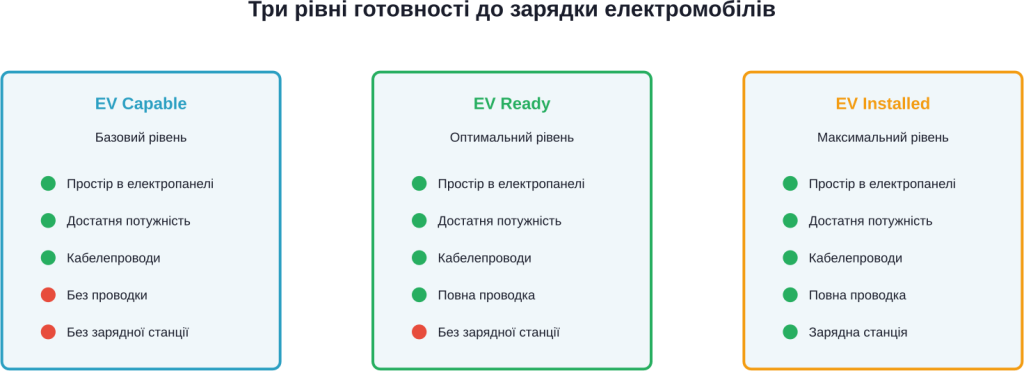
Three readiness levels: EV Capable, EV Ready and EV Installed
Building regulations use three different terms, which are often confused. Let’s take a look at each one.
EV Capable — entry-level
According to the 2022 California Building Code, ‘EV Capable’ refers to a parking space with space in the electrical panel and sufficient capacity to support a branch circuit, as well as the necessary cable conduits (underground and/or above-ground) to support the charging of electric vehicles.
To put it simply: it’s like a foundation that’s been laid. The electric panel has sufficient power, and empty conduits have been laid for future cables, but the cables themselves and the charging station aren’t there yet.
EV Ready — ready for quick installation
EV Ready goes one step further. This involves the design and construction of a parking space with the necessary infrastructure, including cable ducts, wiring and any specialised circuits required for the straightforward installation of Level 2 charging devices.
Everything’s already in place here: the wiring has been laid, the distribution board has been installed, and the connection to the main electricity network has been made. All that remains is to set up the charging station itself — a job that takes a few hours, rather than days or weeks.
EV Installed — fully operational
Top tier. The parking space is already fitted with a working charging point. Just turn up, plug in and start charging.
| Features | EV-compatible | EV Ready | EV Installed |
|---|---|---|---|
| Electric panel | ✓ | ✓ | ✓ |
| Sufficient power | ✓ | ✓ | ✓ |
| Cable ducts | ✓ | ✓ | ✓ |
| Wiring installed | ✗ | ✓ | ✓ |
| Charging station | ✗ | ✗ | ✓ |
| Time to installation | 1–2 weeks | 1–2 days | Done |
Why EV Ready is the best choice
There is a certain logic to this. Installing charging stations at every parking space in a block of flats or a commercial premises is expensive, especially if the residents or users do not yet own electric vehicles.
On the other hand, EV Capable saves money now, but creates problems later. When someone actually wants a charging station, they’ll have to dig up the car park, lay cables and block off some of the spaces for weeks.
EV Ready strikes a balance. According to discussions within the professional community, this approach allows building owners to prepare for the future without incurring unnecessary costs today.
Regulatory requirements and standards
The European Commission has published draft delegated acts to amend the AFIR and launched a consultation on 10 December 2024. These amendments are aimed at improving the regulatory framework for alternative fuel infrastructure in the EU, including charging stations for electric vehicles.
According to Regulation (EU) 2023/1804, AFIR does not require charging stations to provide the maximum rated power continuously or for a specific period of time; the Regulation addresses the issue of power limits for infrastructure, but does not set mandatory minimum durations for continuous power supply. This is an important clarification for capacity planning in EV Ready infrastructure.
In the USA, the National Electric Vehicle Infrastructure Programme (NEVI) has set minimum standards for public charging projects, which also have an impact on private construction.
Technical requirements for EV Ready
What exactly needs to be installed? The details may vary depending on local building regulations, but the general requirements include:
- A dedicated electrical panel or sufficient space in an existing panel with spare capacity for Level 2 charging
- The wiring run from the main panel to the parking space
- Cable ducts (underground and/or above-ground) have been installed to protect the wiring
- A designated space for installing a charging station (usually at a height of 90–120 cm from the floor)
- Appropriate signage for the electrical panel and parking space
Implementation costs at different stages
Although specific prices vary depending on the region and the complexity of the project, the general trend is clear.
Installation. EV Ready is much cheaper to install during the construction phase than retrofitting an existing building. Wiring work, carried out whilst the walls are still exposed, takes hours rather than days. No planning permission is required.
Many jurisdictions have begun to require new buildings to be ‘EV Ready’ or at least ‘EV Capable’ precisely because of this difference in cost.
EV Ready and energy efficiency in buildings
The EV Ready concept aligns well with the new standards for zero-emission buildings. Under European legislation, all new buildings in the EU must comply with the ‘nearly zero-energy’ standard from 2020; this standard will be replaced by the ‘zero-emission building’ requirement.
This is replaced by a requirement for ‘zero-emission buildings’, which comes into force from 2028 for new buildings owned by public authorities, and from 2030 for all other new buildings.
Buildings account for around a third of energy-related greenhouse gas emissions in the EU. EV-ready infrastructure is becoming a natural part of a holistic approach to decarbonisation.
The future of infrastructure charges
With the adoption of new delegated acts by the European Commission in 2026, the regulatory framework continues to evolve. Stakeholders have the opportunity to provide feedback on these draft acts by the end of the year.
Meanwhile, Advanced Energy United has published the ‘EV Ready Grid Guidebook 2024: A Practical Guide to Preparing the Grid for Electric Vehicle Adoption at Scale’, a practical guide to preparing the electricity grid for the widespread adoption of electric vehicles. Sales of electric vehicles are growing year on year in the USA, driven by car manufacturers’ shift towards electric models.
To meet the growing demand for energy, policymakers and regulators must plan infrastructure proactively. ‘EV Ready’ is becoming not just a recommendation, but a standard.

Charging infrastructure from ECOFACTOR
ECOFACTOR’s charging infrastructure is being developed as a comprehensive network that ensures reliable and convenient charging in a variety of conditions. The company installs and maintains charging stations for private, corporate and public use, creating an accessible ecosystem for electric vehicle owners across Ukraine.
Our network offers AC charging solutions for homes and offices, as well as fast DC charging stations for motorways, urban areas and commercial premises. We are expanding our network coverage so that electric car drivers can choose the best charging option depending on their route and time, and easily find a suitable location nearby.
Manage charging via the mobile app
Digital convenience is a key part of EV Ready. To this end, a mobile app is available for iOS and Android, which simplifies interaction with the network and makes the charging process easier to understand.
The app displays a map of charging stations with up-to-date information on the location and availability of charging points. You can also plan your route and pay for charging online. We are constantly improving our digital services to ensure that using an electric car remains a comfortable experience both in the city and on long-distance journeys.
Equipment and accessories
One particular area of development is providing customers with the necessary equipment. Online shop ECOFACTOR offers chargers in various power ratings and formats for home and business use. The catalogue also features cables and adapters and additional solutions for connection and safe operation.
We have put together our product range so that you can find a technically suitable solution both for private households and for commercial premises seeking to meet EV Ready standards.
A comprehensive approach to electric cars
ECOFACTOR combines charging stations, mobile apps for iOS and Android, a map of charging stations and an online shop into a single system. We view EV Ready as a comprehensive model in which infrastructure, technology and equipment work in harmony.
By 2026, this means being ready to provide a simple, straightforward and reliable electric car network across the whole of Ukraine, without any unnecessary steps or technical complications.
Conclusion
EV Ready strikes a sensible balance between preparing for the future and keeping costs under control today. It is not just a technical standard — it is a recognition that the electrification of transport is no longer a question of ‘if’, but of ‘when’.
For building owners, this means lower modernisation costs down the line. For residents and tenants, it means the assurance that their homes are ready for electric vehicles when they are ready to make the switch. For society, it represents another step towards decarbonisation by 2050.
Are you planning a new build or a refurbishment? Check your local building regulations regarding EV Ready requirements. Your future self (and the planet) will thank you for it.
Frequently asked questions about EV Ready
Is it compulsory to install EV Ready in new-build properties?
It depends on the jurisdiction. Many cities and regions in the EU and the USA already require that at least a certain percentage of parking spaces in new residential and commercial developments be ‘EV-capable’ or ‘EV-ready’. Check your local building regulations for specific requirements.
How much does it cost to upgrade from ‘EV Capable’ to ‘EV Ready’?
The cost varies depending on the distance from the fuse box, the complexity of the wiring work and local rates for electrical installation work. Please contact official service providers for current prices in your area.
What is the difference between Level 1 and Level 2 charging for EV Ready?
Level 1 uses a standard domestic socket and charges slowly. Level 2 requires special wiring (usually 240V/400V) and provides much faster charging. ‘EV Ready’ usually means it is compatible with Level 2.
Can you set up a DC fast-charging point at an EV Ready parking space?
Not usually. Fast DC charging requires much higher power (50+ kW) and specialised equipment. EV Ready is typically designed for Level 2 charging (up to 22 kW). DC charging requires a separate, high-capacity electrical infrastructure.
How does EV Ready affect property prices?
Discussions within the professional community show that buildings with EV-ready infrastructure are becoming increasingly attractive to buyers and tenants, particularly in regions with high levels of electric vehicle adoption. This is seen as an investment in the future.
What other requirements are there for EV Ready, apart from the electric infrastructure?
In addition to electrical wiring, it is often necessary to ensure that parking spaces are clearly marked, that they are accessible to people with disabilities (in the case of public car parks), that they comply with fire safety requirements, and that there is sufficient space for the installation and maintenance of the equipment.
Does EV Ready infrastructure require regular maintenance?
As EV Ready does not include any active equipment (only wiring and panels), maintenance is minimal. It is recommended that you periodically check the electrical connections and labelling, particularly before the actual installation of the charging station.