


Table of contents:
When fuel prices reach astronomical levels, the issue of saving money on transport becomes critical for every driver. Electric vehicles have gone from being a futuristic dream to a real alternative that allows you to drastically reduce your monthly transport costs.
But just how cost-effective are electric cars in the Ukrainian context? And what specific benefits do their owners enjoy, apart from saving on ‘fuel’?
We remind you that you can purchase home and commercial charging stations in our online storeand also use the public charging stations ECOFACTORcharging points located throughout Ukraine. For convenient access to charging infrastructure, we recommend using our mobile applicationwhich is available on iOS and Android.
Real Cost Savings: Figures That Speak for Themselves
The most obvious advantage of an electric vehicle is the cost per kilometre. The difference is so striking that many owners of petrol cars simply don’t believe the figures until they’ve worked it out for themselves.
Comparison of Costs per 100 km of Mileage
| Parameter. | Electric car (EV) | Car with an internal combustion engine |
|---|---|---|
| Fuel cost per 100 km | 30–70 UAH (depending on the tariff) | 300–500 UAH (depending on fuel prices and consumption) |
| Maintenance costs (annual, average) | upgrading the multimedia system: 2,000–5,000 UAH; | 10,000–20,000 UAH |
| Access to motorway lanes | No. | No. |
These figures show savings of 5 to 10 times on direct travel costs. For the average driver who travels 15,000–20,000 kilometres a year, the annual savings can amount to 40,000–60,000 hryvnias.
And that’s just the start.
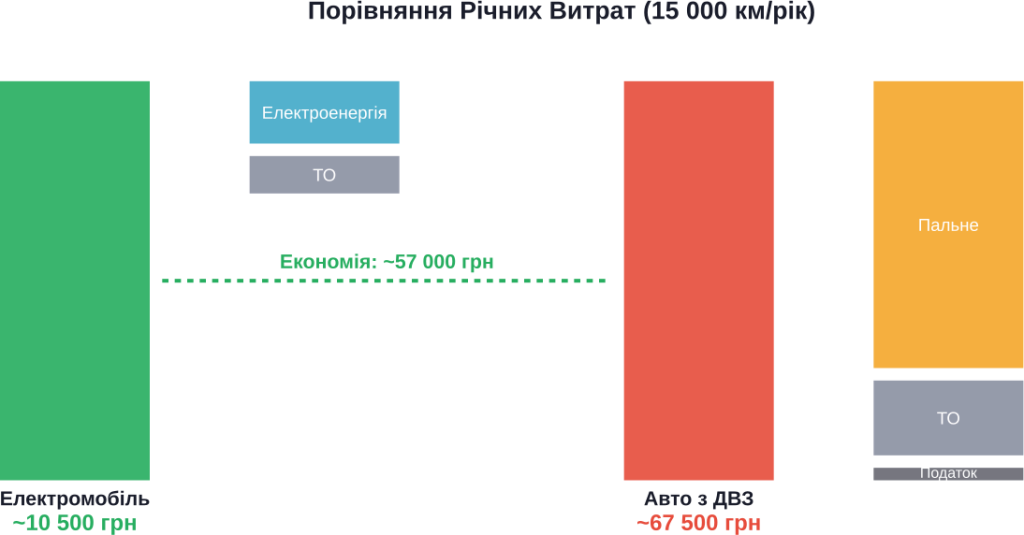
Charging Costs: Where’s It Cheaper?
Charging at home using the night-time tariff is the most cost-effective option. The cost per kilowatt-hour can be between 1.5 and 2.5 hryvnias, which makes travelling 100 kilometres incredibly cheap.
Public charging stations are more expensive, but still considerably cheaper than petrol. According to charging network operators, the average cost at public stations is 15–25 UAH per kWh, depending on the power output and charging speed.
Fast DC charging costs more, but saves time. Charging to 80% takes 30–60 minutes, compared with 8–12 hours using a domestic socket.
Access to Public Transport Lanes: Time — Money
Dedicated lanes for electric cars remain a complex issue, as there is virtually no infrastructure in place in Ukraine.
In many European countries, electric vehicles are allowed to use public transport lanes. Norway, the Netherlands and Germany grant such privileges.
In Ukraine, there are as yet no such legislative initiatives. The Ministry of Infrastructure has included the development of green transport among its strategic priorities. No specific measures have been taken regarding dedicated lanes.
Electric Car Maintenance: Why It’s Much Cheaper
This is where the real magic of saving money begins. An electric car isn’t just a car without an exhaust pipe. It’s a fundamentally different design with far fewer parts that can break.
| Type of service. | Electric car | Internal combustion engine |
|---|---|---|
| Oil and filter change | Not required | Every 10–15,000 km |
| Clutch | None | Needs replacing |
| Gearbox | One-way or absent | Complex, requires servicing |
| Brake pads | Last longer (regenerative braking) | Standard wear |
| Spark plugs | Not applicable | Replacement at regular intervals |
Advantages. Simpler Design
Not having to change the oil and filters isn’t just a matter of convenience. It represents a real saving of 3,000–5,000 hryvnias every year. Fewer moving parts mean fewer potential points of failure.
An electric motor has just a few moving parts, compared to the hundreds found in an internal combustion engine. The result? Reliability and minimal visits to the garage.
However, it is worth bearing the battery in mind. It is the most expensive component of an electric vehicle, and its service life is limited. Modern lithium-ion and lithium iron phosphate (LFP) batteries are designed for 10–20 years of operation or 300,000–500,000 km of mileage (and more for LFP) before losing 20 per cent of their capacity.
Tax Relief and State Support
The government is keen to promote environmentally friendly transport, but for the time being, owners of electric vehicles receive few tax benefits.
Owners of electric vehicles in Ukraine are exempt from import duties and VAT, but they are required to pay a contribution to the Pension Fund (3–5 per cent) upon first registration under the standard procedures. The excise duty amounts to just 1 euro per 1 kWh of battery capacity.
Charging Station Infrastructure in 2026
The issue of infrastructure remains critical for a mass transition to electric vehicles. As of late 2024 – early 2025, there were between 13,000 and 15,000 charging points (connectors) in Ukraine.
According to the Global EV Outlook 2025, published by the International Energy Agency (IEA), in 2024, more than 1.3 million public charging points were added to the global network — an increase of more than 30 per cent compared with the previous year.
Ukraine is gradually catching up with global trends. The main routes between major cities are already covered by a network of charging stations, making inter-city journeys a real possibility.
Challenges and Reality
But to be honest, it’s not all plain sailing. The war has affected the pace of infrastructure development. Energy problems and power cuts are creating additional challenges for electric car owners.
That is why a home charging station is becoming not just a convenience, but a necessity. Being able to charge your vehicle overnight at a lower tariff provides a safety net against energy crises.
How saving money on an electric car becomes a reality with ECOFACTOR
Tax incentives on imports offer a significant discount up front, but the day-to-day savings really start to add up where there is a decent charging infrastructure. At ECOFACTOR, this is exactly what we’re all about: we handle the full cycle — designing, manufacturing and maintaining charging stations, whilst providing a platform for operators and a user-friendly tool for drivers. Our range includes mobile chargers, AC stations up to 44 kW for car parks and urban locations, as well as DC stations up to 420 kW for fast-charging stops on motorways and high-traffic locations. For us, this isn’t just a ‘someday, somewhere’ prospect, but our day-to-day work, because without charging networks, any incentives seem rather theoretical.
To make it easier for drivers to charge their vehicles, we’ve brought all the charging infrastructure together in one place — in our mobile app for iOS and Android. It features a map of charging points across Ukraine, showing connector types, power output, port status in real time and current rates. This is convenient both for those who simply want to charge predictably whilst on the road, and for those who calculate the cost kilometre by kilometre. What’s more, when fuel prices ‘spike’ again, the question of ‘where to charge and how much it costs’ is no longer a surprise.
And if you’re planning to set up a home charging station or are thinking of setting up a charging station as a business, we have an online shop offering chargers, accessories and inverters. There, you can find solutions to suit your needs — from basic equipment for the home to equipment for commercial premises.
Is Now the Right Time to Switch to an Electric Car?
It depends on your needs and driving conditions. If you’re able to set up a home charging station, drive more than 15,000 kilometres a year and live in a big city, an electric car will pay for itself in 3–5 years.
For those who live in a detached house, the solution is obvious. Having your own solar-powered charging station turns an electric car into virtually free transport once the initial investment has been made.
According to the IEA’s Global EV Outlook 2025, the global fleet of electric vehicles (excluding 2/3W models) is forecast to reach 250 million units by 2030 — approximately a fourfold increase from the level at the end of 2024. Ukraine remains part of this trend.
Conclusion: Work Out Your Profit
Electric vehicles in Ukraine are no longer just an experiment for enthusiasts, but a sensible economic choice for an ever-increasing number of drivers. Savings on fuel and minimal maintenance costs paint a compelling picture.
Of course, there are challenges. The infrastructure is still developing, and the energy situation remains unstable. But the trend is irreversible.
If you’re thinking of buying a new car, take the time to work out your costs in detail. Work out the annual mileage, fuel costs and maintenance costs for your current car. Compare these with an electric car in the same class.
The figures might surprise you. And then the question will shift from ‘is it worth it?’ to ‘when exactly should I make the switch?’
Frequently asked questions
How much does it cost to charge an electric car at home?
When using the night-time tariff, the cost of a full charge for a 60 kWh battery is around 90–150 hryvnias. This provides a range of 300–400 kilometres, depending on the model and operating conditions.
Can you use public transport lanes in electric vehicles in all cities?
No, this right is not yet in force in Ukraine.
What are the actual savings on running costs for an electric vehicle compared to a petrol car?
On average, you can save between 5,000 and 15,000 hryvnias a year as there is no need to change the oil, filters or spark plugs, nor is any complex transmission maintenance required. Brake pads also last 2–3 times longer thanks to regenerative braking.
How long does an electric vehicle’s battery last?
Modern lithium-ion and lithium iron phosphate (LFP) batteries are designed for 10–20 years of service or 300,000–500,000 km of mileage (and more for LFP). After this, the battery loses around 20–30 per cent of its original capacity, but the car remains roadworthy.
How has the war affected the electric vehicle market in Ukraine?
Energy challenges have created additional difficulties, yet demand for electric vehicles remains stable. Owners have adapted by installing home charging stations and backup power sources. Infrastructure development has slowed, but has not come to a halt.
Is it worth buying a second-hand electric car?
Yes, provided you check the condition of the battery thoroughly. Second-hand electric cars from Europe are often more affordable than new petrol cars in the same class. The key thing is to have the battery checked at a specialist service centre before you buy.