


Table of contents:
Short Summary: Kia Soul EV is a compact electric crossover with a range of up to 276 km (39.2 kWh version) or up to 452 km (64 kWh version), which is ideal for city trips and short intercity routes in Ukraine. In winter, the real range decreases by 20–30%, but even in cold weather, 30–40 km of daily driving requires charging once every few days. Owners note low operating costs, the convenience of home charging, and responsive dynamics, although weak points include the limited range of older versions and battery degradation after 100–150 thousand km.
Kia Soul EV is the first electric vehicle from the Korean brand, which quickly won the sympathy of drivers thanks to its iconic design, reasonable price on the secondary market, and sufficient characteristics for daily trips. In Ukraine, this compact electric crossover often appears among imported cars from Europe and the USA.
But is it really suitable for Ukrainian realities? How much will it drive in winter? What are the pitfalls of operation?
Let’s analyze in detail — from the battery to the real experience of owners.
We remind you that you can purchase home and commercial charging stations in our online store, as well as use public charging stations ECOFACTOR located throughout Ukraine. For convenient access to charging infrastructure, we recommend using our mobile app, available on iOS and Android.
Main Technical Specifications of Kia Soul EV
Kia Soul EV was produced in three main versions, differing in battery capacity and range.
| Parameter | Soul EV 27 kWh | Soul EV 39.2 kWh | Soul EV 64 kWh |
|---|---|---|---|
| Battery | 27 kWh | 39.2 kWh | 64 kWh |
| Range | 150 km (EPA) | 276 km (WLTP) | 452 km (WLTP) |
| Power | 111 hp | 136 hp | 204 hp |
| Torque | 285 Nm | 285 Nm | 395 Nm |
| Acceleration 0–100 km/h | ~11.2 s | ~10.0 s | ~7.6 s |
| Top Speed | 145 km/h | ~160 km/h | 167 km/h |
Older versions with a 27 kWh battery most often come to Ukraine — they are cheaper, but the range is limited. If you plan only city trips, this will be enough. For regular trips out of town, it is better to look for 39.2 or 64 kWh versions.
Real-World Range: What to Expect in Ukrainian Conditions
Official WLTP figures sound optimistic, but reality is always a bit different.
In summer with moderate use of air conditioning, the real range is:
- 27 kWh: 150–170 km
- 39.2 kWh: 230–250 km
- 64 kWh: 380–420 km
In winter the situation changes. Cabin heating takes a significant part of the energy.
City in winter — minus 20–25% to the range. Highway in winter — minus up to 30%. Summer with air conditioning — minus 5–10%.
If you drive 30–40 km daily, even in winter you will need to charge once every few days. This is convenient — you plug the car into a home outlet in the evening, and in the morning the battery is full.
Kia Soul EV Charging Time
Charging is a critical point for any electric vehicle. The Kia Soul EV supports both slow charging from a regular outlet and fast DC charging.
| Charging Type | Time to 80% | Comment |
|---|---|---|
| Regular 220V Outlet | 10 hours | Convenient at home overnight |
| AC 6.6 kW (Type 2) | 5–6 hours | Home wall station |
| DC Fast 50 kW (Chademo / 27 kWh) | 30–33 minutes to 80% | Public CCS stations |
Fast CCS 50 kW charging — 30–40 minutes to 80%. In that time you can drink coffee and continue your journey. But remember: frequent fast charging accelerates battery degradation.
For daily trips, it is optimal to charge slowly at home — it is cheaper and safer for the battery.

Choose a Charging System for Your Kia Soul EV
Daily use of the Kia Soul EV quickly shows that charging is not one scenario, but several different ones: home, city, trips. It is important that these options do not conflict with each other and do not require a constant search for new solutions. ECOFACTOR provides the foundation from which you can build your own usage format.
You can start with the online store — there you will find accessories, cables, and mobile chargers for different tasks. Next — the charging station configurator, which allows you to select an AC station for home connection or a DC station for locations with higher loads. Separately, there is a map of charging stations for network navigation, and the mobile app for Android and iOS is used to manage the charging process.
If the question goes beyond one car, ECOFACTOR offers another level. This is the platform for operators for working with the network and users, as well as a white-label solution for launching your own service. Additionally, energy-efficient solutions for home and business are available to combine charging with energy consumption.
Contact ECOFACTOR and build a charging system that matches your conditions, rather than forcing you to adapt to it.
Operating Costs in Ukraine
One of the main advantages of electric vehicles is low energy costs compared to gasoline.
At Ukrainian electricity rates, a full charge of a 39.2 kWh battery costs about 80–120 UAH. This is enough for 200–250 km in summer.
For comparison: a gasoline car with a consumption of 7 l/100 km requires significantly higher fuel costs.
Maintenance is also minimal — no need to change oil, filters, or spark plugs. Main items: brake fluid, washer fluid, tires, and periodic battery diagnostics.
Battery Degradation: Real Experience
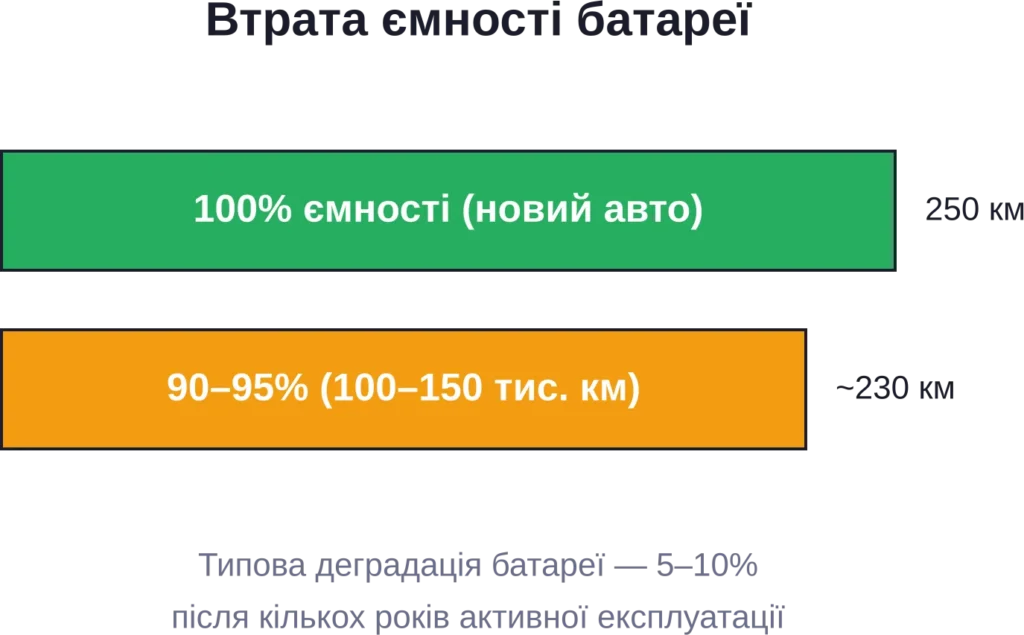
After several years of operation and 100–150 thousand km, the battery loses some capacity. Typical loss is 5–10%.
This means that a car with 120 thousand km mileage may drive not 250 km, but 225–240 km on a full charge. For city trips this is not critical, but it is worth considering when buying a used Soul EV.
Advantages and Disadvantages of Kia Soul EV
What experience have owners accumulated in Ukraine?
Advantages
- Low operating costs: electricity is many times cheaper than fuel
- Reliable design: minimum breakdowns if the battery is in good condition
- Quiet cabin: no engine noise
- Compact dimensions: convenient for parking in the city
- Home charging: no need to go to a gas station
Disadvantages
- Limited range of older versions (27 kWh) — only 150–170 km in summer
- Significant drop in range in winter due to heating
- Battery degradation after 100–150 thousand km
- Few public fast chargers in some regions of Ukraine
- High cost of battery replacement (if needed)
Who Is the Kia Soul EV Suitable For
This electric crossover is an excellent option for:
- City residents with daily mileage up to 50 km
- Families with the ability to charge at home or at work
- Those who want to save on fuel and maintenance
- A second car in the family for short trips
It will not be suitable if:
- You regularly drive distances over 200 km without the possibility of recharging
- There is no access to home charging
- You need a car for long-distance travel
Frequently Asked Questions about Kia Soul EV
How much does it cost to charge a Kia Soul EV at home in Ukraine?
At the night tariff, a full charge of the 39.2 kWh battery costs about 80–120 UAH, which provides 200–250 km of range in summer.
Can I charge a Kia Soul EV from a regular 220V outlet?
Yes, you can. A full charge will take 10 hours to 80%. For home use, this is a convenient option — plug it in at night, and the battery is full in the morning.
How far will the Kia Soul EV go in winter?
The real range in winter decreases by 20–25% in the city and up to 30% on the highway due to cabin heating and a cold battery. The 39.2 kWh version will drive about 190 km in the city in winter.
What is the battery degradation after 100–150 thousand km?
Typical capacity loss is 5–10% after several years of active use. This means the range will decrease by approximately 15–25 km compared to a new car.
Is it worth buying a used Kia Soul EV?
If the battery is in good condition (capacity loss up to 10%) and home charging is available, this is a smart choice for city trips. Check the battery condition with diagnostics before purchasing.
What are the maintenance costs of a Kia Soul EV compared to a gasoline car?
An electric vehicle does not require oil, filter, or spark plug changes. The main expenses are brake fluid, tires, washer fluid, and periodic battery diagnostics. Maintenance savings amount to several thousand hryvnias per year.
Conclusion
The Kia Soul EV is a practical electric crossover for the city and short intercity trips. The real range of the 39.2 kWh version (230–250 km in summer, 190 km in winter) is sufficient for most daily tasks. Low charging and maintenance costs make it a profitable alternative to gasoline cars.
The main thing is to have access to home charging and understand the winter range limitations.
Looking for an affordable city electric vehicle with a proven reputation? The Kia Soul EV deserves attention, especially the versions with a 39.2 or 64 kWh battery.