

Table of contents:
Keeping an EV charging station online is about more than delivering high charging power. Every component, including the charging cable, has to perform reliably throughout the day, especially at busy locations where chargers see constant use.
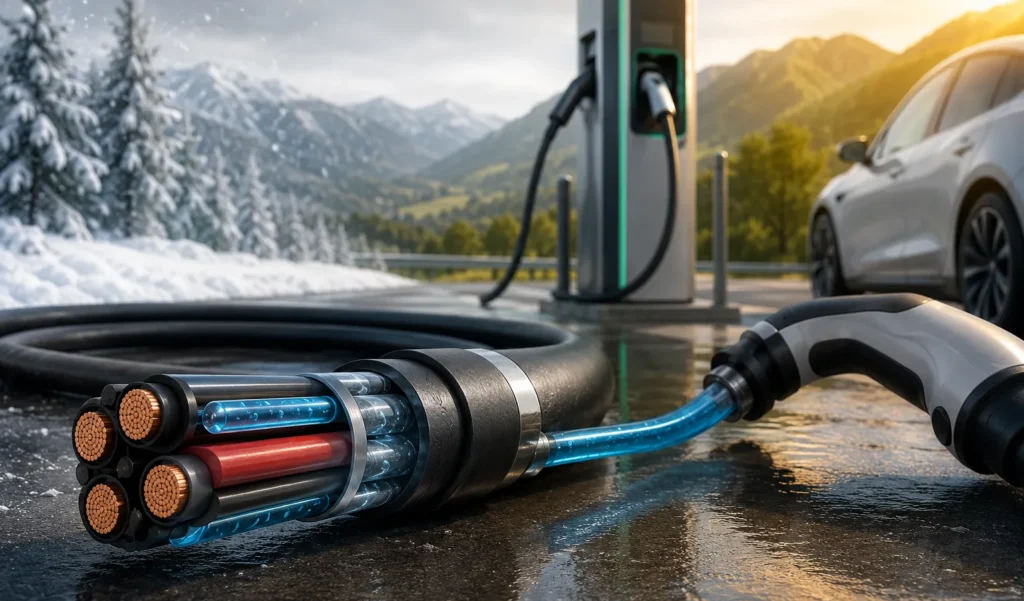
As charging speeds continue to increase, heat becomes one of the biggest challenges for both equipment and operators. Liquid-cooled cables are designed to manage that heat more effectively, helping chargers maintain stable performance under higher electrical loads.
In this article, we’ll look at whether liquid-cooled cables really improve uptime, where they make the biggest difference, and why more high-power charging projects are starting to use them.
We remind you that you can purchase home and commercial charging stations in our store, as well as use public charging stations ECOFACTOR located throughout Ukraine. For convenient access to charging infrastructure, we recommend using our mobile app, available on iOS and Android.
Uptime Starts with Temperature, Not Just Hardware
When people think about charging station reliability, they often focus on the charger itself. The power electronics, software platform, payment system, and network connection all matter, but the charging cable deserves just as much attention.
Every charging session sends a large amount of current through the cable and connector. Electrical resistance naturally produces heat. At lower power levels, air cooling is usually enough to keep temperatures under control. Once charging power moves into the ultra-fast category, the amount of heat increases quickly.
If that heat cannot be removed efficiently, several things can happen: charging current is reduced automatically, charging sessions take longer than expected, connectors experience greater thermal stress, components wear more quickly, and chargers require maintenance sooner.
For drivers, the difference may simply feel like slower charging. For operators managing dozens or hundreds of charging points, repeated thermal issues can reduce station availability and increase operating costs. Liquid-cooled cables are designed to address this specific challenge.
What Actually Happens Inside a Liquid-Cooled Cable?
The idea sounds more complicated than it really is.
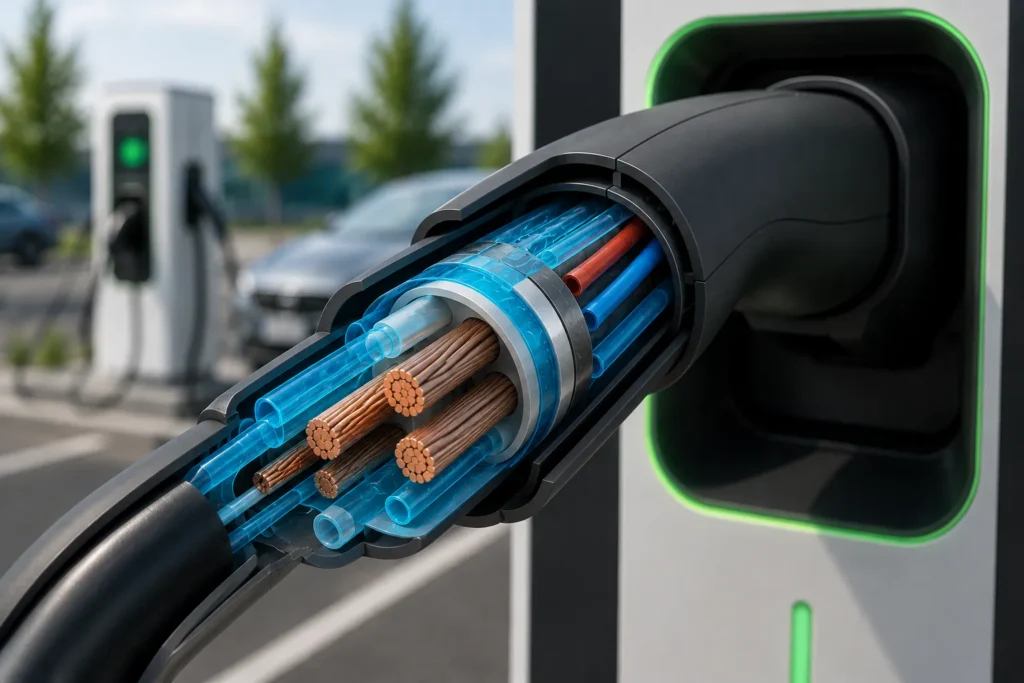
Instead of relying on surrounding air to cool the conductors, a liquid-cooled cable includes internal channels that allow coolant to circulate through the cable assembly and connector. As heat builds during charging, the coolant absorbs it and carries it away to a cooling system where it can be dissipated safely.
This creates a much more efficient thermal path than air cooling alone. The result is not necessarily faster charging by itself. Instead, it allows the charging system to maintain higher power for longer without exceeding safe operating temperatures.
That distinction matters. A charger capable of delivering 350 kW is only useful if its cable and connector can continuously support that level of power.
Why Overheating Leads to Downtime
Downtime is rarely caused by one dramatic failure. More often, it develops through repeated exposure to conditions that place extra stress on equipment. Heat is one of those conditions.
As temperatures rise inside the connector and cable, charging systems begin protecting themselves. Modern DC fast chargers continuously monitor temperatures and automatically reduce output when components become too hot. This process is commonly known as thermal derating.
Thermal derating prevents damage, but it also changes the charging experience. Instead of delivering maximum available power throughout the session, the charger gradually lowers current to keep temperatures within safe limits.
Over time, repeated thermal cycling can contribute to faster connector wear, insulation aging, contact degradation, additional maintenance requirements, and shorter replacement intervals. Liquid cooling cannot eliminate every maintenance issue, but by keeping temperatures more stable it helps reduce one of the biggest causes of thermal stress.
Air Cooling and Liquid Cooling Compared
Both approaches have an important place in EV charging infrastructure. Air-cooled systems remain an excellent solution for AC charging and many DC chargers with moderate power output. They are simpler, require fewer components, and generally cost less.
The balance changes as charging power increases.
| Air-Cooled Cables | Liquid-Cooled Cables |
|---|---|
| Simpler construction | Integrated cooling circuit |
| Suitable for moderate charging power | Designed for sustained high-power charging |
| Larger cable diameter at high current | Smaller cable diameter at similar current |
| Heavier at very high power | Easier handling despite higher power |
| More likely to derate under heavy thermal load | Better temperature stability during extended charging |
This does not mean every charging station should use liquid-cooled technology. It means the operating conditions determine which approach makes more sense.

Equip Charging Sites With ECOFACTOR Solutions
Charging reliability depends on many factors, including equipment quality, installation, and ongoing operation. Alongside charging stations, ECOFACTOR provides complementary energy solutions, including hybrid inverters, battery systems, and solar panels. The company also offers an iOS and Android app with a charging station map that helps drivers locate charging points and access station information.
ECOFACTOR solutions may include:
- Charging stations for public and commercial sites
- Cables and accessories for charging installations
- Hybrid inverters for integrated energy projects
- Battery systems for energy storage support
Contact ECOFACTOR to discuss equipment for reliable EV charging operations.
Where Liquid-Cooled Cables Make the Biggest Difference
Not every charging station works under the same pressure. Some locations handle only a few charging sessions a day, while others are used almost non-stop from morning until late evening. That difference matters. The more often a cable is used, the less time it has to cool down between sessions, and the more important thermal control becomes.
Liquid-cooled cables usually bring the most value in places where charging speed, uptime, and daily traffic are all connected.
Highway Charging Hubs
Highway chargers are built for drivers who need to get back on the road quickly. After a long trip, nobody wants to stop at a high-power charger and see the charging speed drop because the connector is already too hot from previous sessions.
At busy highway locations, chargers may work for hours with very short breaks between vehicles. Liquid-cooled cables help keep temperatures more stable during repeated high-power sessions, which supports more predictable charging speeds and fewer performance drops during peak travel times.
Commercial Fleet Depots
Fleet charging is all about schedule. Delivery vans, service vehicles, taxis, municipal transport, and company cars often need to charge within a set window before going back into operation.
If charging slows down, the issue is not only one delayed vehicle. It can affect routes, dispatch planning, and vehicle availability for the whole day. Liquid-cooled cables are useful here because they help chargers handle repeated high-current sessions without relying on long cooling breaks between vehicles.
Urban Fast-Charging Sites
In cities, fast chargers often serve a mixed audience: private drivers, ride-hailing cars, delivery vehicles, and local businesses. These sites can see high turnover, especially near shopping centers, office areas, residential complexes, and transport routes.
The cable and connector are handled again and again throughout the day. Heat, bending, pulling, and frequent plugging all add stress. Liquid-cooled cables help reduce the thermal part of that stress, which can support better reliability at sites where the charger rarely sits unused for long.
Transport and Logistics Centers
Charging at logistics yards, warehouses, bus depots, and transport hubs can be intense. Vehicles often charge in batches, and the equipment may need to support predictable charging cycles every day.
For these locations, uptime is tied directly to operations. A charger that works at reduced output can still create planning problems if vehicles are waiting. Liquid-cooled cables help maintain stable charging performance under heavier use, which makes them a good fit for sites where delays are expensive and schedules are tight.
For businesses planning charging projects in Ukraine, these scenarios are becoming more relevant every year. Public charging, retail charging, fleet electrification, and transport infrastructure are all moving toward higher daily usage. In those cases, liquid-cooled cables are not just about faster charging. They help make high-power charging more practical to run day after day.
What Else Affects Uptime Besides Cooling?
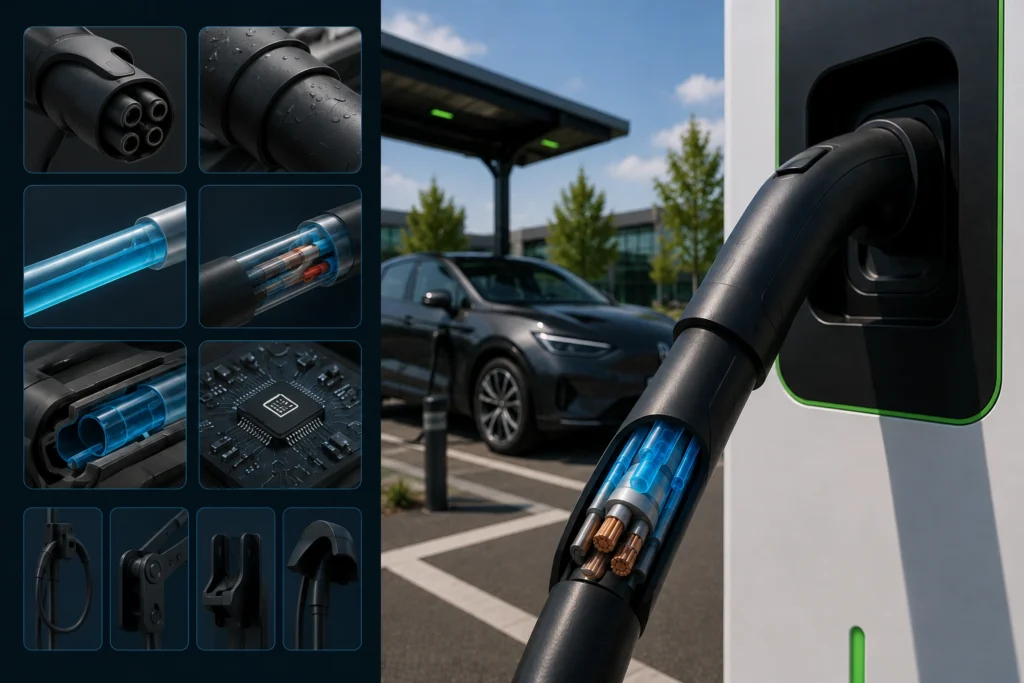
Liquid cooling helps manage heat, but it does not make a charging cable reliable on its own. A liquid-cooled cable still has to be well designed, properly sealed, easy to handle, and supported by the charger’s monitoring system. Otherwise, the cooling system becomes just one more part that can cause problems.
Cable Design Still Matters
A strong liquid-cooled cable depends on several details working together: quality connector design, durable sealing against moisture and dust, coolant materials that do not damage insulation or contacts, effective thermal monitoring, properly designed cooling channels, and software that can track temperature changes in real time.
A poorly designed liquid-cooled cable will not outperform a well-made conventional cable just because it has coolant inside. Engineering quality still decides how the cable behaves after months of daily use, bad weather, rough handling, and repeated high-power charging sessions.
Lighter Cables Are Easier on People and Equipment
One practical advantage of liquid cooling is cable weight. Traditional high-current cables often need thicker conductors to control heat. That makes them heavier, stiffer, and harder to move.
Liquid cooling removes heat more efficiently, so the cable does not have to rely only on extra copper. In many cases, this allows a thinner and lighter cable while still supporting high charging power. For drivers, that means easier plugging and unplugging. For operators, it reduces strain on cable management systems, retractors, support arms, and connector holsters.
This may sound like a small detail, but after thousands of charging sessions, easier handling can mean less mechanical wear and fewer damaged parts.
Lower Heat Can Support Longer Service Life
Charging cables go through constant heating and cooling. Insulation expands and contracts. Connector contacts experience stress. Seals age. Metal parts slowly wear under repeated thermal cycles.
Keeping temperatures more stable helps reduce that pressure on the cable assembly. It does not guarantee a fixed service life, because usage, climate, maintenance, and installation quality all matter. Still, reducing unnecessary heat usually supports longer component life and fewer unexpected failures.
That is why operators should not look only at the purchase price. For busy charging sites, uptime, maintenance effort, replacement cycles, and service access often matter just as much as the cable itself.
Choosing the Right Cable for the Right Project
Not every installation requires liquid-cooled technology. Selecting charging hardware should always begin with expected operating conditions rather than the highest available specification.
The table below illustrates where each approach typically fits.
| Installation Type | Typical Choice |
|---|---|
| Residential charging | Air-cooled |
| Workplace AC charging | Air-cooled |
| Public AC charging | Air-cooled |
| Standard DC fast charging | Depends on power level |
| High-power public charging | Often liquid-cooled |
| Fleet charging depots | Frequently liquid-cooled |
| Highway ultra-fast charging | Commonly liquid-cooled |
For many Ukrainian businesses beginning EV infrastructure projects today, scalability has become an important consideration. Installing equipment that supports future demand can reduce the need for major upgrades as EV adoption continues to grow.
Frequently Asked Questions
Do liquid-cooled cables make EV charging faster?
Not by themselves. Their job is to keep temperatures under control so the charger can maintain higher power for longer without reducing output because of overheating.
Are liquid-cooled cables necessary for every charging station?
No. They are most useful at high-power DC charging stations where equipment is used frequently and handles high charging currents. AC chargers and lower-power DC chargers often perform well with air-cooled cables.
Do liquid-cooled cables require more maintenance?
Yes, they include additional components such as coolant circuits and seals that need regular inspection. However, better thermal management can help reduce wear on cables and connectors used in demanding environments.
Can liquid-cooled cables improve charger uptime?
They can. By reducing heat buildup and lowering the risk of thermal derating, they help chargers maintain more stable performance during busy periods. Uptime still depends on the overall quality of the charging system and regular maintenance.
Why are liquid-cooled cables lighter than some conventional cables?
Because they remove heat more efficiently, manufacturers do not have to rely only on thicker conductors to manage temperature. This allows many high-power cables to stay thinner and easier to handle.
Are liquid-cooled cables a good choice for fleet charging?
In many cases, yes. Fleet depots often charge multiple vehicles within a limited time, so stable high-power charging and reliable equipment can help keep daily operations on schedule.
Conclusion
Do liquid-cooled cables improve uptime? In many high-power charging applications, the answer is yes, but not because liquid cooling magically prevents failures.
Their value comes from controlling one of the biggest challenges in ultra-fast charging: heat. By maintaining lower operating temperatures, reducing thermal derating, supporting sustained high-current charging, and limiting unnecessary thermal stress on connectors and cables, liquid-cooled systems help charging stations remain available for longer periods under demanding conditions.
For operators building fast-charging infrastructure in Ukraine, the question is becoming less about whether liquid cooling works and more about where it delivers the greatest operational value. As charging demand continues to increase, choosing equipment that balances performance, reliability, and long-term maintenance will remain one of the most important decisions in any EV charging project.