

Table of contents:
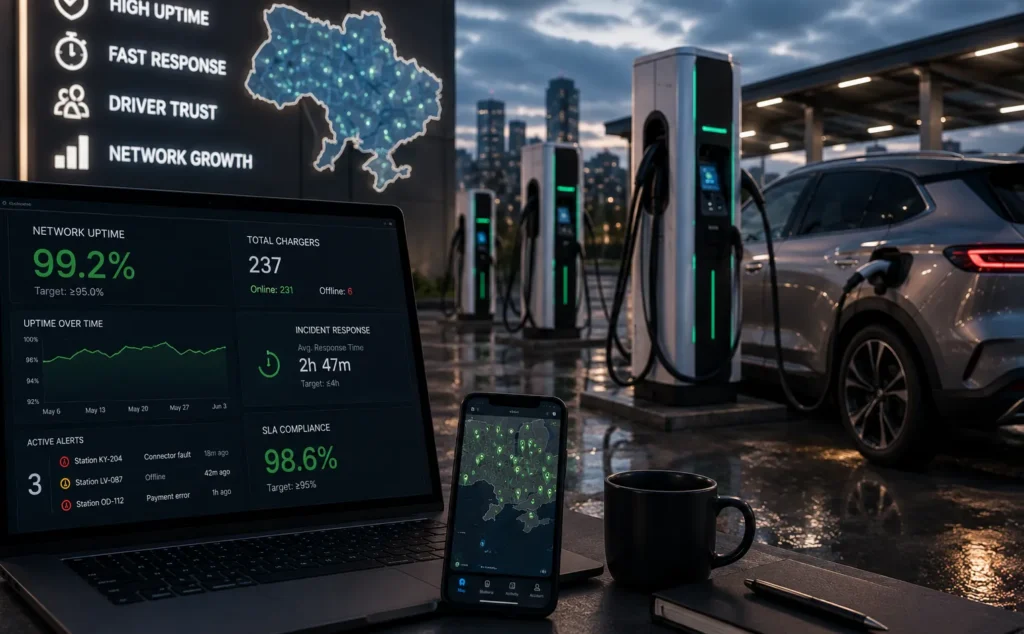
As EV charging networks grow, CPOs can no longer focus only on installing more chargers. The bigger challenge is keeping those chargers available, stable, and easy to use every day. Drivers notice when a station is offline. Site owners notice when equipment creates complaints instead of value.
That is why SLA performance now matters as much as network size. Clear response times, proactive maintenance, and reliable support help CPOs reduce downtime, protect revenue, and grow without losing control of service quality.
We remind you that you can purchase home and commercial charging stations in our store, as well as use public charging stations ECOFACTOR located throughout Ukraine. For convenient access to charging infrastructure, we recommend using our mobile app, available on iOS and Android.
The Shift from Expansion to Reliable Operations
A few years ago, CPO growth was mostly measured by how many chargers had been installed. More locations meant a stronger network. That logic still matters, but it is no longer enough.
Drivers now expect public chargers to work when they arrive. Businesses expect charging infrastructure to support revenue, not create regular service problems. Fleet operators plan routes and shifts around charger availability. If too many stations are offline, the network may look large on paper but feel unreliable in real life.
As networks grow, operations become harder to manage. Different hardware, software, locations, and power setups all need monitoring, updates, maintenance, and support. One faulty connector can create queues, missed charging sessions, and frustration that drivers remember.
That is where SLA performance becomes part of growth. A good SLA sets clear expectations before problems happen and helps operators keep service quality stable as the network expands.
SLA Performance as a Competitive Metric
An SLA, or service level agreement, is a clear agreement between a CPO and a service provider that defines how charging infrastructure will be supported after installation. It sets expectations for response times, maintenance, monitoring, repairs, reporting, and service quality.
Not long ago, this was often treated as a secondary detail. Chargers were installed, the network went live, and maintenance was discussed only when something stopped working. That approach is becoming risky.
Today, customers want to know what happens after launch. Fleet operators ask how fast faults will be fixed. Property owners want confidence that chargers will not sit offline for weeks. Public and commercial partners look at long-term reliability, not only the price of installation. For CPOs, SLA performance is no longer hidden in the contract. It has become part of how the network is judged.
Clear Service Standards Protect Hardware Performance
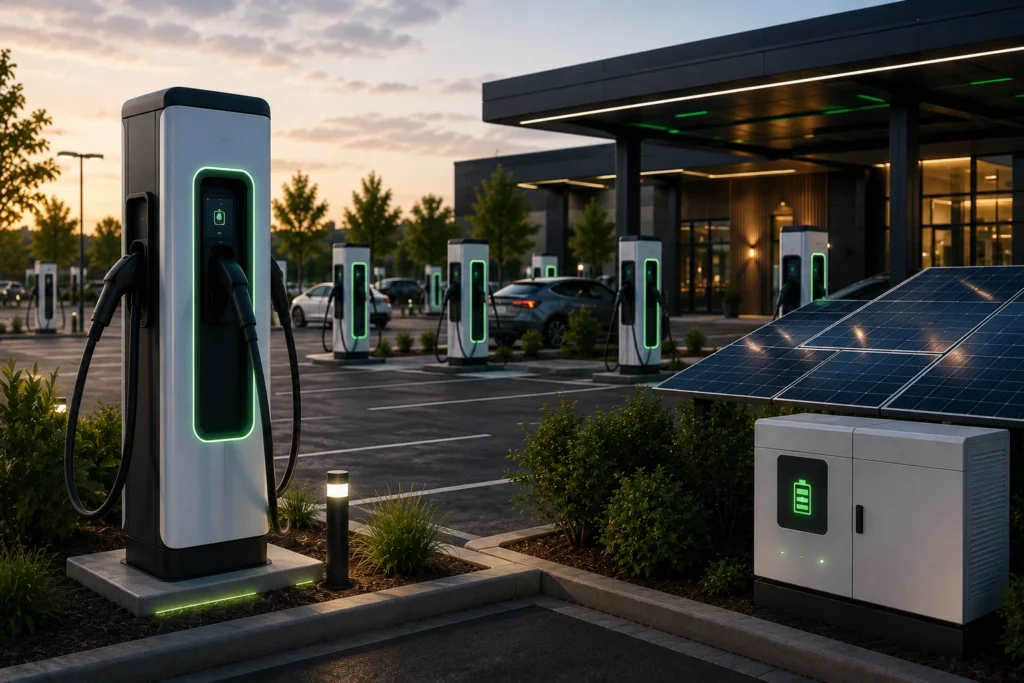
Even strong charging equipment needs regular attention. A charger is not just a metal box with a cable. It works through hardware, software, connectivity, payment systems, user apps, and a management platform.
An SLA helps define who is responsible when one of these parts does not work as expected. It may include remote diagnostics, planned inspections, firmware updates, repair timelines, and escalation rules for urgent issues.
Without this structure, small problems can stay unnoticed until drivers start reporting failed sessions or offline stations. By then, the issue affects more than equipment. It affects trust, revenue, and the reputation of the CPO.
Faster Fault Handling Reduces Downtime
Many people think an SLA is only about how quickly an engineer arrives on site. That matters, but it is only one part of proper service performance.
A modern SLA can include continuous monitoring of charger status, clear priorities for different fault types, remote diagnostics and remote fixes where possible, defined response and repair times, preventive maintenance planning, software and firmware updates, spare parts handling, and regular reporting on uptime and incidents. Together, these elements help reduce downtime instead of simply reacting faster after a charger has already failed.
Reliable Charging Builds Driver Confidence
EV drivers rarely know what service agreement stands behind a charging network. They only see whether the charger works.
If the session starts quickly, the experience feels normal. If the charger is offline, blocked by errors, or unavailable for days, the driver remembers it. One failed charging attempt can be enough for someone to choose another network next time. That is why SLA performance quietly becomes part of the customer experience. It shapes reliability before the driver even thinks about the company behind the charger.
Consistent Service Supports Network Growth
As a CPO adds more locations, support becomes harder to manage. More chargers mean more updates, more inspections, more alerts, more service requests, and more chances for something to go wrong.
Without a clear SLA, service quality can become uneven. Some faults are fixed quickly. Others wait because priorities are unclear, responsibilities overlap, or nobody has a full picture of the issue. A structured SLA gives the network a consistent service process. It defines what should happen, who should act, and how quickly each issue should move forward.
For CPOs planning long-term growth, this consistency matters. Speed is important, but predictable service across the whole network is what makes scaling realistic.
What Modern SLA Performance Actually Includes
Not every service agreement delivers the same level of support. Some focus mainly on repair visits after a fault has already occurred. Others are designed to keep chargers operating smoothly long before drivers notice a problem. The strongest SLAs combine several operational practices into one coordinated support model.
Response Times That Match Business Needs
Response times should reflect how charging infrastructure is actually used. A public DC fast charging site serving drivers throughout the day has different requirements from workplace chargers used during office hours. Fleet depots operating overnight follow another schedule entirely.
Instead of applying identical response targets everywhere, many operators define service priorities based on operational impact. Critical locations receive faster intervention, while lower-risk sites may follow different maintenance schedules without affecting customer service. Matching response times to business needs helps balance reliability with operating costs.
Remote Monitoring Before Drivers Report Problems
One of the biggest changes in charging network management is the growing role of remote monitoring. Modern platforms continuously track charger health, communication status, connector availability, charging sessions, and system alerts. Rather than waiting for customer complaints, operators can often identify developing issues automatically.
Examples include communication interruptions, unexpected error codes, reduced charging performance, unstable power delivery, and repeated session failures. Detecting these warning signs early allows technical teams to investigate before they become full service interruptions.
Preventive Maintenance Instead of Constant Repairs
Waiting for equipment to fail is rarely the most efficient maintenance strategy. Preventive maintenance helps identify worn components, inspect connectors, verify electrical connections, test safety systems, and confirm that chargers continue operating within expected parameters.
Although preventive work requires planning, it usually reduces emergency repairs later. Scheduled maintenance can often be completed during periods of lower usage, avoiding unnecessary disruption for drivers. For growing CPOs, this approach creates more predictable operating costs and reduces unexpected outages.
Software and Firmware Stay Part of the SLA
Charging stations are connected devices, which means maintenance extends beyond physical hardware. Software updates improve compatibility with vehicles, strengthen cybersecurity, fix operational issues, and introduce new functionality. Firmware updates may improve charger performance or address manufacturer recommendations.
Managing these updates across dozens or hundreds of chargers becomes increasingly difficult without structured processes. An effective SLA should include ongoing software management alongside traditional field service, ensuring the network remains secure, compliant, and ready for future developments.

Strengthen Charging Network Performance With ECOFACTOR
As charging networks expand, service reliability becomes increasingly important for both operators and drivers. Alongside charging stations, ECOFACTOR provides hybrid inverters, battery systems, and solar panels that support long-term infrastructure development. The company also offers an iOS and Android app with a charging station map that helps users access charging information more easily.
ECOFACTOR can help support charging operations through:
- Infrastructure solutions for growing charging networks
- Digital tools that improve driver access to charging points
- Energy equipment for integrated charging projects
- Cables and accessories for network expansion and maintenance
Contact ECOFACTOR to discuss solutions that support reliable charging network performance.
One SLA or Many? The Challenge of Multi-Vendor Networks
Few charging networks stay with a single hardware manufacturer forever. Networks often grow over several years, during which technology changes, new charging locations have different requirements, and purchasing decisions evolve. A CPO may begin with AC chargers from one supplier, add DC fast chargers from another, and later expand again using equipment from a third manufacturer.
From the driver’s perspective, that variety is almost invisible. From the operator’s perspective, it can introduce unnecessary complexity.
Different Vendors Often Mean Different Support Processes
When each hardware supplier has its own maintenance agreement, support procedures quickly become fragmented. Operators may need to manage different response times, different reporting systems, separate technical contacts, multiple spare parts suppliers, different maintenance schedules, and different escalation procedures. As the network expands, coordinating these relationships takes more time and increases the chance that important issues are overlooked or delayed.
A Unified Service Model Simplifies Daily Operations
Many CPOs are moving toward service arrangements that cover multiple hardware brands under one operational framework. Instead of managing separate maintenance contracts for every manufacturer, operators work with a single support organisation responsible for coordinating service across the network.
| Multiple Service Providers | Unified Service Approach |
|---|---|
| Separate SLAs | One SLA |
| Different reporting formats | Centralised reporting |
| Multiple support contacts | One support team |
| Different escalation paths | Clear escalation process |
| Independent maintenance planning | Coordinated maintenance schedule |
A unified model does not remove the differences between charger manufacturers. Hardware specifications, replacement parts, and technical documentation still vary. What changes is the way service is organised. For growing CPOs, that operational consistency often becomes more valuable than adding another layer of administration.
Growth Becomes Easier to Manage
The larger a charging network becomes, the harder it is to rely on informal processes. When operators manage dozens or hundreds of charging points across multiple locations, support must be predictable. Maintenance schedules, reporting, incident management, and communication all need clear structure.
A well-organised SLA supports that consistency. Instead of creating new service processes every time another site is added, operators expand within an existing framework. That makes future growth less about managing complexity and more about delivering reliable charging across every new location.
Practical Steps CPOs Can Take to Improve SLA Performance
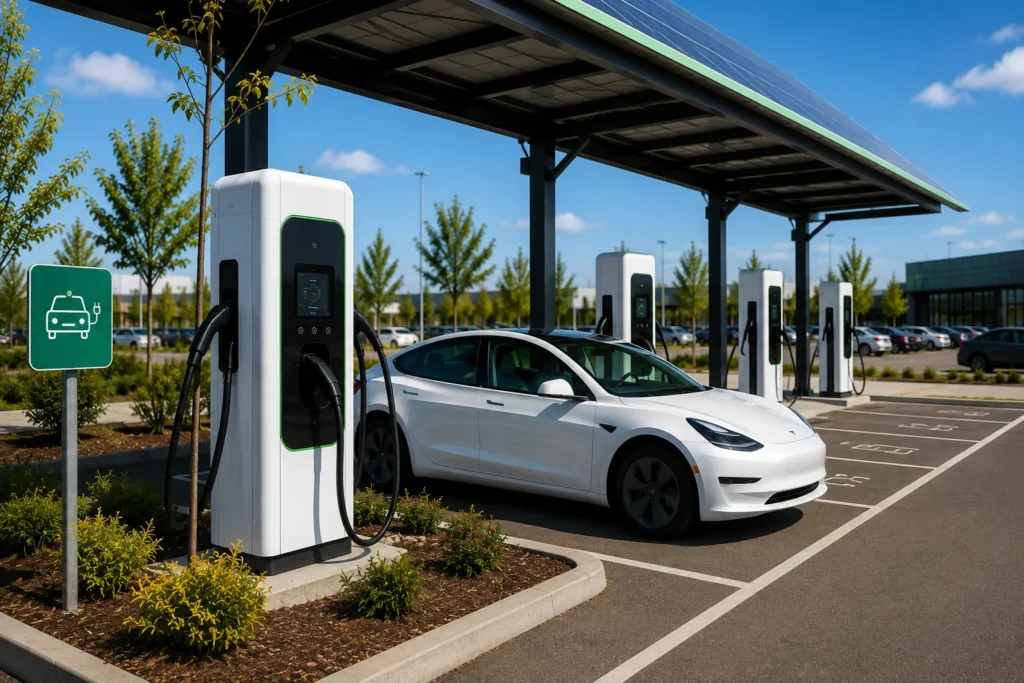
Improving SLA performance does not always require a complete overhaul of an existing charging network. In many cases, steady improvements to maintenance processes, monitoring, and service coordination deliver noticeable results over time.
1. Review What Causes Downtime
Not every service request deserves the same level of attention. Some chargers may repeatedly experience communication issues, while others require connector replacements more often than expected. Looking at historical service records helps identify patterns that would otherwise remain hidden.
Useful questions include which chargers generate the highest number of incidents, whether certain locations are affected more often than others, which faults are resolved remotely, which problems require repeated engineer visits, and whether software issues are becoming more common than hardware failures. Understanding these trends makes future maintenance planning more effective.
2. Make Monitoring Part of Everyday Operations
Monitoring systems are most valuable when they become part of daily routines rather than something checked only after drivers report problems. A consistent monitoring process helps technical teams identify offline chargers quickly, detect repeated warning messages, track charging session success rates, monitor communication stability, and confirm that software updates have been successfully completed.
The sooner a problem is identified, the more options are available for resolving it before customers are affected.
3. Keep Firmware and Software Up to Date
Charging infrastructure changes continuously, even when the hardware stays the same. Manufacturers regularly release firmware updates to improve stability, address security issues, and maintain compatibility with new vehicles or evolving industry standards. Charge point management systems also receive updates that improve functionality, reporting, and overall performance.
Delaying these updates may not create immediate problems, but over time it can increase the likelihood of compatibility issues or operational faults. Treating software maintenance as a routine activity rather than an occasional project helps keep the network reliable.
4. Work With Clear Responsibilities
One of the most common reasons repairs take longer than expected is uncertainty about who is responsible for each stage of the process.
When a fault occurs, everyone involved should understand who receives the initial alert, who performs remote diagnostics, when field engineers are dispatched, who communicates with the site owner, and how repairs are confirmed before closing the incident. Clear responsibilities reduce delays and help support teams work more efficiently, especially as networks continue to expand.
Final Thoughts
The EV charging market is no longer judged only by the number of installed chargers. Drivers, site owners, and fleet operators now expect charging infrastructure to work reliably every day.
A strong SLA helps CPOs meet that expectation through monitoring, preventive maintenance, remote diagnostics, software updates, field service, and clear response processes. For Ukraine’s growing charging market, this is becoming especially important. Expansion still matters, but long-term growth depends on keeping existing chargers online and ready to use. SLA performance is now part of how CPOs compete, scale, and build trust.
Frequently Asked Questions
What is an SLA in EV charging?
A service level agreement, or SLA, defines how charging infrastructure will be supported after it is installed. It typically covers response times, maintenance, monitoring, repair priorities, and other service commitments that help keep chargers available and operating reliably.
Why is SLA performance important for Charge Point Operators?
As charging networks grow, maintaining consistent uptime becomes more challenging. A well-designed SLA helps CPOs reduce downtime, organise maintenance, respond to faults more efficiently, and provide a more reliable charging experience for drivers.
Is a warranty enough to keep EV chargers operating?
No. A warranty and an SLA serve different purposes. A warranty generally covers manufacturing defects in the hardware, while an SLA focuses on day-to-day operational performance, including maintenance, monitoring, and service response. Many operators rely on both to protect their charging infrastructure.
Can one SLA support chargers from different manufacturers?
Yes, if the service provider has the necessary expertise and processes. A hardware-agnostic service model allows CPOs to manage chargers from multiple manufacturers under one support framework, making maintenance easier to coordinate as networks expand.
How does proactive maintenance improve charger uptime?
Proactive maintenance identifies potential issues before they develop into service interruptions. Combined with remote monitoring and regular software updates, it allows operators to resolve many problems early, reducing unexpected downtime and helping chargers stay available for drivers.