

Table of contents:
The EU’s Alternative Fuels Infrastructure Regulation (AFIR) is changing how public EV charging is designed and operated. It is not just about installing more chargers. It sets clear rules for payments, pricing, data sharing, smart charging, and interoperability across Europe.
For energy companies, utilities, and charging network operators, that changes how new projects should be planned. Infrastructure that meets today’s demand but ignores AFIR requirements may need expensive upgrades much sooner than expected.
This guide explains what AFIR requires, what energy companies should build into new charging sites from day one, and how the right combination of hardware, software, and energy management can make compliance much easier as the market continues to evolve.
We remind you that you can purchase home and commercial charging stations in our store, as well as use public charging stations ECOFACTOR located throughout Ukraine. For convenient access to charging infrastructure, we recommend using our mobile app, available on iOS and Android.
AFIR in Plain English
The Alternative Fuels Infrastructure Regulation, better known as AFIR, is an EU regulation that sets common rules for public charging infrastructure. It came into force in 2024 as part of the Fit for 55 package, which supports the transition to lower-emission transport across Europe.
Before AFIR, charging networks developed at different speeds and often followed different rules. Drivers could face inconsistent payment methods, limited charging coverage, unclear pricing, and varying user experiences depending on the country or operator.
AFIR aims to remove those differences. It establishes a common framework for how public charging infrastructure should be built, operated, and connected. The regulation covers much more than charging stations themselves. It includes payment methods, pricing transparency, data sharing, interoperability, smart charging, and technical standards.
Why AFIR Matters for Energy Companies
Energy companies are becoming key players in EV charging. Many already operate public charging networks, supply electricity to charging sites, or invest in new charging hubs for businesses, municipalities, and transport operators.
AFIR changes what these projects should look like from the beginning. Instead of treating charging stations as standalone electrical equipment, companies now need to think about the entire operating environment. Every new site should be capable of processing payments, sharing operational data, supporting remote management, and working with modern communication standards. This approach helps create charging networks that are easier to expand, simpler to maintain, and more convenient for drivers.
How AFIR Works Across Public Charging Infrastructure
AFIR combines infrastructure targets with operational requirements. Some parts of the regulation define where charging stations should be deployed, particularly along the Trans-European Transport Network (TEN-T). Others describe how public charging should work after installation.
For example, AFIR sets expectations for charging capacity along major transport corridors, transparent pricing before charging begins, ad-hoc payments without mandatory registration, real-time charger information, smart charging capabilities, common technical standards, and digital connectivity between chargers and management systems. Rather than introducing one major rule, AFIR creates a complete framework for operating public charging infrastructure across Europe.
The Shift From Chargers to Connected Infrastructure
One of the biggest changes introduced by AFIR is the way charging infrastructure is viewed. A few years ago, installing charging equipment was often the main objective. Today, the charger is only one part of a much larger system.
A modern public charging site typically includes charging hardware, a Charge Point Management System (CPMS), payment services, internet connectivity, energy management, remote monitoring, driver applications, and reporting and data exchange. If one of these components is missing, daily operations become more difficult, and future compliance may require additional investment. This is why many operators now design charging projects as connected digital infrastructure rather than independent charging stations.
Core AFIR Requirements for Energy Companies
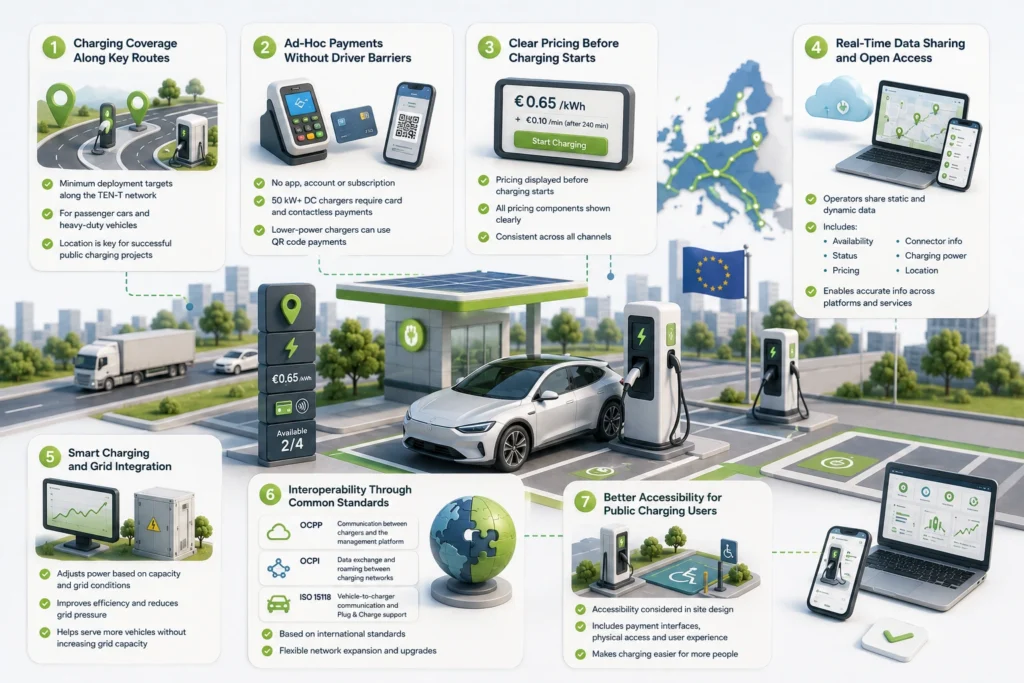
AFIR introduces several practical requirements that directly influence how public charging infrastructure is designed and operated. Some apply to physical equipment, while others focus on software, payments, and communication between different systems. Together, they create a charging experience that is easier for drivers and simpler to integrate across Europe.
Charging Coverage Along Key Routes
One of AFIR’s best-known objectives is expanding charging infrastructure along the Trans-European Transport Network (TEN-T). The regulation sets minimum deployment targets for both passenger vehicles and heavy-duty transport. Member States are responsible for meeting these targets, but energy companies and Charge Point Operators play a central role in building the required infrastructure. For businesses planning large public charging projects, location has become just as important as charger specifications.
Ad-Hoc Payments Without Driver Barriers
Drivers should be able to start charging without downloading an app, creating an account, or signing a subscription. For publicly accessible DC chargers with a power output of 50 kW or more, AFIR requires widely accepted electronic payment methods, including payment cards and contactless payments. Lower-power public chargers can use alternatives such as secure QR code payments.
This means operators should think beyond payment terminals themselves. The entire payment process, from authorization to settlement, should work reliably across the network.
Clear Pricing Before Charging Starts
Charging prices should never come as a surprise. AFIR requires operators to display pricing clearly before a charging session begins. Drivers should understand whether they are paying per kilowatt-hour, per minute, per session, or through a combination of pricing components. Occupancy fees are allowed, but they must be communicated before charging starts. Keeping pricing consistent across chargers, mobile apps, websites, and payment interfaces helps avoid confusion and improves trust.
Real-Time Data Sharing and Open Access
Public charging stations generate information that drivers rely on every day, including charger availability, operational status, pricing, connector information, charging power, and station location. AFIR requires operators to make both static and dynamic data available through standardized digital systems. Accurate information allows navigation services, roaming platforms, and future National Access Points to display reliable charging information across Europe.
Smart Charging and Grid Integration
AFIR does not treat charging as a fixed electrical load. Instead, charging infrastructure should be capable of adjusting power based on available capacity and grid conditions. This supports more efficient electricity use while reducing unnecessary pressure on local distribution networks. As charging demand grows, smart charging helps operators serve more vehicles without automatically increasing grid capacity.
Interoperability Through Common Standards
Public charging infrastructure should work with different vehicles, charging platforms, and service providers. That is why AFIR references international standards rather than proprietary technologies. Several standards are particularly important.
| Standard | Purpose |
|---|---|
| OCPP | Communication between chargers and the management platform |
| OCPI | Data exchange and roaming between charging networks |
| ISO 15118 | Vehicle-to-charger communication, including Plug & Charge support |
Following these standards gives operators greater flexibility when expanding or upgrading their networks.
Better Accessibility for Public Charging Users
AFIR is not only about technology. It is also about making charging easier for more people. New public charging sites should consider accessibility during planning. That includes payment interfaces, physical access around the charger, and a charging process that does not create unnecessary obstacles for drivers. Good accessibility improves everyday usability while helping operators meet evolving public infrastructure expectations.
Infrastructure Energy Companies Should Build Today
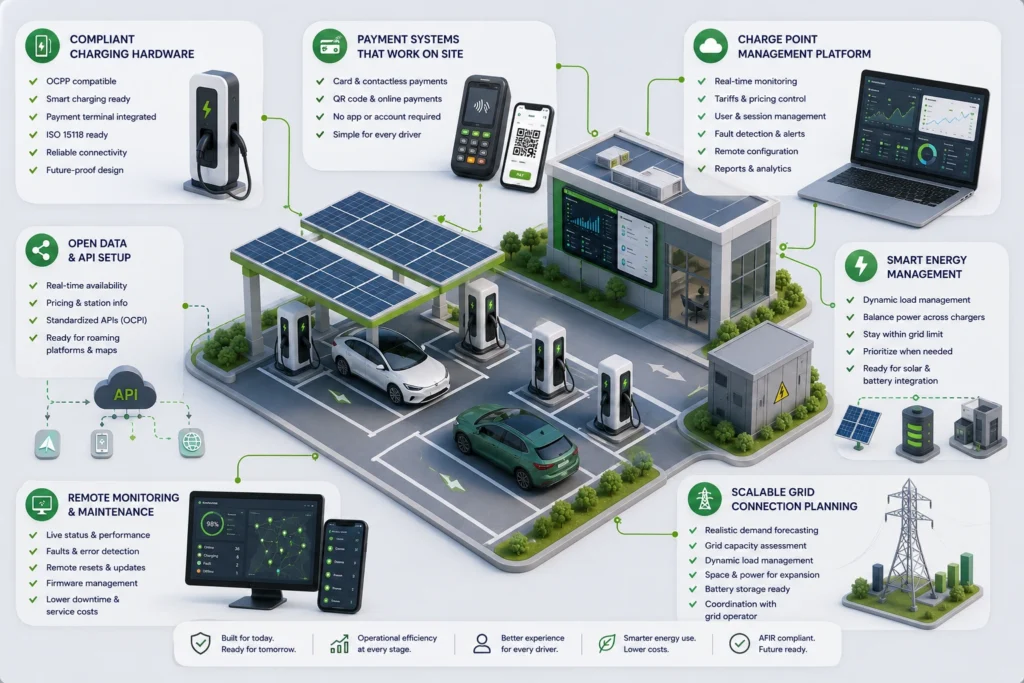
AFIR compliance is easier when it is designed into the project from the start. Retrofitting payment, data, and smart charging functions later can be messy, especially when sites already operate daily and drivers depend on them. For energy companies, the safer approach is to build charging infrastructure as a connected system from day one.
Compliant Charging Hardware
Hardware should support the required power levels, connector types, payment setup, and communication standards. It should also be suitable for future upgrades. When choosing chargers, companies should check OCPP compatibility, remote firmware update support, payment terminal integration, smart charging capability, ISO 15118 readiness, reliable connectivity options, and service and maintenance access. The charger itself does not need to do everything alone, but it must work properly with the platform, payment system, and energy management layer.
Payment Systems That Work On Site
Payment should be planned as part of the site design, not added at the end. A public charging site may need a built-in card reader, a shared payment terminal, contactless payments, or QR-based online payment depending on charger power and use case. The important part is that drivers can start charging without being forced into a closed ecosystem.
For Ukrainian companies looking toward European standards, this is one of the first areas to consider. Payment habits differ by market, but public charging must be simple enough for local drivers, visitors, fleet users, and cross-border travelers.
Charge Point Management Platform
A Charge Point Management System is the operational center of the charging network. It connects chargers, payments, tariffs, monitoring, users, data, and maintenance into one system. Without it, every site becomes harder to control as the network grows.
For energy companies, this platform is not just an IT tool. It is what turns a set of chargers into a manageable charging business. It helps teams monitor chargers in real time, update tariffs, track sessions, detect faults, and respond before small problems become visible to drivers.
Open Data and API Setup
AFIR places a strong focus on data because drivers need reliable information before they arrive at a station. If a map says a charger is free, but it is actually out of service, the whole experience fails. That is why static and dynamic data must be accurate and updated regularly.
Energy companies should prepare systems that can share station location, connector type, power level, availability, pricing, operational status, and access conditions with external systems where required. This data should not live only inside one internal dashboard. It needs to be ready for roaming platforms, mapping services, partner apps, and national data portals.
Smart Energy Management
A public charging hub does not operate in isolation. It shares capacity with buildings, commercial loads, batteries, solar systems, and local grid constraints. If every charger runs at full power during a peak period, the site may exceed its available capacity or generate unnecessary electricity costs.
Instead, smart energy management continuously adjusts charging based on what is happening across the site. Depending on the situation, it can reduce charging power when the building’s electricity demand increases, balance available power between multiple chargers, prevent the site from exceeding its contracted grid capacity, prioritize charging for selected vehicles when needed, and prepare the infrastructure for future battery storage or solar integration.
Remote Monitoring and Maintenance
Charging stations need constant supervision. Not every problem requires a technician on site, but every serious issue needs to be noticed quickly. Remote monitoring helps operators see what is happening across the network without waiting for driver complaints. It can show charger status, failed sessions, communication errors, payment problems, connector faults, firmware versions, and uptime trends. Remote maintenance can reduce downtime and make service teams more efficient. A remote reset, software update, or configuration change can often solve issues faster than a site visit.
Scalable Grid Connection Planning
AFIR pushes the market toward larger, more reliable charging capacity. That makes grid planning one of the most important parts of any new project. Energy companies should avoid building sites that work only for the first installation phase. If a location may later need more chargers, higher power, or heavy-duty vehicle support, the electrical design should leave room for growth.
This does not always mean overspending on day one. It means making decisions that do not block expansion later: realistic demand forecasts, enough physical space, transformer capacity assessment, dynamic load management, possible battery storage, and coordination with the grid operator. A charging site that cannot grow may become outdated before it becomes profitable.

Prepare Charging Infrastructure With ECOFACTOR
As charging infrastructure develops, many organizations also consider future regulatory and technical requirements. Alongside charging stations, ECOFACTOR provides hybrid inverters, battery systems, and solar panels for different infrastructure projects. Drivers can also access charging locations through the iOS and Android app and charging station map.
ECOFACTOR can support infrastructure planning with:
- Charging solutions for commercial and public projects
- Energy technologies for integrated infrastructure
- Equipment suitable for network expansion
- Cables and accessories for charging installations
Contact ECOFACTOR to discuss charging infrastructure for future development projects.
The Cost of Waiting Too Long
Delaying AFIR readiness can look cheaper at first. A company installs chargers, starts operations, and plans to deal with compliance upgrades later. That approach can work for a small private site, but it becomes risky for public infrastructure.
Retrofitting is usually harder than building correctly from the start. Payment terminals may require new hardware, new wiring, certification, and software integration. Data sharing may require platform changes. Smart charging may not work if the chargers or backend were never designed for it.
The most expensive problems are often not visible during installation. They appear later, when the site needs to connect to roaming services, report data, update tariffs, or handle higher demand. At that point, every change affects a live network. For energy companies, the better question is not only how much the first installation costs. It is how much the site will cost to operate, upgrade, and keep compliant over the next several years.
AFIR and the Ukrainian Charging Market
Ukraine is not an EU Member State, so AFIR does not apply in the same direct way as it does inside the European Union. Still, Ukrainian energy companies should not ignore it.
There are several reasons for this. First, Ukraine is moving closer to European standards in energy, transport, and infrastructure. Second, many charging technologies, platforms, payment solutions, and vehicles already follow European market requirements. Third, investors and international partners often look for infrastructure that can scale beyond one local market.
For Ukrainian operators, AFIR can work as a practical benchmark. It shows where public charging is heading: more transparency, easier payments, better data, smarter grid use, and stronger interoperability. This matters for highways, city charging hubs, retail locations, logistics sites, hotels, business centers, and fleet infrastructure. The more public and commercial the site is, the more useful AFIR logic becomes during planning.
Planning Checklist for New Charging Sites
Before building a new public charging site, energy companies should check whether the project is ready for both current use and future requirements. Key questions include whether drivers can pay without a mandatory app or subscription, whether pricing is clear before charging starts, whether the operator can monitor and manage chargers remotely, whether the hardware supports open communication standards, whether charger status, availability, and pricing can be shared with external systems, whether smart charging is available for load control, whether the grid connection is planned for future expansion, whether the platform can support roaming, reporting, and tariff changes, and whether accessibility and driver convenience are considered at the site level.
This checklist will not replace technical design, but it helps avoid the most common planning gaps. A charging site should not only be connected to electricity. It should be connected to the systems that make public charging work.
Frequently Asked Questions
Does AFIR apply only to EU countries?
AFIR is an EU regulation, so its legal requirements apply within the European Union. Even so, many manufacturers, software providers, and charging operators outside the EU already design their products and projects around these standards because they simplify cross-border compatibility and future expansion.
Do all public chargers need a payment terminal?
Not always. Under AFIR, publicly accessible chargers with a power output of 50 kW or more must support widely accepted electronic payments, such as contactless card payments. Lower-power chargers can use other secure payment methods, including QR code payments, depending on the installation.
What is the difference between AFIR and OCPP?
They solve different problems. AFIR is a regulation that defines how public charging infrastructure should operate. OCPP is a communication protocol that allows charging stations and management platforms to exchange information. Many AFIR requirements are much easier to meet when chargers support OCPP.
Why is smart charging part of AFIR?
As more electric vehicles connect to the grid, charging needs to become more flexible. Smart charging helps operators balance available power, avoid unnecessary peak demand, and use existing electrical capacity more efficiently without affecting the driver’s charging experience.
Should Ukrainian energy companies prepare for AFIR now?
For companies investing in public charging infrastructure, it makes sense. While AFIR is not mandatory in Ukraine, its requirements reflect the direction of the European charging market. Building with these principles in mind today can reduce future upgrades and make new projects easier to scale.
Conclusion
AFIR makes one thing clear: public charging infrastructure is no longer just about installing chargers. It is about building a connected, transparent, and manageable system that works for drivers, operators, energy companies, and the grid.
For energy companies, this changes how projects should be planned. Charging hardware still matters, but it is only one part of the job. Payment access, pricing clarity, real-time data, smart charging, remote management, and open standards now shape the long-term value of every site.
Ukrainian companies do not need to copy every European rule blindly. But they should understand the direction. Charging infrastructure built today will stay in use for years. If it is designed with AFIR-style requirements in mind, it will be easier to operate, easier to upgrade, and better prepared for the market that is already forming around Europe.