

Table of contents:
The Audi e-tron is not just a premium electric crossover. It offers comfort, technology and confidence on the road. But even the most powerful electric car needs to be charged properly.
Whether you’re already an e-tron owner or are just planning to buy this electric car, understanding how and where to charge it is key to a hassle-free ownership experience. In this guide, we’ll look at all the types of charging, charging times, connectors, costs and practical tips for Ukraine.
We remind you that you can purchase home and commercial charging stations in our online storeand also use the public charging stations ECOFACTORcharging points located throughout Ukraine. For convenient access to charging infrastructure, we recommend using our mobile applicationwhich is available on iOS and Android.
What charging connectors and standards does the Audi e-tron support?
The Audi e-tron is fitted with a universal charging system, making it compatible with most charging stations in Ukraine and Europe.
The main connector for alternating current (AC) is Type 2. This is a standard European connector used on domestic Wallbox charging points and public charging points with a power output of up to 22 kW. The Audi Q8 e-tron’s on-board charger (2024–2026 model range) supports AC charging at up to 11 kW as standard, however, a second on-board charger is available as an option, which allows the power to be doubled to 22 kW.
For fast charging with direct current (DC), Kona uses the CCS Combo 2, which is the same Type 2 but with additional contacts on the bottom for high power transfer.
This is important: the Ukrainian market for charging stations is predominantly based on the CCS and Type 2 standards, so there should be no compatibility issues.

Types of charging stations in Ukraine
Understanding the different types of charging points will help you plan your journeys and optimise your costs. In Ukraine, there are three main categories.
Home exercise (Level 2 AC)
The most convenient option for everyday use. Install a Wallbox at home, plug in your e-tron overnight — and you’ll have a full charge by the morning.
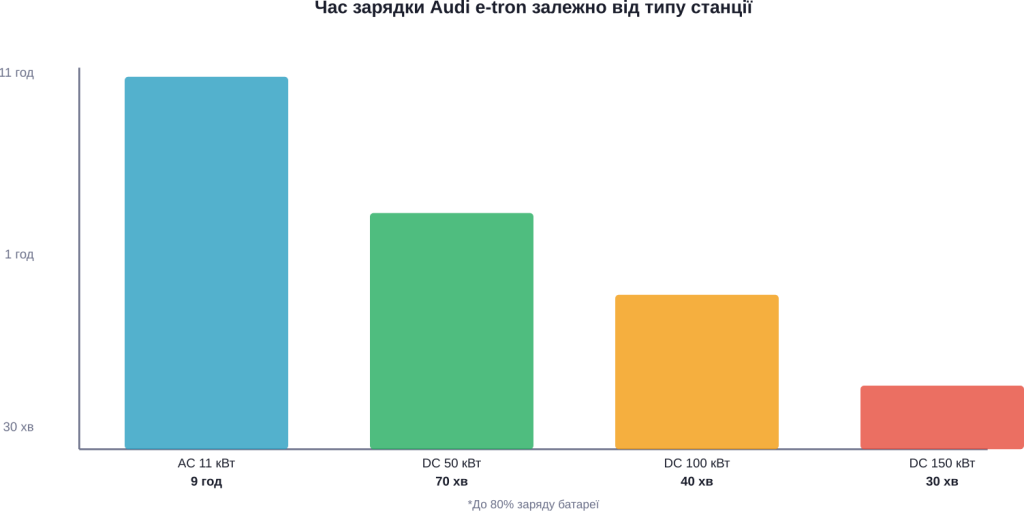
Home charging stations typically have a power output of 7–11 kW. According to Blink Charging, Level 2 charging stations can charge the e-tron in 4–10 hours, depending on the initial charge level. For an e-tron with a 95 kWh battery, a full charge from an 11 kW home charging station will take around 9 hours.
The benefits are obvious: low electricity costs (domestic tariff), convenience (plug it in and forget about it), and the option to charge at night using the green tariff.
Public charging stations (AC and DC)
The network of public charging points in Ukraine is expanding rapidly. The stations are located near shopping centres, petrol stations, hotels and on motorways.
Slow AC charging points (7–22 kW) are ideal for topping up whilst shopping or having lunch. As users point out, near Silpo, ATB or Epicentre you can find stations with a capacity of up to 11 kW — simply plug in the cable and do your shopping whilst your car charges to 10–20 per cent.
Fast DC charging stations (50–150 kW) are located on motorways and in major cities. It is here that the e-tron really shows off its fast-charging capabilities.
Ultra-fast charging stations (DC 150+ kW)
Here, the e-tron can be charged at maximum speed.
According to owners, the 150 kW e-tron reaches 80 per cent charge in 30–35 minutes at charging stations. This is ideal for long journeys — stop for a coffee, and you can carry on with plenty of range to spare.
| Charging type | Power | Time to 80% | Where is the charging port on the VW e-Golf? | Cost |
|---|---|---|---|---|
| Home (AC) | 7–11 kW | 9–11 hours (full charge) | Private garage | 50–70 UAH |
| Public AC charging station | 7–22 kW | 4–8 hours (full charge) | Shopping centres, car parks, cafés | 100–200 UAH |
| Fast DC | 50–100 kW | 50–60 minutes | Motorways, large petrol stations | 150–250 UAH |
| Ultra-fast DC | 150+ kW | 30–35 minutes | Individual networks | 200–300 UAH |
Where to find charging points without any hassle – the ECOFACTOR network
When you drive an Audi e-tron, the most important thing isn’t that it can charge quickly, but that you can actually find the right charging station when you need it. Here at ECOFACTOR, we’re building an ecosystem around this: the charging station map on our website and in our mobile app helps you quickly filter stations by connector type and power output, check their status in real time, and then simply start a charging session in just a few clicks. The app is available for both iOS and Android, with payment and process monitoring directly from your phone – no need to go on a ‘quest’ at the charging terminal.
To cater for a range of charging scenarios, we provide both charging stations and the associated services. We offer mobile chargers, AC stations up to 44 kW and DC stations up to 420 kW – for home connections, car parks, commercial premises and motorways where speed is critical. And if you need to find a cable, adapter, inverter or other charging accessories to suit your daily routine, you can do so in our online store, without having to search ‘through classifieds’.
For business, we offer the following separately: operator platform, so that venue and network owners can manage charging points, connections and services more easily, and drivers can see a clear infrastructure that works not only ‘on the map’, but also in real life. In short, we’re trying to make sure that charging an e-tron in Ukraine is as routine as popping in for a coffee – with no surprises and no unnecessary delays.
How long does it take to charge an Audi e-tron?
Charging time depends on three factors: battery capacity, charging station power and the initial charge level.
The standard Audi Q8 e-tron 50 has a 95 kWh battery and a range of up to 453 km under the WLTP cycle. The 55 variant is fitted with a larger battery and offers an extended range.
The specific figures are as follows:
- At a home charging station, a full 11 kW charge will take around 9 hours. This means that if you plug in the e-tron at 10.00 pm, you’ll have a 100% charge by 7.00 am the next morning.
- At a public AC charging station with a 7 kW output, the process will take 11–13 hours for a full charge. However, in reality, you’ll rarely be charging from 0 to 100 per cent — more often than not, you’ll just be topping up by 20–30 per cent.
- At fast-charging DC stations with a power output of 125 kW or more, the Audi Q4 e-tron takes around 28–38 minutes to charge from 5% to 80%. If you use stations with a power output of just 50 kW, this process will take over 70 minutes.
- The Audi Q8 e-tron 55 supports a peak charging power of up to 170 kW, which allows the battery to be charged from 10% to 80% in 31 minutes at compatible charging stations.
But why 80 per cent, exactly? Because the charging rate drops significantly over the last 20 per cent — this is the battery’s protective mechanism.
The cost of charging Audi e-tron in Ukraine
Let’s look at the actual figures. As of February 2026, prices vary depending on the type of charges and the region.
Home exercise
The cheapest option. If your domestic tariff is 4–5 UAH per kWh (daytime) or 1.44 UAH (night-time ‘green’ tariff in some regions), a full charge of a 95 kWh battery will cost:
- Daily rate: 95 kWh × 4.5 UAH = 427.5 UAH
- Night-time tariff: 95 kWh × 1.5 UAH = 142.5 UAH
In reality, you rarely charge your battery from zero, so the average cost of a home charge to top up to 50–60 per cent is 50–70 UAH.
Public stations
Prices here are higher due to the cost of maintaining the networks. AC charging points near shopping centres often cost 8–12 UAH per kWh. For a 50 kWh charge, that works out at 400–600 UAH.
Fast DC charging stations are more expensive: 12–18 UAH per kWh. Charging to 80 per cent (around 76 kWh) will cost 900–1,370 UAH.
But please note: some providers offer subscription plans or a fixed price per session, which may work out cheaper.
A comparison with a petrol car
The Audi e-tron requires approximately 20–25 kWh to travel 100 km (depending on driving style). When charging at home, this costs 90–112 UAH.
A petrol crossover in the same class consumes 10–12 litres per 100 km. With petrol priced at 55 UAH per litre, that works out at 550–660 UAH per 100 km. The savings are clear, even when using public charging points.
The optimal charging strategy for the Audi e-tron
Not all charging methods are equally beneficial for the battery. Audi’s official website in Ukraine recommends following a few simple rules.
The 20–80% rule for everyday use
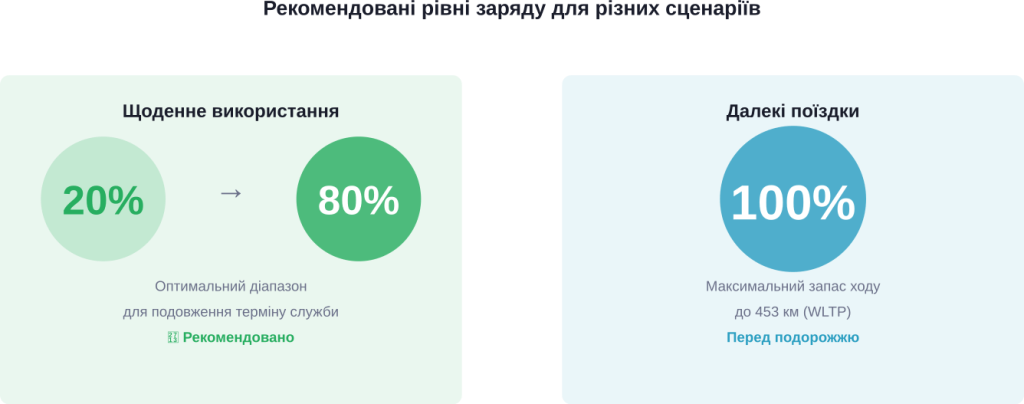
For short journeys — to work, for shopping, around town — set your target charge level to 80 per cent. This extends the battery’s service life and prevents degradation.
You shouldn’t let the e-tron’s battery level drop below 20% unless necessary. Deep discharges put strain on lithium-ion cells.
As Audi states: ‘High-voltage batteries are designed to last for the vehicle’s entire service life, but normal ageing processes reduce their capacity over time.’ Maintaining a charge level within the optimal range of 20–80 per cent minimises these processes.
100% charge before long journeys
Before setting off on a long journey, Audi recommends setting the target value to 100%. This will provide the maximum range — up to 453 km for the Q8 e-tron 50.
However, you shouldn’t do this regularly — a full charge puts more strain on the battery.
Usage: charging timer
The timer function in the myAudi system allows you to schedule the start of charging for a specific time. This is useful for:
- Overnight charging at a discounted rate.
- When the cabin is pre-conditioned, the climate control system can run on mains power, thereby saving battery charge.
Set the timer via the app, and the e-tron will start charging at 23:00, when the night-time tariff applies.
Protection against low temperatures
In winter, the battery is less efficient. The Audi e-tron has a battery heating system, but there are things you can do to help:
- Park your car in a warm garage, if possible.
- Use the cabin pre-conditioning function whilst charging — this will warm up the battery from the mains.
- Charge it more often, but for shorter periods — this keeps the battery within its optimal temperature range.
Practical tips for Audi e-tron owners
A few practical tips based on users’ experiences:
- Always have a plan B: before you set off, check a few stations along your route — not all of them run reliably, especially in the regions.
- Carry adaptors with you: although the e-tron is compatible with most charging stations, a Type 2 adaptor can sometimes come in handy in rare situations.
- Aim to charge to 70–80 per cent: don’t wait for a full 100 per cent at fast-charging stations — the last 20 per cent takes twice as long to charge and blocks the station for other drivers.
- Use recovery mode: the e-tron has three energy recovery modes for braking. The most aggressive mode can recover up to 25 per cent of energy during city driving.
- Keep an eye on the price: prices at public charging points can vary by a factor of 2–3. Apps show the prices — choose the best value options.
- Install a home Wallbox: if you have a private garage, the home station will pay for itself in 1–2 years thanks to the savings on public charging.
Warranty and battery maintenance
Audi provides a warranty for the e-tron’s high-voltage battery covering 8 years or 160,000 km of mileage.
The warranty covers instances where the battery capacity falls below 70 per cent of its rated capacity during the warranty period (corresponding to a loss of 30 per cent or more). Should this occur, Audi will replace or repair the battery free of charge.
However, this applies only if the operating instructions are followed. If you consistently charge the battery to 100% and discharge it to 0%, the warranty will not cover natural wear and tear.
Regular inspections at official Audi service centres include battery diagnostics. The monitoring system constantly tracks the condition of the battery cells and alerts you to any potential problems.
Conclusion
The Audi e-tron is an electric crossover that integrates seamlessly into Ukraine’s infrastructure. Type 2 and CCS Combo 2 connectors are compatible with the vast majority of charging stations, and charging power of up to 150 kW allows the battery to be charged to 80 per cent in half an hour.
For everyday use, install an 11 kW home Wallbox – it will pay for itself within a year and offer maximum convenience. Keep the charge level between 20% and 80% to extend the battery’s lifespan, and charge to 100% before long journeys.
The network of public charging stations in Ukraine is expanding rapidly — the main routes are covered by stations spaced 50–100 km apart.
The actual running costs of the e-tron are 5–6 times lower than those of a petrol-powered equivalent when charged at home. Even when taking public fast-charging stations into account, the savings amount to 40–60 per cent.
Ready to make the switch to electric? The Audi e-tron proves that this isn’t a compromise, but a step forward in terms of comfort, technology and economy.
Start by installing a home charging station and downloading an app to find public charging points — this will make your journey into the world of electric cars as comfortable as possible.
Frequently Asked Questions
Can you charge an Audi e-tron from a standard 220V socket?
Yes, you can use the portable charging device that comes with the car. But it’s very slow — it takes up to 40 hours to fully charge. A standard mains socket only provides 2–3 kW, so this method is only suitable for emergency top-ups or if the car is parked for several days.
How much does it cost to install a home Wallbox?
The cost of the 11 kW charging station itself ranges from 15,000 to 40,000 UAH, depending on the manufacturer and supplier. Installation and connection cost a further 5,000–15,000 UAH, depending on the complexity of the electrical system in the garage (according to Ukrainian Audi dealers and specialist service centres). In total, expect to pay between 20,000 and 55,000 UAH for a turnkey solution.
Does temperature affect the speed of the e-tron?
Yes, significantly. At temperatures below 0°C, charging rates can drop by 30–50 per cent, particularly at the start of the process. The system automatically heats the battery to the optimum temperature, but this takes time and energy. In summer, at temperatures above +35°C, the charging rate may also be limited to protect the battery from overheating.
What is the actual cost of driving 100 km in an e-tron?
When charging at home using the night-time tariff of 1.5 UAH/kWh and with an average consumption of 20–25 kWh/100 km, the cost is around 30–37 UAH. At the standard daytime rate of 4.5 UAH, this works out at 90–112 UAH. At public fast-charging stations, at 15 UAH/kWh, the cost is around 300–375 UAH. By way of comparison, a similar petrol-powered crossover would cost 550–660 UAH per 100 km.
Can you charge the e-tron in the rain or snow?
Yes, the charging system is fully waterproof to IP44 standard (some stations are IP54). The connectors are protected against moisture, and the electronics automatically check for leaks before charging begins. However, avoid charging during a thunderstorm — although the risk is minimal, it’s better to be safe than sorry.
What should I do if the station isn’t working?
First, check the status in the app — the station may be undergoing maintenance. Try restarting your session via the app or scan the QR code again. If that doesn’t work, call the operator’s helpline (the number is usually displayed at the stations). Always have a backup option — a second station within a 10–20 km radius.
Does the battery deteriorate as a result of frequent rapid charging?
Technically, yes, but the impact isn’t significant with moderate use. If you use fast charging 1–2 times a week, the additional battery degradation will be minimal — around 2–3% over 5 years. However, if you charge exclusively at fast-charging stations every day, the battery will age 10–15 per cent faster. The optimal approach is 80 per cent home charging and 20 per cent fast charging for journeys.