

Table of contents:
Installing an EV charging station is only the beginning. Over the next several years, charging infrastructure may need to support new communication standards, stricter cybersecurity rules, different payment requirements, smart energy features, and software updates that do not even exist yet.
That is why businesses are paying more attention to stranded assets. In EV charging, a charger does not have to stop working to lose its value. It can become difficult to maintain, incompatible with new requirements, or expensive to upgrade. In some cases, the hardware is still in place, but the software, support, or compliance needed to keep it operating is no longer available.
This article explains what stranded assets mean in EV charging, why regulation changes increase the risk, and what businesses should consider today to build charging infrastructure that remains useful, compliant, and ready for the years ahead.
We remind you that you can purchase home and commercial charging stations in our store, as well as use public charging stations ECOFACTOR located throughout Ukraine. For convenient access to charging infrastructure, we recommend using our mobile app, available on iOS and Android.
What Makes an EV Charging Asset “Stranded”?
When businesses invest in EV charging, they usually think about power output, installation costs, and expected demand. Those are all important, but they are only part of the picture. Charging infrastructure is expected to remain in operation for many years, and during that time the industry around it keeps changing.
A stranded asset is infrastructure that loses its practical or economic value before reaching the end of its physical lifespan. In EV charging, a station can become stranded even if it still charges vehicles. The problem is that it may no longer support current standards, receive software updates, integrate with modern platforms, or meet regulatory requirements. Keeping it in service becomes increasingly difficult or too expensive to justify.
This is different from normal equipment aging. Every charger eventually needs maintenance, replacement parts, or repairs. Those costs are expected. Stranding happens because the market moves forward while the infrastructure cannot. In other words, the charger does not wear out first. It falls behind.
That distinction is becoming increasingly important. Public charging is no longer viewed as a standalone electrical installation. It is part of a connected ecosystem that includes vehicles, payment services, cloud platforms, energy management systems, and regulatory frameworks. If one part of that ecosystem changes and the charger cannot adapt, the value of the original investment starts to decline.
Why Regulation Changes Matter More Than Ever
A few years ago, installing an EV charger was largely a technical project. Today it is equally a compliance project. European regulations are expanding beyond electrical safety and increasingly cover how charging infrastructure operates throughout its lifetime.
Some of the main areas affected include AFIR, which sets requirements for easier payment methods, transparent pricing, better availability data, and greater interoperability across public charging networks. While not every requirement applies directly in Ukraine today, European standards increasingly influence the equipment available on the market. Cybersecurity is also becoming essential, as charging stations communicate with vehicles, backend platforms, mobile apps, payment providers, and energy management systems. Data sharing expectations are growing, with drivers expecting accurate information about charger availability, connector types, pricing, and station status. Finally, ongoing compliance is no longer a one-time task completed during installation — charging infrastructure must continue adapting as standards, legislation, and industry requirements evolve.
Businesses that invest in equipment capable of receiving updates and supporting new requirements are generally better prepared for future changes than those relying on fixed functionality.
Future Standards Start With Today’s Hardware
Most charging stations remain in service for ten years or longer. Communication standards, software platforms, and digital services evolve much faster. This creates a practical challenge: a charger purchased today should still work with the vehicles, platforms, and operating requirements that appear several years from now.
| Technology change | Why it matters for long-term value |
|---|---|
| OCPP evolution | Newer OCPP versions support stronger security, better device management, and more advanced smart charging. Chargers limited to older functionality may become harder to connect to modern CPMS platforms. |
| ISO 15118 | This standard enables secure communication between the vehicle and charger, including Plug & Charge. Adoption is still developing, but compatible infrastructure is better prepared for future driver expectations. |
| Smart charging | Charging can respond to electricity prices, building demand, solar generation, battery storage, and local grid capacity instead of always running at maximum power. |
| V2G readiness | Vehicle-to-Grid is still emerging, but it points to a future where EVs interact more actively with the energy system. Modern communication standards make that future easier to support. |
| Software support | Firmware updates help improve compatibility, fix issues, strengthen cybersecurity, and add new functions without replacing hardware. |
A charger that can evolve through software has a much better chance of staying useful throughout its intended lifespan. A charger that stays exactly as it was on installation day is more exposed to early replacement.
Choosing Infrastructure That Can Adapt
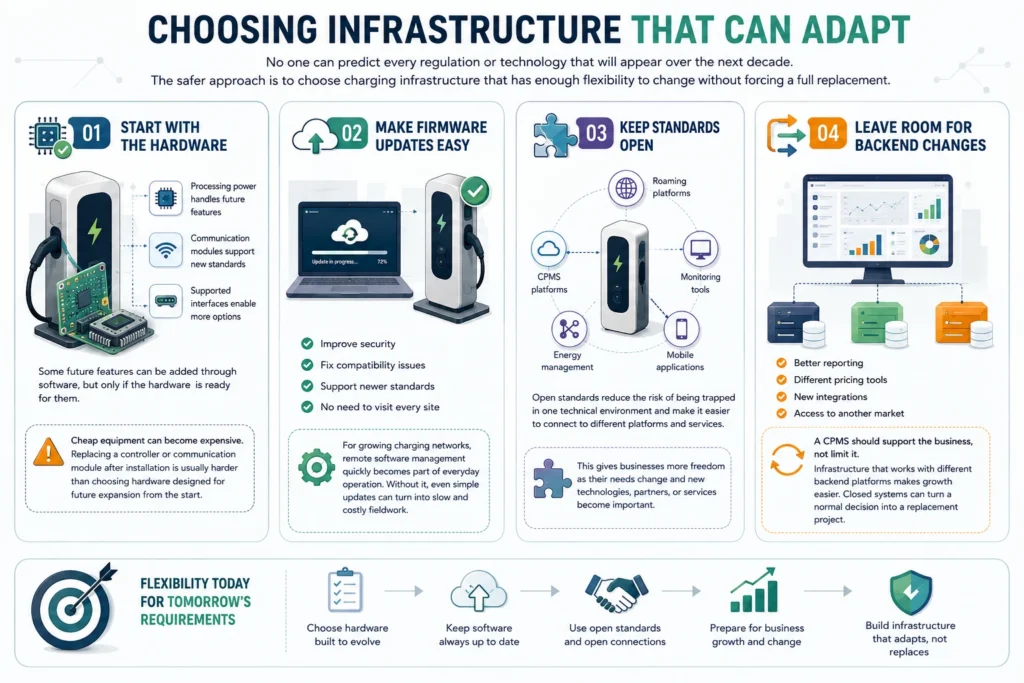
No one can predict every regulation or technology that will appear over the next decade. The safer approach is to choose charging infrastructure that has enough flexibility to change without forcing a full replacement.
Start With the Hardware
Some future features can be added through software, but only if the hardware is ready for them. Processing power, communication modules, and supported interfaces all influence what a charger can handle later. This is where cheap equipment can become expensive. Replacing a controller or communication module after installation is usually harder than choosing hardware designed for future expansion from the start.
Make Firmware Updates Easy
Firmware updates are not a small technical detail. They help operators improve security, fix compatibility issues, and support newer standards without sending technicians to every site. For growing charging networks, remote software management quickly becomes part of everyday operation. Without it, even simple updates can turn into slow and costly fieldwork.
Keep Standards Open
Open standards reduce the risk of being trapped in one technical environment. Chargers that support widely used communication protocols are easier to connect to different platforms, services, and network tools. This gives businesses more freedom as their needs change. A site owner may start with a small charging setup today and later add roaming, advanced monitoring, smart energy management, or a new CPMS.
Leave Room for Backend Changes
A Charge Point Management System should support the business, not limit it. As operators grow, they may need better reporting, different pricing tools, new integrations, or access to another market. Infrastructure that can work with different backend platforms makes this kind of change more manageable. Equipment tied to one closed software ecosystem can turn a normal business decision into a replacement project.

Build EV Infrastructure That Lasts With ECOFACTOR
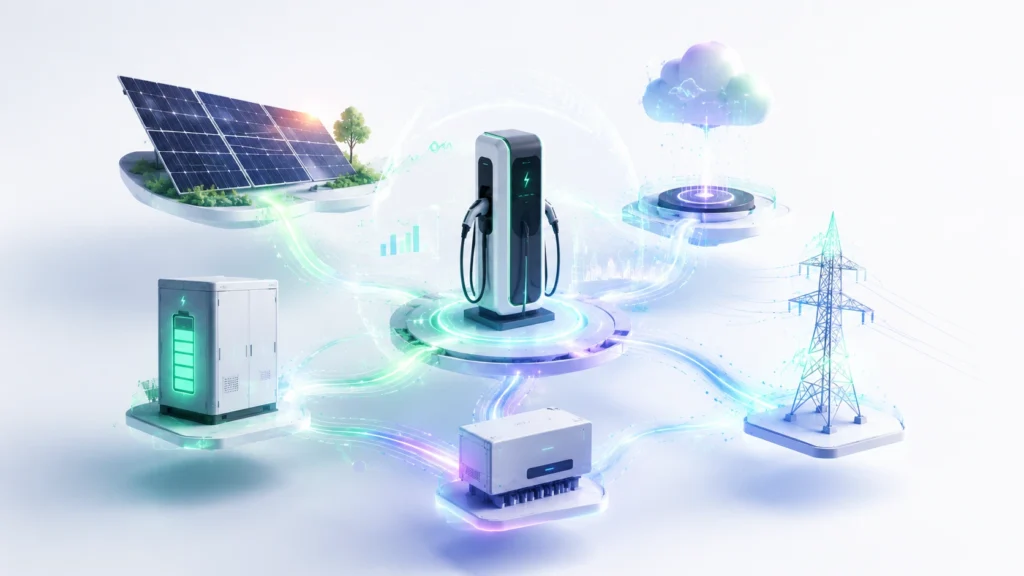
Long-term charging projects should be able to adapt to changing market conditions and future requirements. Alongside charging stations, ECOFACTOR supports EV infrastructure with hybrid inverters, battery systems, and solar panels, while its iOS and Android app and charging station map make charging locations easier to access and manage.
ECOFACTOR can support long-term infrastructure projects with:
- Scalable solutions for future network expansion
- Energy technologies for integrated charging sites
- Equipment for commercial and public deployments
- Cables and accessories for installation and everyday operation
Contact ECOFACTOR to discuss infrastructure solutions that support long-term EV charging projects.
Future-Ready Charging Infrastructure Checklist
Before choosing EV charging equipment, it is worth looking beyond power output, connector type, and purchase price. The charger should be able to stay useful as regulations, vehicles, software platforms, and energy systems continue to change.
A future-ready charging setup should include support for current OCPP versions, ISO 15118 compatibility where needed, remote firmware update capability, integration with open Charge Point Management Systems, smart energy management support, long-term software and security updates, and hardware designed for future software features. These points are not just technical extras. They affect how easily the charging site can be updated, monitored, integrated, and kept compliant over time. Looking beyond the initial specification often leads to lower ownership costs across the full life of the charging site.
Avoiding Vendor Lock-In Before It Becomes a Problem
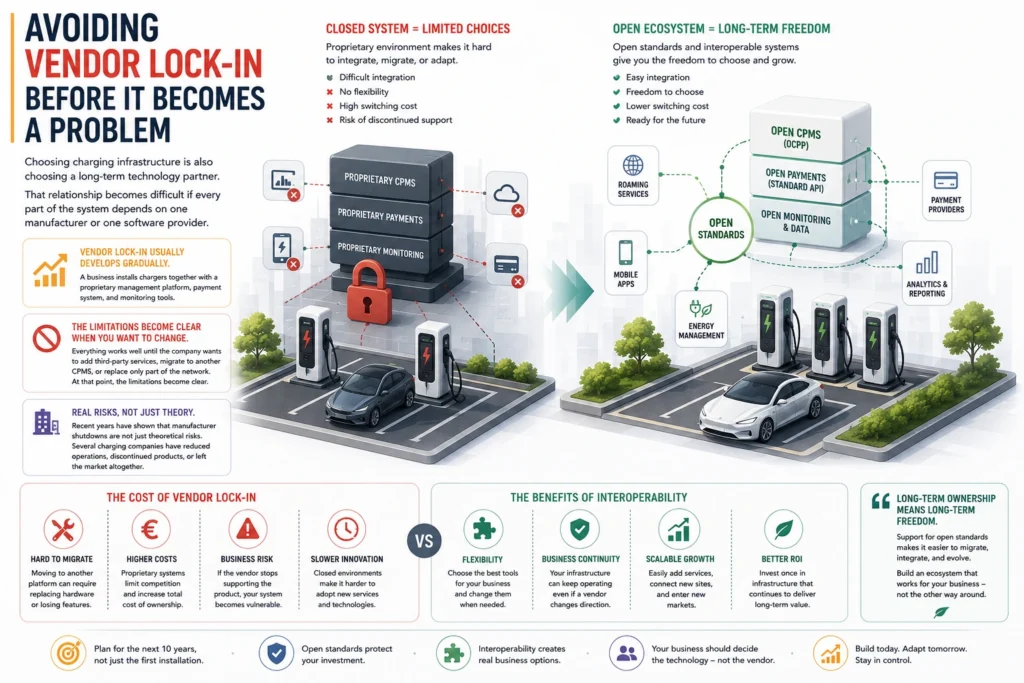
Choosing charging infrastructure is also choosing a long-term technology partner. That relationship becomes difficult if every part of the system depends on one manufacturer or one software provider.
Vendor lock-in usually develops gradually. A business installs chargers together with a proprietary management platform, payment system, and monitoring tools. Everything works well until the company wants to add third-party services, migrate to another CPMS, or replace only part of the network. At that point, the limitations become clear.
Recent years have shown that manufacturer shutdowns are not just theoretical risks. Several charging companies have reduced operations, discontinued products, or left the market altogether. In those situations, operators relying on proprietary systems often have limited options. Even if the chargers remain operational, the lack of software support or firmware updates can shorten their useful life.
Infrastructure built around interoperability offers more flexibility. Support for open standards makes it easier to migrate between software platforms, integrate additional services, and continue operating if one supplier changes its business strategy. Long-term ownership is not only about buying reliable hardware. It is about making sure the entire charging ecosystem can continue evolving without forcing expensive replacement projects.
Planning Charging Infrastructure as a Long-Term Investment
The purchase price of a charging station is only one part of the investment. Installation, operation, maintenance, software support, energy management, and future upgrades all contribute to the total cost of ownership.
Businesses that plan only for today’s requirements often face larger expenses later. Adding new features after installation, replacing unsupported equipment, or rebuilding sites to meet updated regulations usually costs more than preparing for those possibilities from the beginning. For companies in Ukraine, this approach is particularly relevant. The national charging network continues to expand while European technical standards increasingly influence new projects. Infrastructure installed today should not only meet current demand but remain practical as regulations, customer expectations, and energy systems continue evolving.
| Short-term purchasing | Long-term infrastructure planning |
|---|---|
| Focuses mainly on purchase price. | Considers the total cost of ownership. |
| Meets current requirements only. | Prepares for future standards and regulations. |
| Limited software flexibility. | Regular firmware updates and ongoing support. |
| Closed ecosystem. | Open standards and interoperability. |
| Higher risk of early replacement. | Better opportunity to extend the infrastructure’s useful life. |
Planning ahead does not eliminate future changes. It simply makes those changes easier and less expensive to manage.
Frequently Asked Questions
What is a stranded asset in EV charging?
A stranded asset is a charging station that loses business value before the end of its physical lifespan. The hardware may still work, but outdated software, unsupported standards, or changing regulations make it difficult or expensive to keep operating.
Can software updates really extend the life of a charging station?
Yes. Firmware updates can improve cybersecurity, support newer communication standards, fix compatibility issues, and add new features. This allows the same hardware to remain useful for much longer.
Why is interoperability important for avoiding stranded assets?
Interoperability gives operators more flexibility. Chargers that support open standards can work with different management platforms and services, reducing dependence on a single vendor and making future upgrades easier.
Should small charging sites worry about future regulations?
Yes. Even a small installation is likely to operate for many years. Choosing equipment that can adapt through software updates and open standards is often more cost-effective than replacing infrastructure later.
How does AFIR affect charging infrastructure?
AFIR introduces common requirements for public EV charging across the European Union, including payment accessibility, pricing transparency, interoperability, and data sharing. These requirements are already influencing how charging equipment is designed for the wider European market.
Conclusion
Avoiding stranded assets starts long before the first charger is installed. The decisions made during planning, from hardware selection to software compatibility and long-term support, often determine whether charging infrastructure remains valuable for years or requires costly upgrades much sooner than expected.
Regulations, communication standards, and energy systems will continue evolving, and no one can predict every change ahead. What businesses can do is invest in infrastructure that is flexible enough to adapt. Charging stations built with future updates, open standards, and interoperability in mind are better prepared to handle new requirements while keeping ownership costs under control over the long term.