


Table of contents:
The BYD Seagull is exactly the sort of car you can easily picture parked beneath the windows of a prefab block of flats or on the narrow streets of an old neighbourhood. It’s small, cheaper than most hybrids and fully electric. Whereas electric vehicles used to be associated with something premium and out of reach, the Seagull is the opposite: a vehicle that’s as simple and practical as possible for everyday journeys.
This hatchback is already actively driving on the roads of China and the UK, and now it can reach us. Against the backdrop of high fuel prices, unstable tariffs and growing demand for compact cars, Seagull looks more than appropriate. It doesn’t promise cosmic speeds or record range, but it does offer a real opportunity to become part of the electric car community without huge costs.
Format and positioning: who is the BYD Seagull for?
The BYD Seagull isn’t just another electric car for the sake of statistics. It’s clearly designed as a first step into the world of electric motoring for those who haven’t had any experience with it before. It’s ideal for drivers who travel around town every day and don’t plan to go on long journeys on a single charge. And we’re not just talking about young people or ‘tech enthusiasts’ here, but anyone who’s fed up with the constant costs of fuel and maintenance.
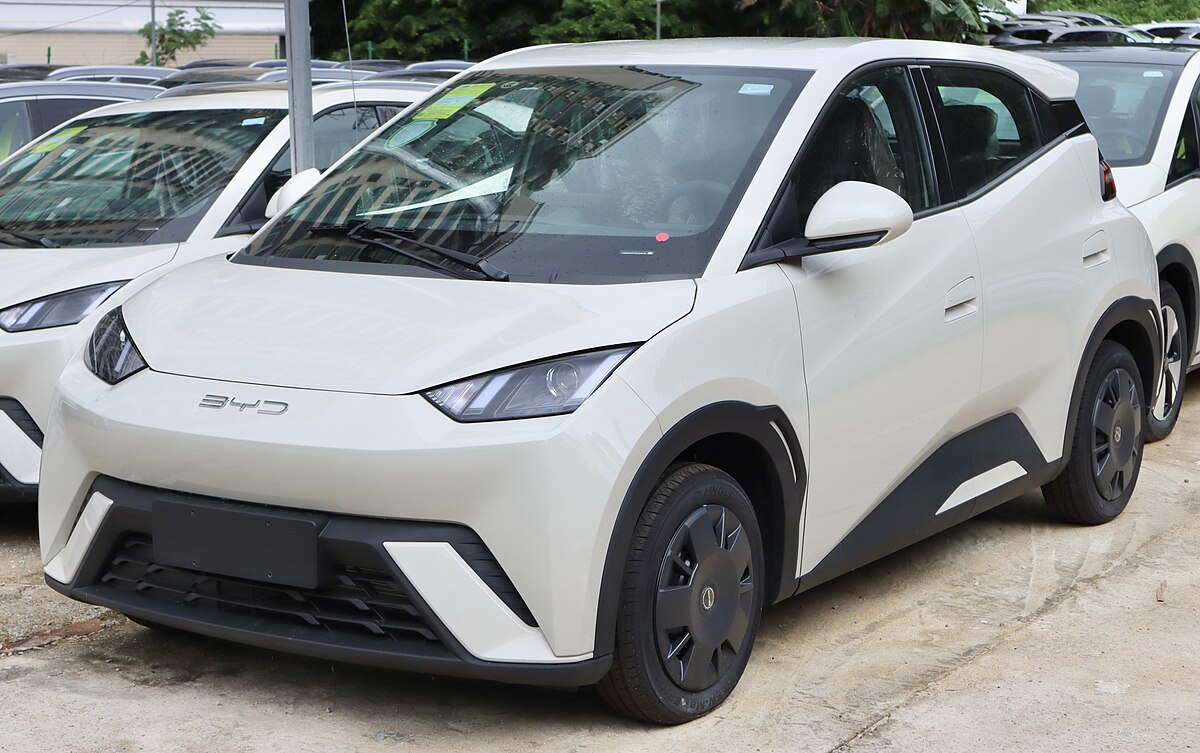
The Seagull is slightly smaller than the Kia Picanto, but has a similar format. It is 3.78 m long, 1.715 m wide and 1.58 m high. It’s ideal for commuting to work, the supermarket, to a child’s club, or just to drive into the city centre and park without nerves. It’s not a station wagon, not an SUV, and definitely not something for status. But that’s exactly what makes it strong – Seagull relies on functionality, not a facade.
Design and dimensions: small but grown-up
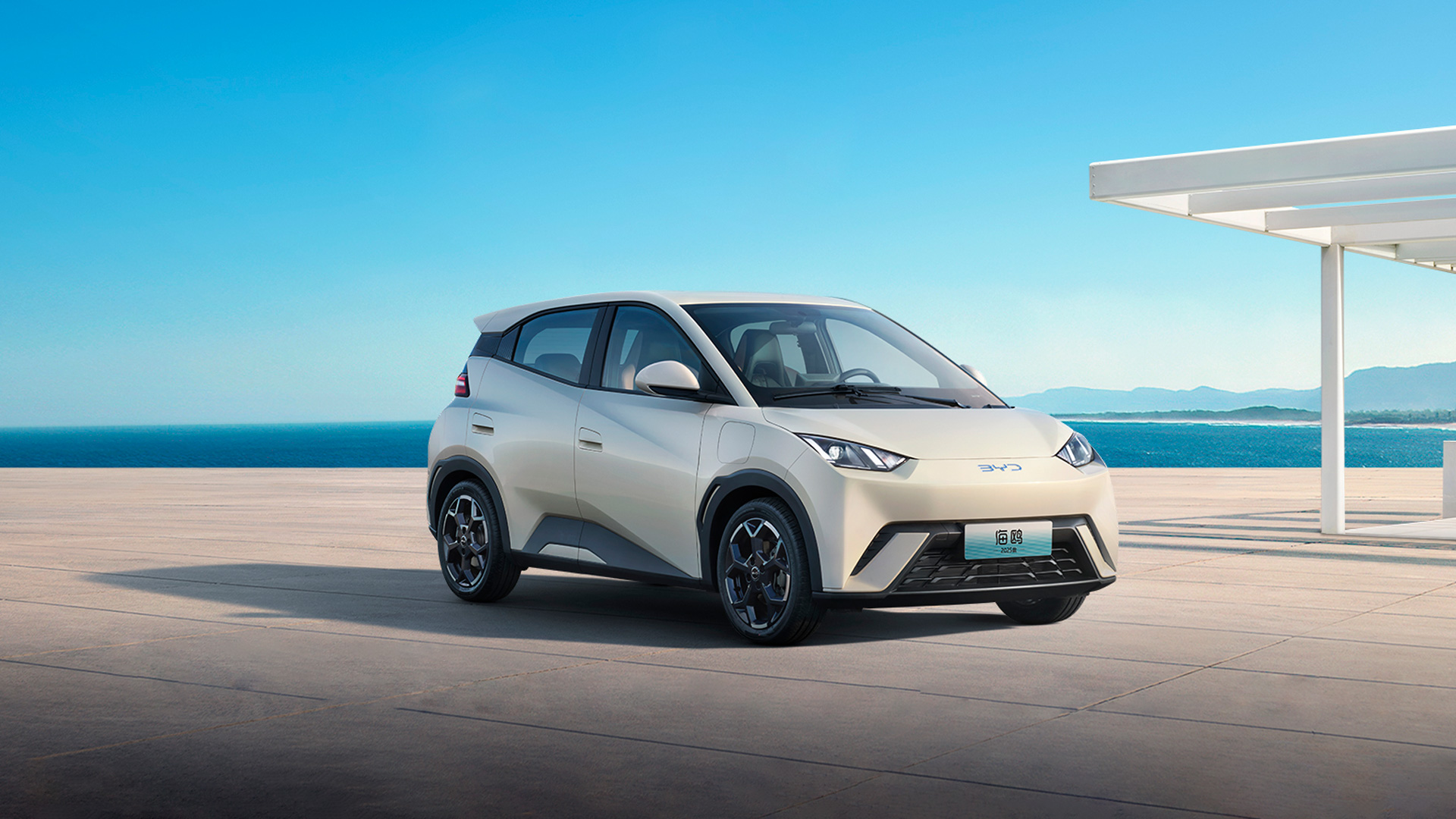
The BYD Seagull does not look cheap. On the contrary, the front optics are sharp, the body lines are clear, and even unusual colours (pink, light green, etc.) look bold and appropriate. Especially in the city, where most cars are monotonous grey.
The cabin feels more spacious than you expect. Even taller drivers can sit comfortably, the visibility is good, and the roof does not put pressure on your head. Visually, the low window line and the dashboard help, as they do not interfere with the view of the road. Rear passengers will be a little more cramped, but there is enough space for two adults. For the fifth person, it will already be cramped, especially for long journeys.
One important detail is that the doors open wide, and the seating is very comfortable – which is rare for cars of this size.
Power, batteries and range: what’s under the hood
All Seagull variants are equipped with a 55 kW (74 hp) front-wheel drive electric motor with 135 Nm of torque. It’s not much, but it’s enough for the city rhythm. Acceleration to 100 km/h takes about 13 seconds. Yes, you won’t be able to fly on the highway, but in the city it’s even too fast.
Batteries available (depending on market):
- 30 kWh LFPup to 305 km of Chinese cycle (CLTC) mileage
- 38.88 kWh Blade Battery: up to 405 km (CLTC)
- 43 kWh (UK specification)Up to 321 km on the European WLTP cycle
The real mileage in mixed mode will be around 250-300 km – and this is very decent for this class. Especially considering that the 90% trips of Ukrainians are 40-50 km a day.
Charging: at home, at night, without panic
Charging speed isn’t the Seagull’s strongest point, but it’s not a failure either. The basic versions support DC charging up to 40 kW, whilst the European variants offer charging up to 65 or even 85 kW. This allows the battery to be charged in about an hour at fast-charging stations.
For most owners, this is the ideal scenario:
- install a 7 or 11 kW Wallbox in a garage or car park
- connect the car at night when electricity is cheaper
- do not wait for the zero level, but recharge every few days
It’s convenient, cheap, and doesn’t require adaptation to the infrastructure at every step. However, you are unlikely to need superchargers.

How ECOFACTOR helps electric car owners in Ukraine
At ECOFACTOR, we are working to make electric mobility in Ukraine an affordable, simple and real part of everyday life. If you are planning to buy a BYD Seagull or already drive an electric car, it is the infrastructure and digital tools that are crucial to how convenient it is to use it.
Our company creates, manufactures and services
In addition to the stations themselves, we have our own network management platform, which is already used by more than 500 operators in 11 countries. It allows you to control charging sessions, tariffs, energy consumption statistics, and even manage the network through the app.
The ECOFACTOR EV Charging mobile app, available on
- find the nearest charging points on map of charging stations
- check their availability in real time
- pay for charging directly from your phone
- receive convenient reports and reminders
In our online store you can order everything you need to connect and use your electric vehicle on a daily basis: cables and adapters, holders, RFID cards, charging units and accessories. We only sell compatible and proven solutions that will not cause any surprises during charging.
For the BYD Seagull, as with any other urban electric car, it is important to have a simple ecosystem at hand: a night charging at home, a reliable public grid in case of need, and a clear digital service. We are creating just such an ecosystem – and developing it every day together with the Ukrainian electric vehicle community.
Interior: a surprise in every detail
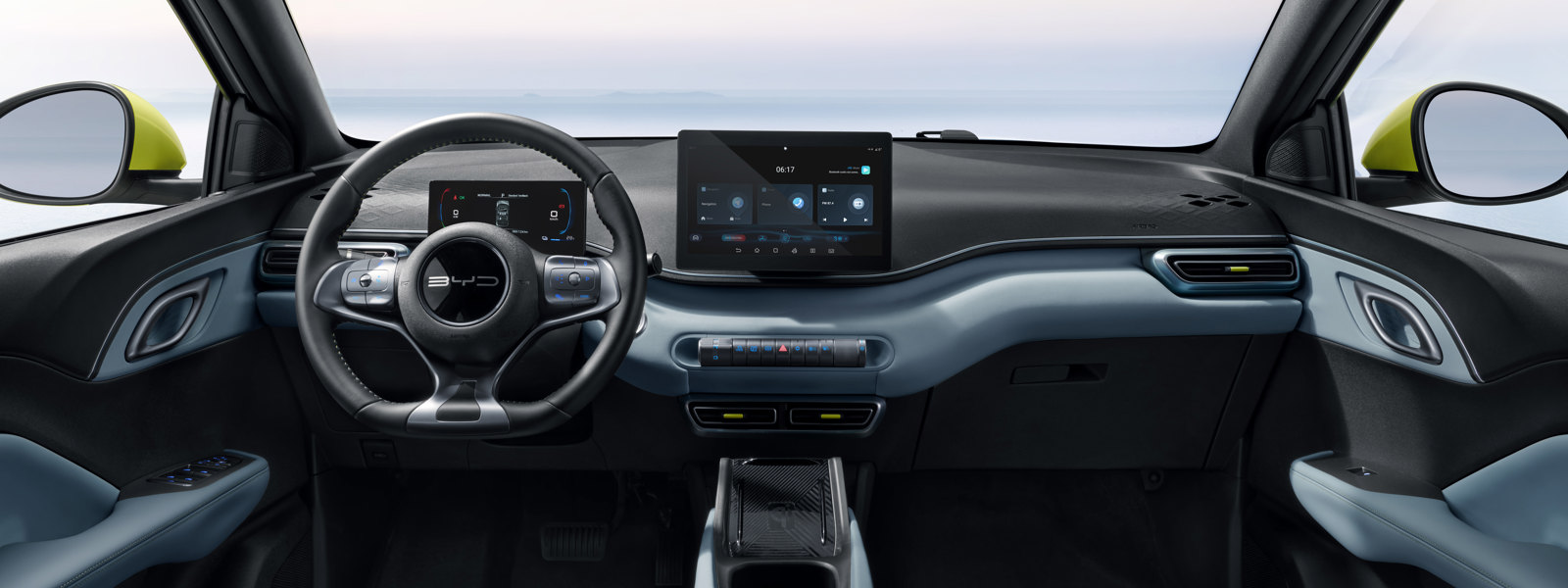
The Seagull’s interior definitely does not look “cheap” or “pared-down”. It has soft plastic trim, pleasant to the touch eco-leather, and a functional arrangement of elements. The central screen, a rotating 10.1-inch display, can change orientation from vertical to horizontal. This is convenient for navigation, video or parking.
Other details:
- Dashboard – a separate 5-inch display
- Wireless charging of your smartphone
- USB-C and 12V connectors
- Voice climate control and multimedia
- Electric driver’s seat (rare in the budget class)
The interior is not full of buttons, but everything is logical – switches, “swings” and a minimum of distractions. Everything looks like someone really thought about the user.
The back is simpler. There’s no air vent, armrest or USB port, but thankfully there are decent seatbelts, electric windows and a bit of space for your things.
Equipment: what can be included in the package
Based on the Chinese and British versions, we can expect the Seagull to have:
- 4 or 6 airbags
- Adaptive cruise control
- Lane-keep assist
- Rear view camera or 360-degree system (in older versions)
- Heated and electrically operated mirrors
- Keyless access
- Electronic parking brake
- Voice commands and integration with Android Auto / Apple CarPlay
Behaviour on the road: not racing, but sharp
The Seagull has surprised reviewers with its handling. Lightweight, docile, with a short turning radius, it is ideal for complex city traffic. It doesn’t fall over in corners, it doesn’t float during manoeuvres, and the steering gives you at least some sense of grip.
The suspension is a little stiff – this is noticeable on Ukrainian potholes and speed bumps. However, thanks to its low centre of gravity and compact dimensions, the car doesn’t feel unstable.
The downside is slow acceleration at speeds above 70 km/h. You really start to feel the power limitations here. In town, it’s fine; on the motorway, be careful and plan your overtaking manoeuvres in advance.
Boot and practicality: more than meets the eye
The standard boot capacity is 230–300 litres. That’s slightly more than some of its internal combustion engine rivals. If you fold down the rear seat backs, you get 930 litres of space. That’s easily enough to fit a TV, a pram and a few supermarket bags.
The car also has the V2L (Vehicle-to-Load) function, which means you can use its battery to power electrical appliances:
- laptop or charging station
- vacuum cleaner or coffee machine in the country
- emergency lighting in the event of a power outage
It’s not a critical feature, but it’s nice and adds flexibility to everyday life.
5. Warranty and service
The Seagull is covered by the standard BYD warranty:
- 6 years or 160,000 km by car
- 8 years or 150,000 km for an electric motor
- 8 years or 160,000 km per battery
Maintenance is minimal: no oil, no belts, no transmissions. Once a year, a technical inspection, and that’s it. This is one of the reasons why electric cars are generally cheaper to own.
Potential for Ukraine: what to consider
At the time of publication, BYD Seagull has not yet been officially confirmed for the Ukrainian market. But everything suggests that it may appear in the near future. Given the popularity of the BYD Dolphin, and the fact that the Seagull has already been adapted for right-hand drive in the UK, there is technically nothing to stop it from being brought to Ukraine.
Potential advantages for our market:
- The price ranges from 25,000 to 30,000 dollars
- Minimal charging costs
- No need for maintenance
- Perfect for the urban lifestyle
Pros and cons: short and sweet
BYD Seagull has a lot of advantages, and they make this electric car an interesting option for urban use. Firstly, its price: compared to other electric vehicles, it looks very attractive, especially for those who could not afford to switch to electric traction before. Secondly, the range is more than enough for daily trips around the city. Thirdly, despite its budget status, the interior looks modern and is equipped with everything you need – from wireless charging to voice control. The dimensions are also worth noting: Seagull feels very comfortable in dense traffic and in car parks. And finally, the electric vehicle’s ease of maintenance allows you to significantly save time and money on service.
However, there were some drawbacks. The car is frankly not designed for the highway – acceleration is slow, and at 70-80 km/h it is already noticeable that it does not “pull” further. On Ukrainian roads, the stiff suspension makes itself felt, especially on pits and bumps. Comfort in the second row is quite basic – passengers lack ventilation, amenities and space. Charging is also not record-breaking fast, so long journeys require planning. Finally, the main issue is that it is not known when and in what form Seagull will appear in Ukraine. But if it does arrive, there will definitely be demand.
Conclusion
The BYD Seagull isn’t about impressions or status. It’s about making an electric car affordable and convenient for everyday use. You wouldn’t call it a one-size-fits-all option for every situation, but it certainly fits in with the realities of city life. Small, simple, electric – and that’s precisely where its value lies. In a world where even hybrids cost a fortune, the Seagull offers an alternative that you won’t be ashamed to park outside your front door.
Yes, it doesn’t pull on the road and doesn’t have a trunk like a crossover. But it is economical, manoeuvrable and low-maintenance. And what’s more, it looks like a normal modern car, not an “experiment on wheels”. If BYD is able to bring the Seagull to the Ukrainian market at a truly competitive price, there is every chance that we will see it in our neighbourhoods in the near future.
Frequently asked questions
Will BYD Seagull be sold in Ukraine?
There is no official confirmation yet, but given the expansion of the BYD line in other countries, there is a high probability that Seagull will appear in our country. If the company finds a partner for local distribution or launches official sales, it could happen in the next year or two.
Is Seagull suitable for trips out of town?
It depends on the route. If we are talking about trips of 50-80 km one way, yes, it will be enough. But for longer distances, especially without a reliable charging infrastructure, it is better to take a car with a longer range or plan stops.
How much does it cost to charge Seagull at home?
If you charge at night at a reduced rate, a full charge will cost about 80-100 hryvnias, depending on the region and battery capacity. For comparison, this money will cover the same distance as a petrol car costing 600-700 hryvnias.
Is it difficult to maintain?
No, like most electric cars, the Seagull has no oil, gearbox or belts. In fact, you only need to keep an eye on the brakes, suspension and battery cooling. One check-up a year is all you need.