

Table of contents:
Running a few charging stations is fairly simple. You can check their status one by one, handle issues as they come up, and keep everything under control. That changes quickly as your network grows. Add more locations, different charger models, or multiple site owners, and daily operations become much harder to manage.
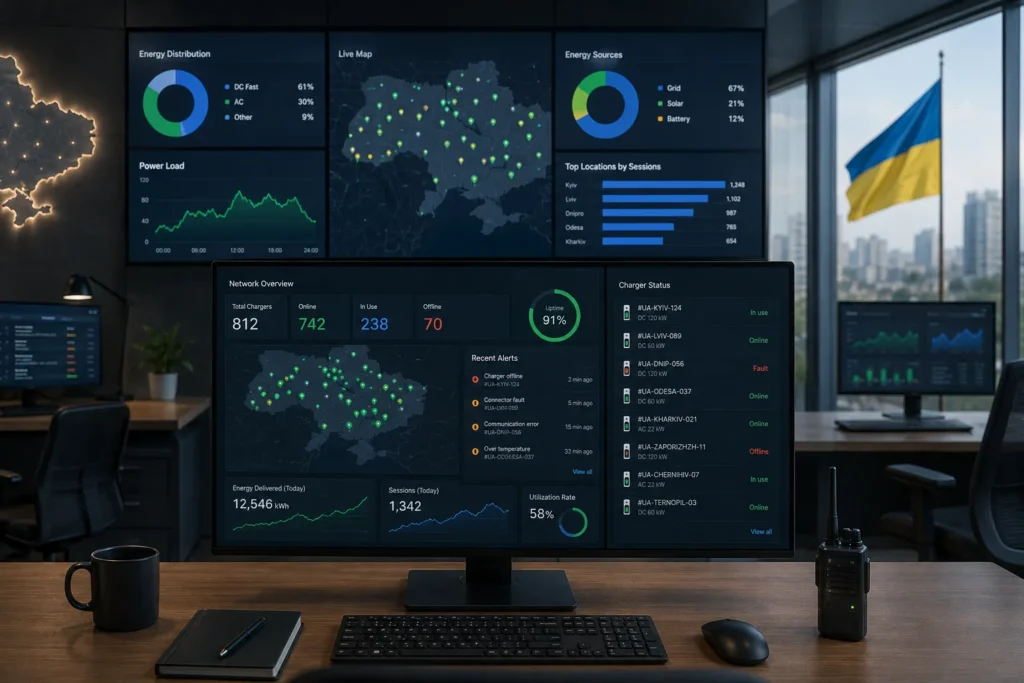
A centralized monitoring platform brings everything together in one place. Instead of switching between systems or waiting for problems to be reported, CPOs can see the health of their entire network from a single dashboard. It makes it easier to spot issues early, keep chargers available, and spend less time on routine management while preparing the network for future growth.
We remind you that you can purchase home and commercial charging stations in our store, as well as use public charging stations ECOFACTOR located throughout Ukraine. For convenient access to charging infrastructure, we recommend using our mobile app, available on iOS and Android.
Why CPOs Outgrow Separate Monitoring Tools
Managing ten charging stations is very different from managing one hundred. With a small network, operators can often rely on the software provided by the charger manufacturer. Checking charger status, restarting a unit remotely, or reviewing charging sessions only takes a few minutes. As the network expands across multiple locations, that approach becomes increasingly difficult to maintain.
A growing CPO may operate chargers from different manufacturers, serve multiple site owners, and support both public and private charging. Each system can have its own interface, reporting tools, and user management. Instead of getting a clear picture of the network, operators spend time switching between platforms and piecing information together.
This is where centralized monitoring becomes essential. Rather than treating every site as a separate project, a centralized monitoring platform connects the entire charging network into one environment. Operators can monitor chargers, review events, investigate issues, and manage daily operations without constantly moving between different systems.
The result is not simply a cleaner dashboard. It is a faster and more consistent way to run a charging business as the network continues to grow.
What Centralized Monitoring Actually Does
At its core, centralized monitoring continuously collects operational data from every connected charging station and displays it in a single interface. The information is updated in real time, giving operators an accurate picture of what is happening across the network without visiting each location or logging into multiple systems.
Most modern platforms communicate with chargers using OCPP, allowing compatible hardware to send operational data to the central management system regardless of the manufacturer. Instead of monitoring chargers one by one, CPOs can oversee the entire network from a single dashboard.
The exact interface depends on the platform, but a well-designed monitoring system usually provides visibility into the information operators use every day.
| Dashboard information | Why it matters |
|---|---|
| Charger availability | See immediately which chargers are available, occupied, or offline. |
| Active charging sessions | Monitor charging activity across every location. |
| Faults and alarms | Detecting technical issues before they affect more drivers. |
| Communication status | Identify chargers that have lost connection with the backend. |
| Energy consumption | Track power usage across sites and identify demand patterns. |
| Firmware status | Confirm that chargers are running the latest approved software version. |
| Event history | Review previous faults and operational events to simplify troubleshooting. |
Bringing all of this information together allows operators to understand the health of the entire network in seconds instead of spending valuable time collecting data from different sources.
How Centralized Monitoring Improves Daily Operations
A monitoring platform does much more than display charger status. It becomes the place where daily operational decisions are made.
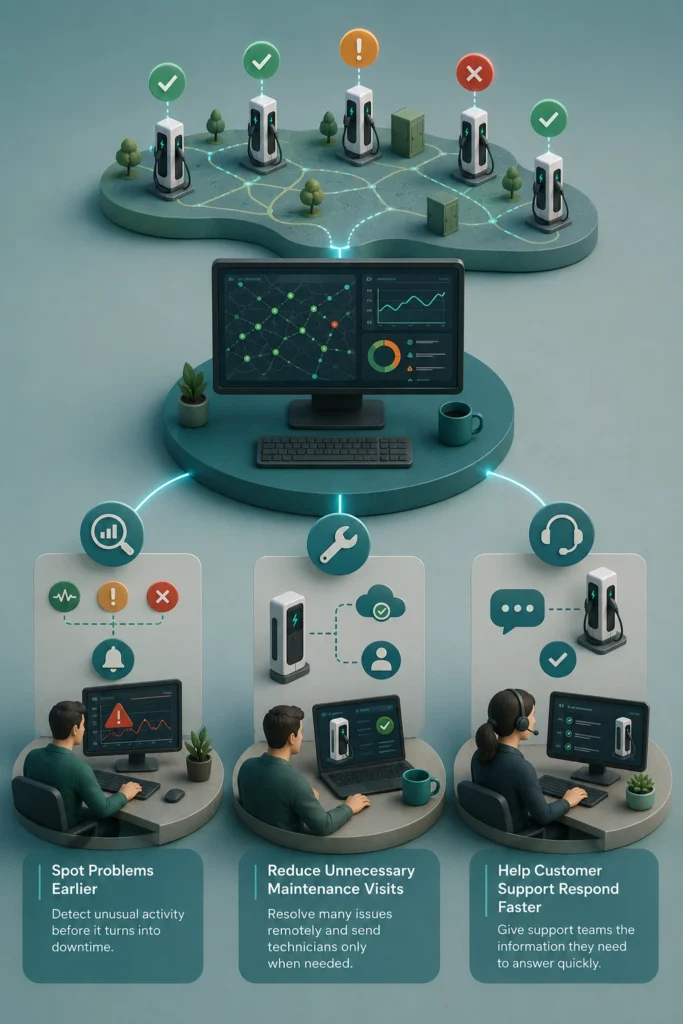
Instead of reacting whenever a driver reports a problem, operators can identify unusual activity as it happens. A charger that repeatedly loses connection, generates frequent errors, or suddenly stops accepting charging sessions can be investigated before it creates a long queue of support requests.
Spot Problems Earlier
Most technical issues do not appear without warning. Communication interruptions, repeated charging failures, unstable power delivery, or unsuccessful user authentication often leave clear signs before a charger becomes unavailable.
A centralized monitoring system continuously tracks these events and alerts operators when something falls outside normal operation. That gives technical teams time to investigate remotely and decide whether the issue requires a software fix, a configuration change, or an on-site visit.
Reduce Unnecessary Maintenance Visits
Sending technicians to every reported issue is expensive, especially for networks spread across different cities or regions.
Remote diagnostics allow operators to understand what happened before dispatching a service team. In many cases, the problem can be resolved remotely by restarting the charger, updating firmware, correcting configuration settings, or restoring communication with the backend. When a site visit is necessary, technicians arrive with a much clearer understanding of the issue, reducing repair time and avoiding repeat visits.
Help Customer Support Respond Faster
When drivers contact customer support, they expect quick answers. Without centralized monitoring, support teams often have to contact technical staff before they can confirm whether a charger is online or investigate what happened during a charging session.
A shared dashboard gives customer support immediate access to operational information. They can verify charger status, review recent events, and provide accurate updates while the issue is still being investigated. That shortens response times and improves the overall charging experience without increasing support workload.
Choosing a Monitoring Platform That Can Grow With Your Network
Not every monitoring system offers the same level of flexibility. Some platforms work well for a single hardware brand but become restrictive as networks expand. Others are designed to support mixed infrastructure from the beginning.
Before choosing a platform, it is worth looking beyond the dashboard itself.
Hardware Compatibility
Many CPOs gradually build networks using equipment from different manufacturers. A monitoring platform should support this reality rather than forcing operators into one hardware ecosystem. Platforms based on open standards such as OCPP make it much easier to integrate compatible chargers from different vendors into one operational environment.
Scalability
The right platform should work just as effectively for twenty chargers as it does for several thousand. Adding new charging stations or locations should not require rebuilding the monitoring system or introducing separate software for different regions.
User Roles and Access
As networks grow, more people become involved in daily operations. Operations managers, customer support teams, technicians, finance departments, and external service partners rarely need access to the same functions. A good monitoring platform allows administrators to assign different permissions, helping each team access the information relevant to its work while protecting sensitive operational data.
Integration With Business Systems
Charging networks rarely operate in isolation. Many CPOs integrate their monitoring platform with billing systems, ERP software, CRM platforms, customer applications, or energy management solutions. Well-documented APIs and flexible integration options reduce manual work and allow operational data to move automatically between systems.
Centralize Charging Network Management With ECOFACTOR
Managing multiple charging locations often requires clear visibility across the network. Alongside charging stations, ECOFACTOR provides energy solutions that include hybrid inverters, battery systems, and solar panels. The company also offers digital tools through its iOS and Android app, while the charging station map helps drivers locate and access charging points.
ECOFACTOR can support charging network management through:
- Tools that simplify access to charging network information
- Infrastructure solutions for multi-site charging projects
- Energy technologies that complement charging operations
- Cables and accessories for installation and ongoing support
Contact ECOFACTOR to discuss solutions for centralized charging network management.
Signs Your Network Has Outgrown Basic Monitoring
Many operators continue using manufacturer software longer than they intended simply because it still works. The challenge is that operational complexity often grows gradually, making it difficult to recognize when a different approach is needed.
Several situations usually indicate that centralized monitoring would make daily operations easier: regularly switching between multiple manufacturer portals, customer support being unable to quickly verify charger status, technicians spending significant time identifying faults before repairs begin, new locations requiring additional software instead of joining the existing system, different departments maintaining separate reports for the same charging network, and expanding the network increasing administrative work faster than charging revenue.
None of these issues necessarily prevent a network from operating. Together, however, they often signal that manual processes are becoming a barrier to further growth.
Monitoring Is Only Valuable When It Leads to Action
A dashboard filled with charts does not improve network performance on its own. The real value comes from turning information into decisions that keep chargers available and operations running smoothly. A modern monitoring platform should help operators act immediately, not simply observe what is happening.
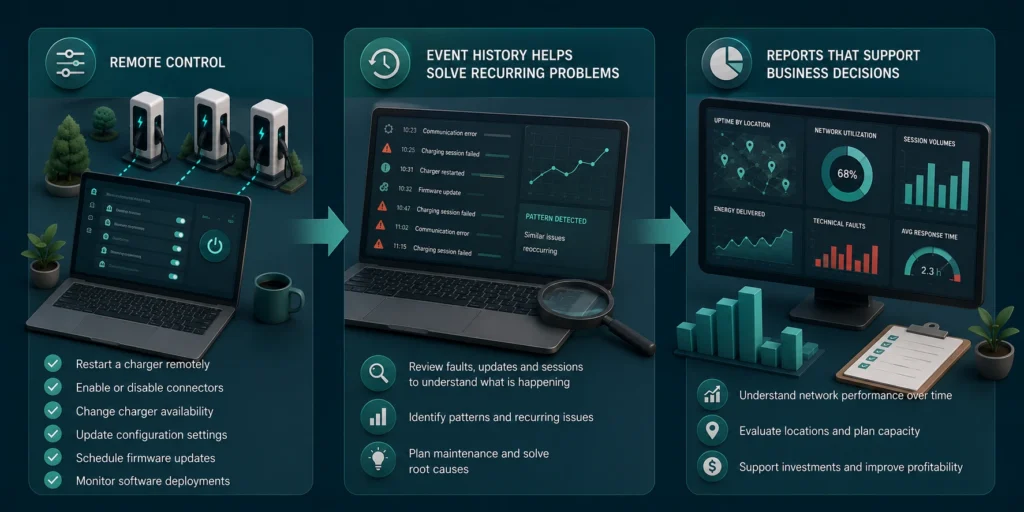
Remote Control
Many operational tasks no longer require someone to visit the site. Depending on the charger and platform, operators can restart a charger remotely, enable or disable connectors, change charger availability, update configuration settings, schedule firmware updates, and monitor the progress of software deployments. Completing these tasks from a central dashboard saves time and helps maintain consistent operations across the network.
Event History Helps Solve Recurring Problems
Some technical issues appear only once. Others return repeatedly over several weeks or months. Keeping a complete event history makes these patterns much easier to identify. Operators can review previous faults, communication interruptions, firmware updates, and charging sessions to understand whether a problem is isolated or part of a larger trend. This information supports smarter maintenance planning and helps avoid repeatedly treating the symptoms instead of addressing the root cause.
Reports That Support Business Decisions
Monitoring platforms collect large amounts of operational data every day. Turning that information into useful reports helps CPOs understand how their network is performing over time. Examples include charger uptime by location, network utilization, session volumes, energy delivered, frequency of technical faults, and average response and resolution times. These reports are valuable not only for daily operations but also for planning investments, evaluating service providers, and identifying locations that may require additional charging capacity.
Centralized Monitoring Becomes More Important as Networks Expand
Every additional charging station increases the amount of information flowing through the network. More chargers mean more charging sessions, more software updates, more users, and more opportunities for technical issues.
Managing that complexity with disconnected tools quickly becomes inefficient. A centralized monitoring platform gives operators one consistent view of the network, whether they manage chargers in a single city or across multiple regions. New sites can be added without changing established workflows, and operational teams continue working within the same environment as the business grows.
For CPOs expanding across Ukraine, where public charging infrastructure continues to develop alongside workplace, retail, residential, and fleet charging projects, this consistency becomes increasingly valuable. Growth is no longer measured only by the number of installed chargers. It depends on how effectively those chargers can be monitored, maintained, and managed every day.
Frequently Asked Questions
What is centralized monitoring for EV charging networks?
Centralized monitoring is a system that lets CPOs oversee all connected charging stations from one dashboard. Instead of checking each charger separately, operators can monitor availability, charging sessions, faults, and network performance across every location in real time.
Is centralized monitoring only useful for large charging networks?
Not necessarily. Even networks with a few dozen chargers can benefit from having one place to manage operations. It becomes especially valuable as new sites, charger models, and service teams are added over time.
Can one monitoring platform manage chargers from different manufacturers?
Yes, if the platform supports open standards such as OCPP. This allows compatible chargers from different vendors to be monitored and managed through the same dashboard, reducing the need for multiple software systems.
Does centralized monitoring reduce maintenance costs?
It can. Remote diagnostics help operators identify many issues before sending technicians to a site. In some cases, problems can be resolved remotely, saving both time and travel costs.
What should CPOs look for when choosing a monitoring platform?
Look for hardware compatibility, OCPP support, real-time monitoring, remote management tools, flexible user permissions, reporting capabilities, and the ability to scale as your charging network grows.
How does centralized monitoring improve the driver experience?
Drivers may never see the monitoring platform itself, but they notice the results. Faster fault detection, higher charger availability, and quicker support all help create a more reliable charging experience.
Final Thoughts
Reliable charging infrastructure depends on more than quality hardware. Once a network reaches a certain size, visibility becomes just as important as the equipment installed on each site.
Centralized monitoring brings chargers, operational data, and management tools into one platform, allowing CPOs to oversee their entire network without relying on multiple systems or manual reporting. From remote diagnostics and faster troubleshooting to performance reporting and long-term planning, one dashboard helps operators spend less time searching for information and more time improving the network itself.
As EV adoption continues to grow, charging businesses that build scalable operational processes today will be better prepared for tomorrow’s expansion. A centralized monitoring system is not simply another piece of software. It becomes the operational foundation that keeps an entire charging network connected, efficient, and ready to grow.