


Table of contents:
Harley-Davidson has achieved what many thought impossible — it has created an electric motorbike that combines the legendary brand with futuristic technology. When the company unveiled the LiveWire in 2019, the world of motorbikes changed forever.
This isn’t just an electric bike with a Harley logo. It’s a powerful machine that’s rewriting the rules on speed and acceleration.
But what is the actual top speed of the electric Harley-Davidson? Can it compete with traditional sports bikes?
We remind you that you can purchase home and commercial charging stations in our online storeand also use the public charging stations ECOFACTORcharging points located throughout Ukraine. For convenient access to charging infrastructure, we recommend using our mobile applicationwhich is available on iOS and Android.
Features. LiveWire’s Speed: Impressive Figures
According to official Harley-Davidson figures, the original 2020 LiveWire has a top speed that is often quoted as being around 177 km/h, although this figure is not confirmed in the official service documentation. But the real magic lies in its acceleration.
According to the official Harley-Davidson website, the LiveWire accelerates from 0 to 60 mph in 3 seconds (which is roughly equivalent to 0–97 km/h). These are figures typically seen in supersport motorbikes.
Why is it so fast? An electric motor delivers torque instantly. There’s no need to wait for the motor to build up speed. Turn the throttle — and all the power is available straight away.
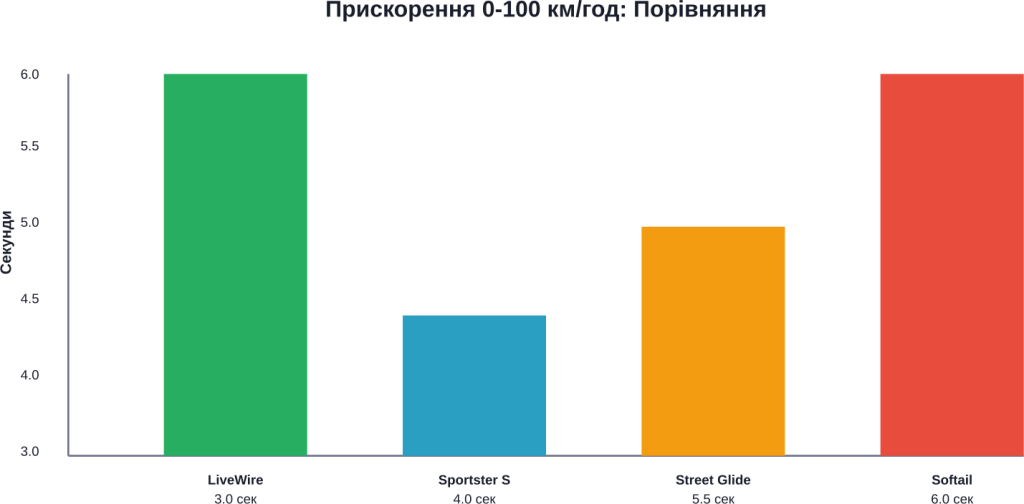
Acceleration Comparison: LiveWire vs Traditional Harley-Davidsons
| Model. | 0–100 km/h | Max. Speed | Engine type |
|---|---|---|---|
| LiveWire (2020) | 3.0 sec | 177 km/h | Electric range |
| Sportster S (2026) | ~4.0 sec | ~200 km/h | Revolution Max 1250 |
| Street Glide | ~5.5 sec | ~180 km/h | Milwaukee-Eight 114 |
| Softail Standard | ~6.0 sec | ~170 km/h | Milwaukee-Eight 107 |
The LiveWire leaves most classic Harleys in its wake when it comes to acceleration. Only the new models based on the Revolution Max platform can compete.
Evolution: From LiveWire to the S2 Del Mar and S2 Alpinista
This is where things get interesting. In 2022, Harley-Davidson spun off LiveWire into a separate brand. It is now LiveWire, Inc. — a standalone company focusing exclusively on electric motorbikes.
The newer S2 Del Mar and S2 Alpinista models have been launched in recent years, although the exact release dates are not specified in the official documentation. According to an academic review by Crown Education, these motorbikes offer similar speed performance to the original LiveWire, but with improvements in battery technology.
The S2 Del Mar is designed for urban riding and coastal trips. The S2 Alpinista, as stated on the official Harley-Davidson website, is designed for customisation and all-round use — from city streets to country roads.
Technical Features: S2 Models
According to the official service documentation, the LiveWire ONE (LW1) model has the following specifications:
- Kerb weight: 255 kg (562 pounds)
- Maximum additional weight: 181 kg (400 lbs)
- GVWR (gross vehicle weight rating): 436 kg (962 lbs)
- Tyres: Michelin Scorcher Sport – front 120/70 ZR17, rear 180/55 ZR17
But wait. Michelin Scorcher Sport tyres aren’t just a random choice. They’ve been specially designed for high speeds and dynamic handling.
Range and Charging Time: A Trade-off with Speed?
Speed is all well and good, but what about practicality? According to official figures, the original 2020 LiveWire offers a range of around 146 miles (235 km) in the urban cycle.
On the track, range decreases at high speeds — this is to be expected with any electric vehicle. When driving aggressively at speeds of around 150–170 km/h, you can expect a range of approximately 100–120 km.
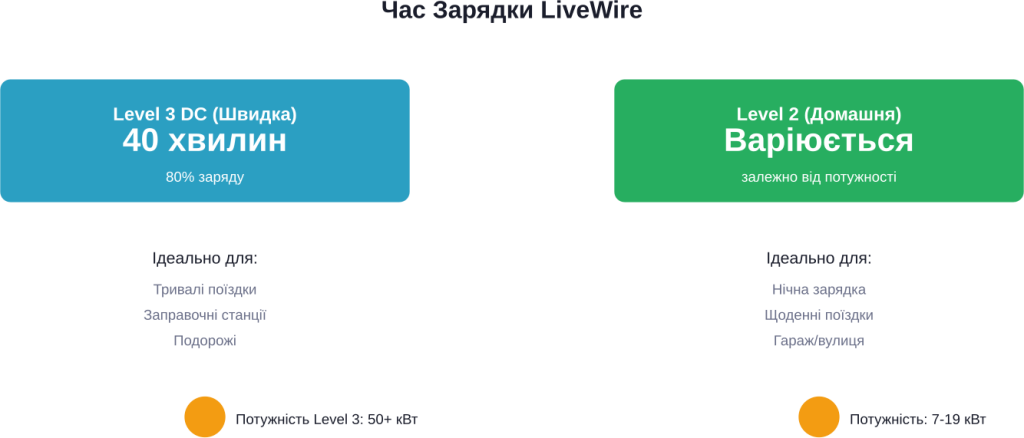
Charging time? Using Level 3 DC fast charging, you can reach an 80 per cent charge in around 40 minutes. For home charging (Level 2), the built-in charger is used; charging times vary depending on the power output of the charging station.
Real Experiences: What Users Say
According to discussions within the community, LiveWire owners highlight several key points regarding speed and handling:
- Firstly, the acceleration is truly impressive. The instantaneous throttle response creates a sensation that no petrol motorbike can match. No lag, no gear changes — just pure power.
- Secondly, the top speed of 177 km/h may seem limited compared to modern sports bikes, which can reach speeds of 250–300 km/h. But for most real-world situations, this is more than enough.
- Thirdly, handling at high speeds. Thanks to its low centre of gravity (the battery is located at the bottom), the LiveWire is exceptionally stable when cornering.
Comparison with Competitors
| Model. | Max. Speed | 0–100 km/h | Range | Price (USD) |
|---|---|---|---|---|
| Harley LiveWire | 177 km/h | 3.0 sec | 235 km | $21,999+ |
| Zero SR/F | 200 km/h | 3.3 sec | 320 km | $19,995+ |
| Energica Ego | 240 km/h | 3.0 sec | 400 km | $24,000+ |
| Lightning LS-218 | 351 km/h | 2.2 seconds | 160 km | $38,000+ |
Sound familiar? The LiveWire sits somewhere in the middle — it’s not the fastest, nor does it have the longest range, but it boasts the prestige of the Harley-Davidson brand and the solid backing of its dealer network.
The Technology That Makes It Possible
What exactly enables LiveWire to achieve such performance figures? A few key technologies:
RESS (Rechargeable Energy Storage System) is a high-voltage battery comprising lithium-ion cells. The exact power and torque figures are not specified in the available official documentation.
Longitudinally-mounted electric motor — a motor mounted lengthways, ensuring optimal weight distribution and efficient torque transmission.
Regenerative braking — a system that recovers energy and feeds it back into the battery during deceleration. This not only increases the range but also provides additional control.
Driving Modes and Their Effect on Speed
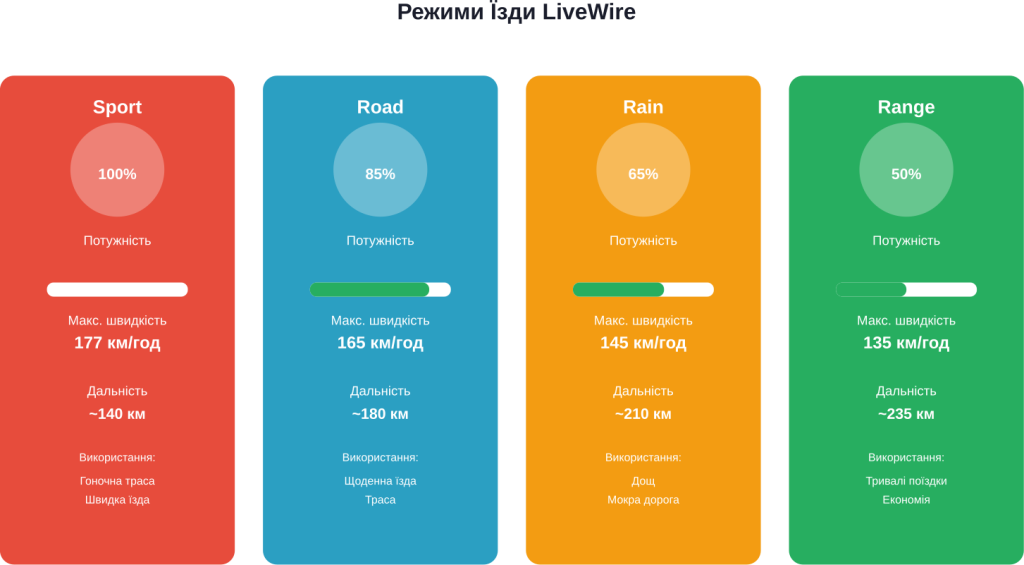
LiveWire offers several riding modes, each of which affects acceleration and top speed in different ways:
- Sport Mode — full power, maximum acceleration, the most aggressive throttle response
- Road Mode — a balanced mode for everyday riding, with a slightly softer response
- Rain Mode — reduced power for safe driving in challenging conditions
- Range Mode — limited power for maximum range
In Sport Mode, you get all the power available. In Range Mode, the top speed may be limited to around 130–140 km/h to save energy.
Ownership Costs: Does Speed Justify the Price?
The official Harley-Davidson website lists second-hand 2020 LiveWire models in a range of price brackets, with specific prices depending on the dealer and the condition of the bike. Newer S2 models cost slightly more.
But is it worth the money? Let’s do the maths:
The cost of electricity varies from region to region, but based on typical rates, a full charge for an electric Harley is significantly cheaper than petrol.
Compare that with a petrol-powered Harley, which uses 5–6 litres per 100 km, and you’ll see why so many owners are switching to electric.
Advantages. and Disadvantages. LiveWire
| Advantages. | Disadvantages. |
|---|---|
| Acceleration from 0 to 100 in 3 seconds | Limited range compared to petrol |
| Low running costs | Charging time is longer than refuelling |
| Minimal maintenance | Higher initial cost |
| Instant torque | Lacks the classic Harley sound |
| The Harley-Davidson brand | Limited charging infrastructure |
| Modern technologies | Resale price not yet known |
The Future of Electric Harleys: What’s Next?
Harley-Davidson continues to expand its electric range. The official website mentions the 2026 Sport range, based on the Revolution Max platform, with updated features.
But the electric range is also evolving. LiveWire, as a separate brand, is working on new models that promise increased range and improved performance.
Generally speaking, the industry is moving towards faster charging stations, higher-capacity batteries and more affordable prices. Harley-Davidson, with its 120-year history, is striving to remain relevant in this new world.
Charging infrastructure for the electric Harley-Davidson: a key component of top speed
When it comes to the topic ‘Maximum speed of an electric Harley-Davidson: a complete guide’, it is important to understand that a motorbike’s potential depends not only on its technical specifications, but also on how conveniently its charging is organised. To fully realise the electric bike’s performance, the rider needs reliable access to power both at home and whilst on long journeys. That is precisely why the charging infrastructure plays a key role.
ECOFACTOR is developing a network across Ukraine comprising state-of-the-art charging stations for various usage scenarios. AC solutions are available for home charging and installation in offices, as well as fast DC stations for motorways and urban locations. This means that owners of electric Harley-Davidsons need not worry about their range, even when riding actively at high speeds.
A mobile app for iOS and Android has been developed to make it easier to manage the process. It features a map of charging stations showing the current status of charging points, a route-planning function and online payment. This approach allows you to plan your journeys, taking into account speed limits and distances, without any unnecessary stress.
As well as public charging networks, there is an online shop offering chargers for home and business use. Here you can find cables and adaptors, as well as additional equipment for personal charging points. This is particularly useful for those who want to keep their battery charged and ready for dynamic journeys.
The charging infrastructure for the MG Cyberster from ECOFACTOR has set an example of a comprehensive approach to the development of electric transport, and a similar system can effectively support electric motorbikes as well. The combination of charging stations, digital services and equipment forms a unified ecosystem in which the owner of an electric Harley-Davidson enjoys freedom of movement without unnecessary restrictions.
Advice for Prospective Buyers
If you’re thinking of buying an electric Harley-Davidson, here are a few tips:
- Assess your range requirements. If your daily journeys are no more than 100–150 km, the LiveWire is ideal. For longer journeys, you’ll need to plan stops for charging.
- Check the availability of charging stations. The infrastructure is better developed in large cities. In rural areas, it can be more difficult.
- Experience the acceleration. Be sure to book a test ride. The instant acceleration of an electric motorbike is something you really need to experience for yourself.
- Take a look at the second-hand options. The official Harley-Davidson website features second-hand 2020 LiveWire models, often with low mileage and at significantly lower prices.
- Bear in mind the cost of installing a home charging point. Installing a Level 2 charging point at home can cost between $500 and $1,500, depending on your existing electrical system.
Conclusion: The Speed Revolution from Harley-Davidson
The top speed of the electric Harley-Davidson LiveWire is around 177 km/h — that’s not a world record for motorbikes. But the real magic isn’t in the top speed.
The real magic lies in accelerating from 0 to 60 mph in 3 seconds. In the instantaneous throttle response. In the low centre of gravity and phenomenal handling. In the absence of vibrations and noise, allowing you to experience the pure adrenaline rush of speed.
Harley-Davidson has proven that electric motorbikes can be fast, exhilarating and true Harleys. This isn’t just an eco-friendly alternative — it’s a whole new way to experience the freedom of the open road.
To check the latest prices, specifications and availability of models, visit the official Harley-Davidson website or contact your local dealer. Technology is advancing rapidly, and new models are released regularly.
Ready to experience the future of motorcycling? Book a LiveWire test ride today and discover what electric speed from this legendary brand is all about.
Frequently Asked Questions (FAQ)
What is the top speed of the Harley-Davidson LiveWire?
According to official figures, the Harley-Davidson LiveWire has a top speed that is often quoted as being around 177 km/h, although this figure is not confirmed in the official service documentation. This provides sufficient speed for most road conditions, although some competitors offer higher top speeds.
How quickly does the LiveWire accelerate from 0 to 100 km/h?
The LiveWire accelerates from 0 to 60 mph (equivalent to approximately 0–97 km/h) in just 3 seconds, thanks to the instant torque of its electric motor. This makes it one of the fastest accelerating motorbikes in the entire Harley-Davidson range.
What is the LiveWire’s actual range?
According to official figures, the LiveWire offers a range of around 146 miles (235 km) in the urban cycle. On the track at high speeds, the range decreases to approximately 100–140 km, depending on riding style and conditions. Range Mode helps to maximise the range.
How long does it take to charge the LiveWire?
Using Level 3 DC fast charging, you can reach 80% charge in around 40 minutes. Level 2 home charging (7–19 kW) uses the built-in charger; charging times vary depending on the power output of the charging station.
Is the LiveWire faster than traditional Harley-Davidsons?
When it comes to acceleration — yes. The LiveWire accelerates faster than most traditional Harley models thanks to the electric motor’s instant torque. In terms of top speed, some petrol-powered models, such as the new Sportster S, may have higher figures, but when it comes to acceleration from a standing start, the LiveWire remains the leader.
How much will a Harley-Davidson LiveWire cost in 2026?
The official Harley-Davidson website lists second-hand 2020 LiveWire models in a range of price brackets, with specific prices depending on the dealer and the condition of the bike. For the latest prices on the new S2 Del Mar and S2 Alpinista models, we recommend visiting the official LiveWire website or contacting a dealer, as prices are subject to change.
Can you ride the LiveWire in the rain?
Yes, the LiveWire has a special Rain Mode, which reduces power output to around 65% for safer riding in challenging weather conditions. The motorbike is designed with waterproof electrical components, but as with any motorbike, caution is required on wet roads.
What maintenance is required for an electric Harley?
Electric motorbikes require significantly less maintenance than petrol-powered ones. There is no need to change the oil, spark plugs, air filters or chain (LiveWire uses a belt drive). Routine maintenance includes checking the brakes, tyres, suspension and software.