

Table of contents:
Choosing EV charging hardware is rarely about the purchase price alone. For Charge Point Operators, the bigger question is what the infrastructure will cost to own and operate over the next five, seven, or even ten years. Installation, software, maintenance, energy management, upgrades, and service all shape the final cost of ownership.
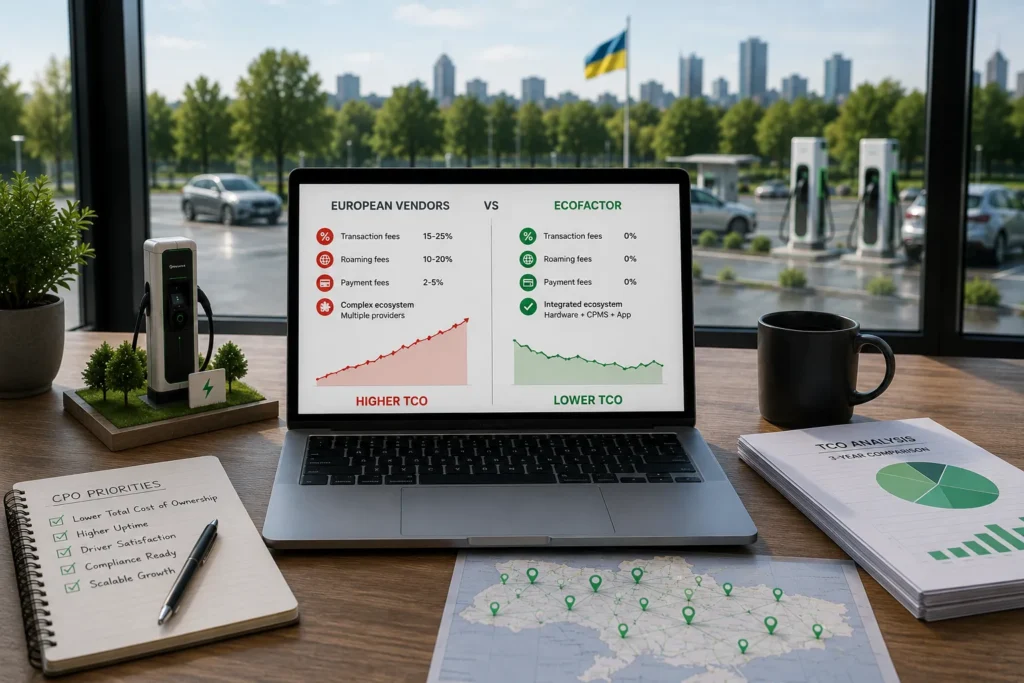
That is why many CPOs now look beyond specifications and compare complete charging ecosystems. European manufacturers have built strong reputations over many years, while newer providers like ECOFACTOR combine hardware, software, and charging management into one integrated solution.
Understanding how these approaches differ can help operators make investment decisions that support reliable growth without creating unnecessary long-term costs.
We remind you that you can purchase home and commercial charging stations in our store, as well as use public charging stations ECOFACTOR located throughout Ukraine. For convenient access to charging infrastructure, we recommend using our mobile app, available on iOS and Android.
What TCO Means for Charge Point Operators
For a Charge Point Operator, the real cost of charging infrastructure does not end when the station is bought and installed. That is only the beginning.
TCO, or total cost of ownership, shows how much a charging network actually costs over its full working life. It includes the charger itself, but it also includes everything that happens around it: installation, software, maintenance, spare parts, support, downtime, payment tools, upgrades, and the time your team spends managing all of it.
This matters because charging infrastructure is not a one-time purchase. A CPO has to keep stations online, make them visible to drivers, manage tariffs, monitor sessions, solve technical issues, and expand the network when demand grows. If these processes are fragmented, the station may look affordable at the start but become expensive to run later.
For Ukrainian operators, this point is especially important. The market is still growing, but expectations are already high. Drivers want working chargers. Site owners want reliable service. Businesses want clear payback. That makes TCO one of the most practical ways to compare different suppliers.
A proper TCO view usually includes charger purchase price, installation and commissioning, grid connection and electrical work, CPMS or charging management software, driver app and payment tools, remote monitoring, support and maintenance, spare parts and repairs, downtime and lost revenue, staff training, future upgrades, and scaling to new locations.
The cheaper charger is not always the cheaper investment. For CPOs, the better question is how easy and predictable the whole system will be to operate after launch.
European Charging Vendors and Their TCO Approach
European charging vendors are often strong on hardware. Many of them have long experience in electrical engineering, energy systems, automotive infrastructure, or public charging networks. Companies such as ABB, Siemens, Webasto, Wallbox, EVBox, EFACEC and others are well known across the European EV market.
Their offerings can include AC chargers, DC fast chargers, ultra-fast charging stations, charging software, load management tools, and equipment for residential, commercial, fleet, workplace, and public locations.
For many CPOs, this is a solid starting point. European vendors usually bring established hardware portfolios, tested engineering standards, different charger formats and power levels, experience in mature EV markets, compatibility with common EV charging protocols, and product options for private and public locations. Still, the buying process can become more layered than it first appears.
A CPO may buy hardware from one vendor, connect it to a separate CPMS, use another company for payment processing, involve a local installer, sign a service agreement with a maintenance partner, and use a different app or roaming solution for drivers.
That model can work well, especially for large operators with strong technical teams. But it also means the CPO has to manage more moving parts. Each extra supplier can add another contract, another support channel, another integration, and another place where something can go wrong.
The hardware may be excellent. The total ownership cost depends on how all the other pieces come together.
The ECOFACTOR Model for Charging Operators
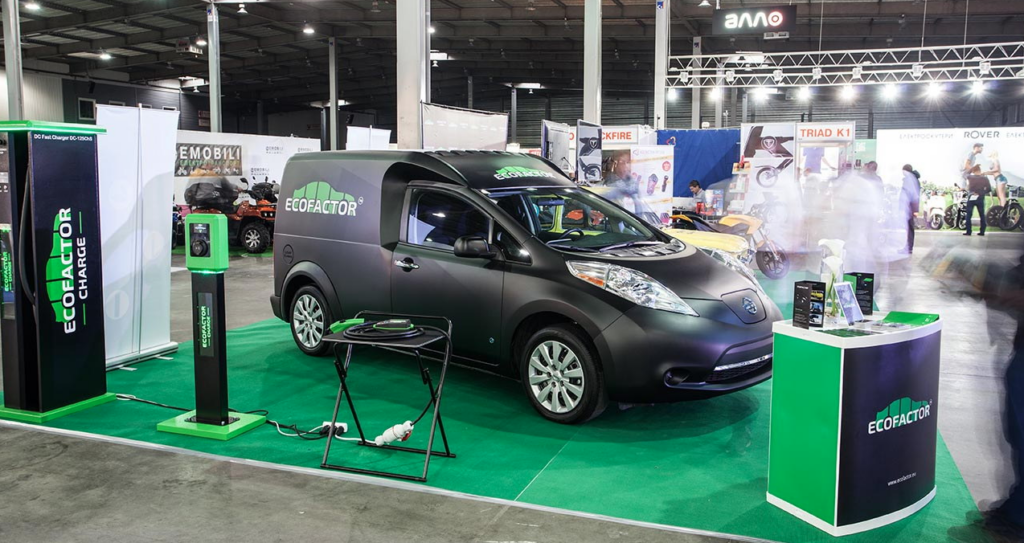
At ECOFACTOR, we take an integrated approach to charging infrastructure. We are not only a hardware manufacturer. We build a connected charging ecosystem that brings together charging stations, software, driver tools, and operational support.
Our offer includes AC and DC charging stations, a Charge Point Management System, the ECOFACTOR app, white-label options, remote monitoring, energy-related solutions, and support for different commercial use cases.
For CPOs, this changes the TCO conversation. Instead of building the operating model from several separate vendors, operators can work with us as one partner that already connects the key parts of the charging business.
For the Ukrainian market, our local experience is especially important. We understand how charging projects work here: business expectations, location types, electricity connection issues, driver behavior, and the need for practical support.
That does not mean European vendors are weak. It means we offer a different ownership model, where fewer operational layers have to be built from scratch by the CPO.

Improve Charging Infrastructure With ECOFACTOR
When evaluating charging infrastructure, the purchase price is only one part of the equation. Alongside charging stations, we provide hybrid inverters, battery systems, and solar panels that can support different EV infrastructure projects. We also offer digital tools through our iOS and Android app, while the charging station map helps drivers find and access charging locations across the network.
We can support charging projects with:
- Infrastructure solutions designed for long-term operation
- Energy technologies that complement charging deployments
- Tools that simplify access to charging network information
- Cables and accessories for installation and ongoing use
Contact ECOFACTOR to discuss infrastructure solutions for long-term charging network development.
Where Both Approaches Are Similar
It would be unfair to present this as a simple “old Europe versus local alternative” story. Both European vendors and ECOFACTOR can support serious charging projects.
Both sides can be relevant for public charging networks, commercial properties, retail locations, fleet charging, hotels and restaurants, residential complexes, shopping and business centers, AC and DC charging infrastructure, and scalable CPO projects.
Both can work with modern EVs and common connector types. Both understand that charging is no longer just about installing a box on the wall. Software, monitoring, driver access, and service quality all matter.
The overlap is real. The difference appears when we look at how much of the operating model is included and how much the CPO has to organize separately.
Where the TCO Starts to Differ
Up to this point, the two approaches may seem quite similar. Both can support modern charging networks and serve the same types of customers. The difference becomes more noticeable once the infrastructure is operating. Day-to-day management, software, maintenance, and future expansion all influence the total cost of ownership, often more than the initial hardware investment.
Software and CPMS
A charging station without proper software is difficult to operate as a business asset. CPOs need to see sessions, manage tariffs, monitor station status, generate reports, and handle user access.
With many European vendor setups, the CPMS may be selected separately or offered through a partner. That can give flexibility, but it can also add cost and integration work. At ECOFACTOR, we offer our own charging management platform. For operators, this can reduce the number of separate decisions needed before launch. Our hardware, platform, and app are designed to work together, which makes daily operation simpler.
Driver Access and Payments
Drivers do not care how many systems are behind the charger. They care whether they can find it, start a session, pay, and leave without stress. In a multi-vendor setup, the app, payments, roaming, and user experience may depend on several companies. Each part needs to connect properly.
We already have our own driver app, which helps connect charging infrastructure with end users. For CPOs, this can reduce the cost and effort of building the driver-facing layer separately.
Support and Maintenance
Support is one of those things that looks boring until the station goes offline on a busy day. European vendors may provide strong technical documentation and service networks, but in Ukraine the actual response often depends on distributors, local partners, or separate service contractors.
At ECOFACTOR, we have a stronger local fit for Ukrainian CPOs. Communication, market knowledge, and support coordination can be more direct. That matters when downtime affects revenue and driver trust.
Integration Costs
Integration is one of the most underestimated parts of TCO. A CPO may need hardware to speak to software, software to connect with payments, payments to connect with the app, and reports to satisfy internal business needs. Every integration takes time. Every integration has to be maintained.
With ECOFACTOR, more of this stays inside one ecosystem. That does not remove all technical work, but it can make the setup easier to control.
Scaling Costs
One charger is simple. Ten chargers are manageable. A few hundred chargers become a different business.
As the network grows, small inefficiencies become expensive. Manual reporting takes too much time. Separate support channels slow down repairs. Different systems make staff training harder. Tariff changes become annoying if they have to be handled in several places.
Our integrated model can make scaling smoother because the CPO works inside one operational structure. For Ukrainian operators planning growth, this can be a serious advantage.

TCO Factors Side by Side
A table cannot show every detail of a charging project, but it helps separate the visible costs from the ones that usually appear later. For CPOs, the most important question is not only who supplies the charger, but how many systems, partners, and support processes are needed to keep the network running.
| TCO factor | European vendors | ECOFACTOR |
|---|---|---|
| Hardware | Strong established options from different suppliers | Own AC and DC charging stations |
| CPMS | May be separate, vendor-based, or partner-based | Own charging management platform |
| Driver app | Often requires a separate solution | ECOFACTOR app available |
| Payments and access | May depend on external integrations | Connected within the ecosystem |
| Vendor management | Several suppliers may be involved | More services handled through one provider |
| Local Ukrainian support | Depends on distributor or service partner | Stronger local market fit |
| OCPP support | Usually available | Supported |
| Scaling | Can require more coordination between systems | Easier within one platform logic |
| Maintenance | Often partner-based | More direct operational control |
| Setup complexity | Can be higher in multi-vendor projects | Lower for CPOs wanting one ecosystem |
| Long-term TCO | Depends heavily on integrations and service model | More predictable when using the full ecosystem |
What CPOs Should Compare Before Signing
A proper comparison should go further than charger price and power output.
Before choosing between European vendors and ECOFACTOR, CPOs should ask what is included in the price after installation, whether CPMS is included or paid separately, whether the charger works with the chosen software without extra integration, who provides technical support, who handles firmware updates, how fast issues can be diagnosed remotely, whether spare parts are available locally, whether tariffs can be managed from one platform, whether a driver app is already available, what happens when the network doubles in size, how many suppliers the CPO will manage every month, and what costs appear in year two, year three, and year five.
These questions usually reveal the real difference between a hardware purchase and a full operating model.
Frequently Asked Questions
Why is TCO more important than the purchase price of a charger?
The purchase price is only one part of the investment. Software, maintenance, support, downtime, upgrades, and network management often account for a much larger share of costs over the lifetime of the charging infrastructure.
Can European charging vendors still be the right choice for CPOs?
Yes. Many European vendors offer reliable hardware with years of experience in the EV market. They can be a good fit for operators that already have their own software, technical teams, or preferred service partners.
What makes ECOFACTOR different from many European suppliers?
ECOFACTOR combines charging hardware, a Charge Point Management System, a driver app, and operational tools within one ecosystem. This can reduce the need to manage multiple vendors and simplify day-to-day operations.
Does an integrated ecosystem always result in a lower TCO?
Not automatically. The outcome depends on the size of the network, operating model, and business goals. However, reducing the number of separate systems and integrations can help lower long-term operating costs for many CPOs.
How does TCO change as a charging network grows?
As more stations are added, software management, maintenance, reporting, and technical support become increasingly important. A solution that works well for a few chargers may require much more time and coordination when the network expands.
What should CPOs compare before selecting a charging solution?
Look beyond charger specifications. Compare software capabilities, support, maintenance, scalability, OCPP compatibility, remote management, and the total number of suppliers involved. These factors often have a greater impact on long-term costs than the hardware alone.
Final Thoughts
European charging vendors offer reliable hardware, proven engineering, and extensive experience across mature EV markets. For some CPOs, especially those with established technical teams and custom software strategies, that approach can be the right fit.
However, we believe TCO should be evaluated as the cost of operating the entire charging business, not just purchasing charging stations.
At ECOFACTOR, we combine charging hardware, CPMS, a driver app, monitoring, technical support, and network management within one ecosystem. This helps reduce setup complexity, simplify coordination, support future expansion, and give operators greater control over long-term operating costs.
We are not trying to replace every European vendor. Instead, we offer a different ownership model. For many CPOs in Ukraine and other growing EV markets, working with one integrated ecosystem can provide a more predictable TCO and make it easier to build and scale a reliable charging network over time.