

Table of contents:
With the growing number of electric vehicles on the roads, investing in charging infrastructure seems like a sure-fire bet. But is that really the case?
The reality is more complex. A successful charging station requires a precise understanding of costs, potential sources of revenue and strategic planning. This is where the ROI calculator becomes an indispensable tool for any investor.
This guide covers all aspects of calculating the return on investment in charging stations for electric vehicles, from initial capital expenditure to long-term operational performance. You will find practical formulas, real-world figures and tried-and-tested strategies to help you make informed investment decisions.
We remind you that you can purchase home and commercial charging stations in our online storeand also use the public charging stations ECOFACTORcharging points located throughout Ukraine. For convenient access to charging infrastructure, we recommend using our mobile applicationwhich is available on iOS and Android
What is an ROI charging station and why is it important?
ROI (Return on Investment) is a key indicator that measures the profitability of your investment in a charging station. It shows how much you will earn in relation to the money spent.
The basic ROI formula is as follows: (Net profit / Total investment) × 100 per cent. It sounds simple, but the devil is in the detail.
When it comes to charging stations, ROI encompasses much more than just the purchase of equipment. It includes installation costs, permits, connection to the electricity grid, ongoing maintenance and operational costs for electricity.
Accurate ROI calculations help to:
- Determine a realistic payback period for the investment
- Compare different types of chargers and their locations
- Justify the business plan to investors or lenders
- Optimise operating costs and pricing strategy
- To assess the impact of government incentives and subsidies
Main types of charging stations and their cost
The first step in calculating ROI is to understand the different types of chargers and their cost characteristics. Choosing the type of charger has a significant impact on your investment budget.
| Component | Level 2 AC charging unit | DC fast charger (DCFC) |
|---|---|---|
| Cost of equipment | $500–$7,000 per unit | $25,000–$100,000+ per unit |
| Charging power | 3–19 kW | 50–350 kW |
| Charging time | 4–8 hours (full charge) | 20–40 minutes (80% charge) |
| Installation cost | $600–$12,600 | $10,000–$100,000+ |
| Ideal applications | Residential complexes, workplaces, hotels | Highways, public spaces, shopping centres |
Level 2 chargers are suitable for locations where cars are parked for longer periods — office car parks, residential areas and hotels. Furthermore, their low upfront cost makes them attractive to newcomers.
Fast direct current (DC) charging stations
Calculation of initial capital expenditure
The actual investment costs go far beyond the price of the charging devices themselves. Here is the full picture of what you need to take into account:
Equipment and hardware
Charging devices are just the start. You’ll also need cables, connectors, protective casings, payment systems and management software.
For Level 2 charging stations, expect costs ranging from $1,100 to $19,600 for a complete system (equipment + installation). For DC fast chargers, the figures rise to between $35,000 and $200,000.
Connection to the mains
This is often the most underestimated part of the costs. Fast-charging stations require a high-capacity electrical connection, which may necessitate an upgrade to the local electricity grid.
The cost of connection varies from $2,000 to $50,000+ depending on the distance to the nearest transformer substation and the required power. In some cases, this amount can reach $70,000.
Permits, licences and site preparation
Don’t forget about building permits, environmental approvals and the possible need to prepare a parking space. These costs range from $500 to $5,000, depending on the region and the complexity of the project.

Operating costs and fixed costs
Once the stations have been installed, the second phase of expenditure begins — operating costs. These recurring costs have a direct impact on your long-term profitability.
The cost of electricity
This is the largest operational expense item. The cost of electricity varies depending on the region, tariff plan and time of day.
Many commercial tariffs include a demand charge (peak load) that can significantly increase bills for fast-charging stations. Careful planning of power usage is crucial.
Maintenance and repairs
Charging stations require regular maintenance: checking connectors, updating software, and cleaning screens and casings. You should expect annual maintenance costs to be in the region of 2–5 per cent of the cost of the equipment.
Unexpected breakdowns can cost between $200 and $5,000, depending on the severity of the problem. Set up an emergency fund to cover unforeseen expenses.
Network and software subscriptions
Most modern charging stations are connected to online management platforms. These services charge a monthly or annual fee — usually between $10 and $100 per charger.
However, these platforms offer valuable features: remote monitoring, payment management, usage analytics and customer support.
Sources of income from charging stations
Now let’s move on to the more enjoyable part — how a charging station generates revenue. Understanding all the possible sources of income will help you maximise your ROI.
Direct payment for charging
The main source of revenue comes from drivers who pay for electricity. There are several pricing models:
- Per kilowatt-hour (kWh) — the most transparent approach, where users pay for the energy they actually consume
- In a minute — encourages drivers to vacate spaces more quickly, thereby increasing turnover
- A fixed feeper session, regardless of its duration or the number of charges
- A combined model — combines several approaches to optimising revenue
The average mark-up is 20–50 per cent on top of the cost of electricity, but this depends on the location and the level of competition.
Membership schemes and subscriptions
Some operators offer monthly subscriptions with unlimited top-ups or reduced rates. This provides a predictable, regular income and boosts customer loyalty.
Additional sources of income
Creative content creators are finding new ways to monetise their work:
- Partnerships with local businesses (restaurants, shops) for joint advertising
- Digital advertising on charging station screens
- Parking fees combined with charging
- Corporate programmes for business clients

Government incentives and support programmes
This is where things get more interesting. Government incentives can dramatically reduce your initial costs and significantly boost your ROI.
Making active use of the available programmes is not just good practice, but a critical strategy for maximising returns. Many investors leave money on the table by failing to explore all the available options.
Federal incentive schemes
Various countries offer federal schemes to support the development of charging infrastructure. These may take the form of direct subsidies, tax credits or grants to cover part of the capital expenditure.
These schemes often cover 30% to 80% of the cost of equipment and installation, which radically changes the economics of the project.
Regional and local incentives
In addition to federal schemes, many regions and local authorities offer their own incentives. Some utility companies also offer discounts on connection charges or special tariffs for charging stations.
A combination of federal, regional and local programmes can cover most of your initial investment.
Calculation: ROI and payback period
Now that you understand all the components, it’s time to put them together into a practical ROI formula.
The basic ROI formula
ROI = [(Total revenue – Total costs) / Total investment] × 100%
Where:
- Total investment = capital expenditure – subsidies
- Total expenses = operating expenses for the period
- Total revenue = all receipts for the same period
Payback period
Payback period = Net investment / Annual net profit
A realistic payback period for charging stations:
- Level 2 chargers in high-traffic locations: 3–5 years
- Fast-charging stations on motorways: 4–7 years
- Stations in less busy areas: 6–10 years
| Parameter. | Conservative scenario | Optimistic scenario |
|---|---|---|
| Initial investment (after subsidies) | $6,000 | $4,500 |
| Average sessions per day | 4 | 8 |
| Average energy per session | 20 kWh | 25 kWh |
| Monthly income | $560 | $1,400 |
| Monthly operating costs | $200 | $350 |
| Monthly net profit | $360 | $1,050 |
| Payback period | 17 months | 4 months |
| ROI over 3 years | 116% | 733% |
Three key factors for your ROI
Having analysed numerous charging station projects, three critical factors have been identified that determine whether an investment succeeds or fails.
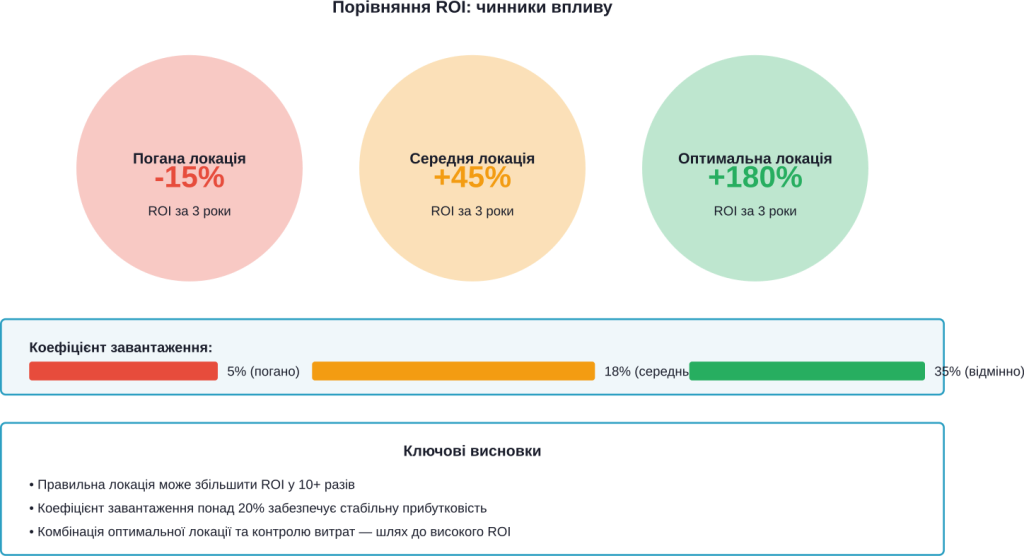
1. Location., location, location
This is the most important factor. Even the cheapest station in a poor location will never pay for itself. Conversely, a more expensive station in the right location can pay for itself within months.
Ideal locations include:
- Worker car parks with long-stay facilities
- Shopping centres and large shops
- Major roads with high volumes of electric vehicles
- Hotels and holiday resorts
- Residential complexes without their own service charges
2. Usage. Load factor
The utilisation rate is the percentage of time during which your station is actively in use. A low utilisation rate means that the equipment is idle and not generating revenue.
Target load factor for profitability:
- Level 2 chargers: at least 15–20 per cent (3–5 hours a day)
- Fast-charging stations: at least 8–12% (2–3 hours a day)
Strategies for increasing occupancy: dynamic pricing, partnerships with local businesses, marketing campaigns and loyalty schemes.
3. Optimisation of operating costs
Many operators focus on maximising revenue but neglect to control costs. Even a small reduction in operating costs can significantly improve net profit.
Key strategies:
- Negotiations with electricity suppliers regarding special commercial tariffs
- Usage of energy management systems to avoid peak tariffs
- Preventive maintenance to avoid costly breakdowns
- Remote monitoring for the rapid detection of problems
Strategies for maximising ROI for charging stations
Understanding the basic calculations is just the start. Here are some tried-and-tested strategies to help you boost your profitability.
Dynamic pricing
Use different rates depending on the time of day, day of the week and demand. Higher prices during peak hours and discounts during periods of low demand help to maximise revenue and balance capacity utilisation.
Partnerships and sponsorship
Collaboration with local businesses can create additional sources of income. Restaurants, hotels and shopping centres can sponsor part of the costs in exchange for advertising their services.
Mobile applications and loyalty programmes
Today’s electric vehicle users expect convenience. A mobile app offering a booking service, information on availability and a loyalty scheme boosts customer loyalty and usage frequency.
Scaling networks
Following the success of the first stations, consider expanding. A network of charging stations offers operational advantages: centralised management, savings on equipment procurement and shared marketing costs.
Understanding non-financial returns on investment
ROI isn’t just about financial metrics. There are other benefits to be gained from investing in charging infrastructure.
Brand value and environmental image
For businesses, installing charging stations demonstrates environmental responsibility. This attracts eco-conscious customers and enhances the company’s reputation.
Competitive advantage
Hotels, shopping centres and office buildings with charging stations gain an edge over their competitors. For owners of electric vehicles, the availability of charging points is often a decisive factor in their choice.
Preparing for the future
According to Electricity for All, 64 per cent of Americans live within a two-mile radius of a public charging station, and this figure continues to rise. Investing now means being prepared for the inevitable increase in the number of electric vehicles.
Common mistakes and how to avoid them
Many investors make similar mistakes when setting up charging stations. Here’s how to avoid them:
Underestimating the cost of connection
Don’t rely solely on the cost of the equipment. Always obtain a detailed estimate of the costs involved in connecting to the electricity grid before deciding on a location.
Ignoring traffic data
Before investing, carry out some research into the location. How many electric vehicles pass by? Are there any residential areas nearby that do not have their own charging stations?
Opting for cheap equipment with poor support
Cost savings on equipment can result in high repair costs and a loss of income due to downtime. Choose tried-and-tested brands with reliable technical support.
Lack of a marketing strategy
Installation of charging stations is only half the story. You need visibility in apps for finding charging stations, local advertising and partnerships.

ROI charging stations: figures and ECOFACTOR’s strategy
When we talk about investing in charging stations, it is important for us not only to install the equipment, but also to provide realistic payback figures. That is why, at ECOFACTOR, we take a comprehensive approach to infrastructure development – from calculating the ROI to the full-scale launch and ongoing support of the facility.
Charging infrastructure from ECOFACTOR
We are rolling out charging stations across Ukraine, creating a convenient and predictable ecosystem for electric vehicle owners and businesses. Our aim is to ensure that investment in charging infrastructure makes financial sense and delivers stable returns.
We install AC charging stations for homes, residential complexes and offices, as well as high-power DC solutions for fast charging on motorways, in shopping centres, at petrol stations and in other public locations. This enables the creation of a flexible business model – ranging from individual stations to large-scale networks.
Digital services as part of ROI
The payback period for a charging station depends directly on its utilisation rate. That is why we provide not just the equipment, but comprehensive digital support. Our mobile app for iOS and Android allows users to quickly find locations through map of charging stations, check the status of ports, plan your route and pay for sessions online.
The easier it is for a driver to find a charging station and start charging, the higher the usage rate. And this has a direct impact on financial performance and the speed of return on investment.
Equipment and additional solutions
We are also developing our own online shop, which offers chargers for both personal and commercial use. The catalogue features cables and adaptors, as well as other accessories required for the infrastructure to function properly.
It is important to us that partners or electric vehicle owners can get everything in one place – from basic equipment to accessories. This simplifies the launch of a project and reduces operating costs.
A comprehensive approach to payback
ECOFACTOR’s charging infrastructure is not just about charging stations as physical facilities. We combine hardware, software solutions, a mobile app for iOS and Android, a map of charging stations and a trading platform into a single system.
This approach enables us to help businesses calculate their actual ROI, forecast demand, scale their network and implement a long-term strategy. We create infrastructure that operates reliably, transparently and profitably – both for investors and for electric vehicle users.
Conclusion: ROI depends on strategy and careful planning
The ROI calculator for electric vehicle charging stations is not just a tool for crunching numbers. It is a strategic approach to assessing all aspects of the investment.
A successful charging station requires a balance between initial capital expenditure, operational efficiency and revenue maximisation. Location remains the most critical factor — even the best equipment cannot compensate for a poor location.
Make use of all available government incentives. They can transform a project from a marginal one into a highly profitable one. Don’t leave money on the table by failing to research the available schemes thoroughly.
Remember: ROI for a charging station is a marathon, not a sprint. Expect a payback period of between 3 and 7 years, depending on the type of equipment and location. But once you’ve reached the break-even point, your station can generate a stable passive income for 10–15 years.
Start by carrying out a detailed analysis of the location, obtain accurate estimates of all costs, research available grants and draw up a realistic business plan. Use this guide as a basis for your calculations, but adapt it to your specific circumstances.
Ready to get started on your charging station project? Check out the official websites of the regulatory bodies in your region for up-to-date information on available support schemes and licensing requirements. Invest wisely, plan strategically — and your charging station will become a profitable asset in the growing electric vehicle ecosystem.
Frequently asked questions (FAQ)
How long does it take to recoup the investment in a charging station?
The realistic payback period depends on the type of station and its location. Level 2 chargers in high-traffic areas can pay for themselves in 3–5 years, whilst fast DC charging stations typically pay for themselves in 4–7 years. The use of government subsidies can reduce this period by 30–50 per cent.
What is the difference in cost between Level 2 charging stations and fast chargers?
Level 2 chargers cost between $500 and $7,000 for the equipment, plus $600–$12,600 for installation. DC fast-charging stations are significantly more expensive — from $25,000 to $100,000+ for the equipment and from $10,000 to $100,000+ for installation. The choice depends on your business models and target audience.
What are the best locations for maximising the ROI of a charging station?
The most profitable locations are those with long parking durations and a high concentration of electric vehicle owners: workplace car parks, shopping centres, hotels, residential complexes without their own charging facilities, and major roads with heavy traffic. The key indicator is an utilisation rate of over 15–20 per cent for Level 2 charging stations.
Are special permits required to install a charging station?
Yes, building permits, electrical connections and, possibly, environmental approvals are usually required. Requirements vary depending on the region and the type of equipment. The cost of permits ranges from $500 to $5,000. It is recommended that you consult with the local authorities at an early stage of planning.
How do government subsidies affect the return on investment?
Government incentives significantly improve the ROI, covering 30% to 80% of capital expenditure. A combination of federal, regional and local schemes can halve your initial investment or more, shortening the payback period and increasing the project’s overall profitability.
How much does the electricity cost to run a charging station?
The cost of electricity is the largest operational expense and varies significantly depending on the region and tariff plan. Commercial tariffs often include a demand charge (peak load) which can significantly increase bills for fast-charging stations. A typical mark-up to ensure profitability is 20–50 per cent above the cost of electricity.
Can you earn extra income from a charging station, apart from the electricity charges?
Yes, there are several additional sources of income: membership schemes and subscriptions with a fixed monthly fee, digital advertising on station screens, partnerships with local businesses for joint advertising, corporate schemes for business clients, and combined parking fees. These additional sources can increase total revenue by 15–30 per cent.