

Table of contents:
Quick Summary: The Ford Focus Electric is a compact electric car produced from 2011 to 2018. On the Ukrainian market, it is mainly available in used condition at prices from $6,500 to $32,000 depending on the year and mileage. A range of up to 120 km, according to some sources around 200 km, makes it a purely urban option, and its limited popularity is associated with a smaller trunk, shortage of spare parts, and competition with the Nissan Leaf.
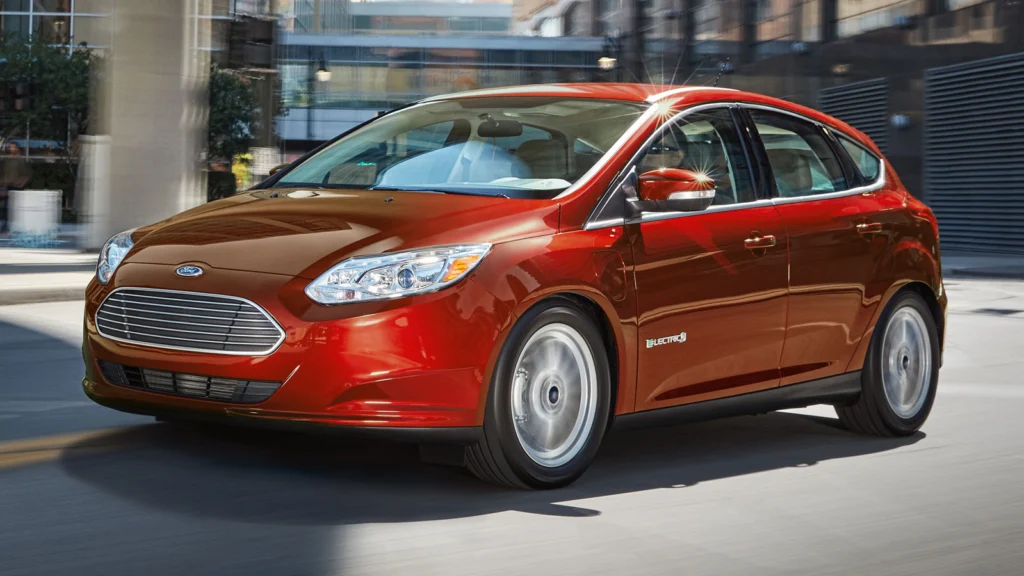
The Ford Focus Electric became one of the first production electric vehicles from the American automaker. The model was created on the basis of the third-generation hatchback, so the designers chose to adapt the existing platform rather than develop a car from scratch.
Does it make sense to consider this electric car for purchase in Ukraine in 2026? Let’s examine it in detail.
We remind you that you can purchase home and commercial charging stations in our online store, as well as use public charging stations ECOFACTOR located throughout Ukraine. For convenient access to charging infrastructure, we recommend using our mobile app, available on iOS and Android.
Technical Specifications of the Ford Focus Electric
The electric car received a rather modest 23 kWh battery, which provides a range of up to 120 km, according to some sources around 200 km. The electric motor has a power of 107 kW (145 hp).
The maximum speed is limited to 136 km/h. Acceleration to 100 km/h takes 9.9 seconds — decent figures for a city car, but not impressive.
| Parameter | Value |
|---|---|
| Battery Capacity | 23 kWh |
| Range | up to 120 km, according to some sources around 200 km |
| Motor Power | 107 kW (145 hp) |
| Max Speed | 136 km/h |
| 0-100 km/h Acceleration | 9.9 sec |
Dimensions and Weight
The length of the car is 4392 mm, width — 1824 mm, height — 1478 mm. Wheelbase — 2649 mm. Curb weight — 1650–1700 kg, of which 295 kg falls on the battery pack.
The five-seater interior and five-door body correspond to the standard Focus configuration. But there is a nuance.
Limited Trunk Space
The usable trunk volume is approximately 410 liters (14.5 cubic feet) only with the rear seats folded; with the seats installed, the volume is about 230–240 liters. The battery occupies part of the trunk space, reducing its volume by 39% compared to a regular Focus with an internal combustion engine.
For those who often carry bulky items or plan long trips with luggage, this is a significant drawback.
Charging System and Energy Recovery Time
The Ford Focus Electric supports two main charging modes. When charging from 220V AC, a full charge takes 7-8 hours. When using a Level 2 AC charging station with 6.6 kW power, a full charge of the 23 kWh battery takes about 3.5-4 hours.

Organize Charging Infrastructure Without Extra Costs
With daily use of the Ford Focus Electric, the charging issue quickly becomes practical. ECOFACTOR solves it through a clear infrastructure – a mobile app for Android and iOS for charging management, a separate map of charging stations for location search, and an online store with equipment.
Get a Personalized Solution for Your Car
What else does ECOFACTOR offer:
- Charging station configurator with two options – AC stations and DC stations
- Various accessories, cables, and mobile chargers
- Operator platform for managing charging infrastructure
- White-label solution for launching your own service
- Energy-efficient solutions for cost optimization
Contact ECOFACTOR and get a ready-made solution for your task today.
Prices on the Ukrainian Market
On the Ukrainian market, the Ford Focus Electric is available only in used condition, as it was never officially sold in Ukraine.
The price range is very wide and depends on the year of manufacture and mileage:
- $6,500: 2013 model with 68,568 km mileage
- $11,000: 2015 model with 148,132 km mileage
- $18,000: 2018 model with 160,000 km mileage
- $32,000: car in good condition
Most buyers focus on 2013-2016 cars in the $7,000-$15,000 range.
Ford Focus Electric vs Nissan Leaf: Why It Lost
On the Ukrainian market, the Nissan Leaf enjoys significantly greater popularity compared to the Ford Focus Electric. Against its background, the Focus Electric looks like an outsider. What are the reasons?
| Criterion | Ford Focus Electric | Nissan Leaf (1st generation) |
|---|---|---|
| Range | up to 120 km | about 200 km |
| Battery Capacity | 23 kWh | 24 kWh |
| Market Availability | Rare | Mass |
| Spare Parts | Shortage | Available |
| Service | Limited | Developed |
The Nissan Leaf has a larger range, a better-developed service network, and a significantly larger number of available used examples. Ford failed to create a competitive ecosystem around its electric car.
But the Focus Electric has advantages: a larger trunk, a more attractive design for fans of the classic hatchback, and a more powerful recuperation system.
Advantages of the Ford Focus Electric
Despite its modest popularity, the electric car has strong points:
- Cost-effective operation: minimal “refueling” cost compared to gasoline cars
- Ease of handling: compact dimensions are ideal for the city
- High recuperation efficiency: 95% of energy returns to the battery
- Familiar platform: handling like a regular Focus
Disadvantages and Problem Areas
Real-world operation reveals serious weak points:
- Limited range: 120 km is not enough for intercity trips
- Reduced trunk: minus 39% of space due to the battery
- Shortage of spare parts: a rare model means problems finding parts
- Battery degradation: documented cases of complete battery corrosion on the Ford Focus Electric
- Limited service: few mechanics are familiar with this model
- High repair cost: battery replacement can cost more than the car itself
Features of Operation in Ukraine
Ukrainian realities impose additional restrictions:
- Charging infrastructure is developed unevenly: In big cities it is easy to find a station, but for trips between cities a 120 km range is critically small.
- Winter operation reduces real range by 30-40%: Cabin heating “eats up” a significant part of the battery. In frost, real mileage can drop to 70-80 km.
- Maintenance cost depends on the availability of a specialized service station: In Kyiv, Odesa, and Lviv there are mechanics familiar with electric cars. In small towns you will have to search.
Practical Tips for Owners
If you have purchased a Ford Focus Electric, you need to follow simple rules:
- Keep the charge at 20-80% for daily use
- Avoid fully discharging the battery
- Store the car in a warm garage in winter
- Regularly check the battery for corrosion
- Plan routes taking into account the range
Alternatives to the Ford Focus Electric
If you are considering an electric car in a similar price range, it is worth paying attention to:
- Nissan Leaf: larger range, better support, available spare parts
- Renault Zoe: compact city option with a range of up to 240 km
- BMW i3: premium segment with interesting design
- Hyundai Ioniq Electric: reliability of the Korean manufacturer
Each of these models has better support on the Ukrainian market and a more developed service network.
Conclusion
The Ford Focus Electric is a controversial choice for a Ukrainian buyer in 2026. The model offers a familiar platform, economical operation, and decent dynamics for the city.
However, the limited range, shortage of spare parts, risk of battery corrosion, and weak service support make it an option only for very specific use cases.
If you need an electric car exclusively for short city trips, have access to home charging, and are ready for possible service problems — the Focus Electric can be considered at a price up to $10,000.
For most buyers, a wiser choice would be the Nissan Leaf or other models with better market support.
Frequently Asked Questions
What Is the Real Range of the Ford Focus Electric in Winter?
In winter conditions, the real range drops to 70-80 km due to the operation of the heating system and reduced battery efficiency at low temperatures. In summer, you can expect 100-120 km.
How Much Does It Cost to Replace the Battery on the Ford Focus Electric?
The cost of a new battery together with labor can exceed $10,000-15,000, which is often more than the cost of the car itself on the secondary market. Therefore, a critical battery failure essentially writes off the car.
Is It Possible to Find Spare Parts for the Ford Focus Electric in Ukraine?
Spare parts are difficult to find due to the low popularity of the model. You will have to order them from abroad or look for them at salvage yards, which increases repair time and cost compared to mass models.
Is It Worth Buying a Ford Focus Electric in 2026?
It is worth it only for purely urban trips of up to 50-60 km per day, with home charging available and readiness for limited service support. For most scenarios, the Nissan Leaf would be a better choice.
What Is the Optimal Price for a Used Ford Focus Electric?
An adequate price for 2013-2015 models is $7,000-12,000 depending on the battery condition and mileage. Paying above $15,000 is not advisable due to the limited range and risks.
How to Check the Battery Condition Before Purchase?
Be sure to perform diagnostics at a specialized service station with the ability to check battery capacity and corrosion. Ask for the service history and check if the range drops critically quickly.
Is It Possible to Drive the Ford Focus Electric Between Cities?
Technically possible if there are charging stations along the route, but the 120 km range makes it extremely inconvenient. Every 80-90 km you will have to stop for 3-4 hours of charging, which is unrealistic for practical use.