


Table of contents:
The debate between hydrogen and electric vehicles is gaining momentum as the world strives to decarbonise the transport sector. Both technologies promise a future without emissions, but they differ radically in their approaches to energy storage and use.
Electric vehicles store energy directly in batteries, while hydrogen vehicles use fuel cells to convert hydrogen into electricity. But which technology will actually win out?
This is not a simple question. The answer depends on how you plan to use the vehicle, where you live, and what budget you have.
We remind you that you can purchase home and commercial charging stations in our online storeand also use the public charging stations ECOFACTORcharging points located throughout Ukraine. For convenient access to charging infrastructure, we recommend using our mobile applicationwhich is available on iOS and Android.
Fundamental differences in technology
Understanding the basic principles of operation is the first step towards making an informed decision.
How electric vehicles work
Electric vehicles (BEVs) use lithium-ion batteries to store electrical energy. When you step on the accelerator, the electric motor converts the stored energy directly into mechanical work.
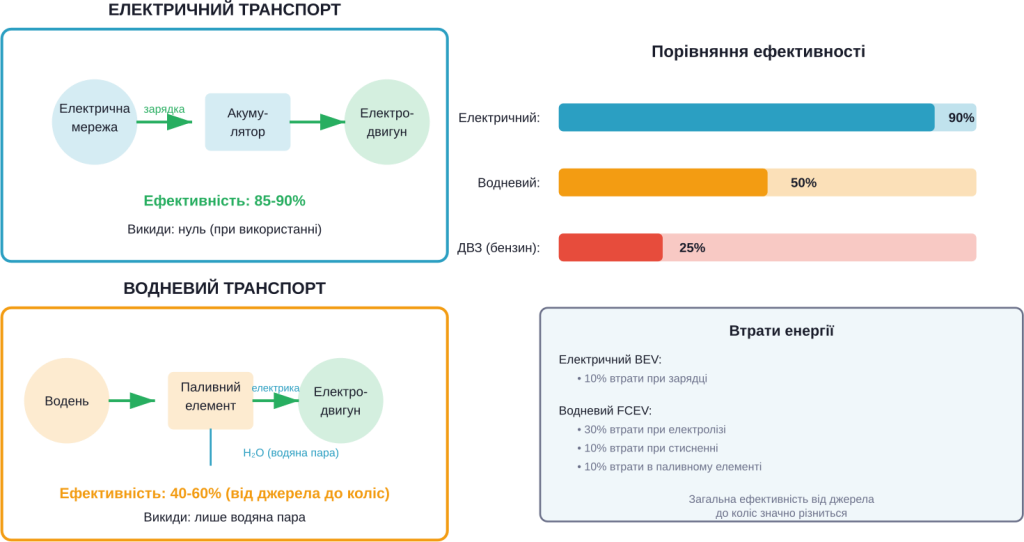
This is an extremely efficient process. Electric motors are highly efficient in converting stored energy into mechanical work, making them significantly more efficient than traditional internal combustion engines.
Charging takes place by connecting to the mains – at home, at work or at public charging stations.
How hydrogen vehicles work
Hydrogen fuel cell vehicles (FCEVs) use a completely different approach. According to the NREL, FCEVs use fuel cells to convert energy, which convert hydrogen into electricity to power the engine.
Hydrogen is stored in special high-pressure tanks. When it is fed into the fuel cell, an electrochemical reaction takes place between hydrogen and oxygen from the air, generating electricity to power the engine.
The only exhaust emissions are water vapour and warm air. Sounds perfect, right? But there are nuances.
Cost of ownership: what is cheaper in the long run
Financial aspects are often a decisive factor. Let’s look at both the initial and operating costs.
Initial cost of acquisition
Electric vehicles are becoming increasingly affordable in 2026. According to NREL’s Transportation Annual Technology Baseline, vehicle price models show different trajectories through 2050 depending on the level of technological progress.
Hydrogen vehicles, on the other hand, remain significantly more expensive. The costs of fuel cells and high-pressure hydrogen storage systems add a significant premium to the price.
But what’s interesting is that the prices of both technologies are declining over time.
| Parameter. | Electric BEV | Hydrogen FCEV | Traditional internal combustion engine |
|---|---|---|---|
| Estimated cost (passenger car) | 30,000-50,000 USD | 55,000-80,000 USD | 25,000-40,000 USD |
| Government subsidies | Available in most countries | Limited programmes | No |
| Fuel cost (per 100 km) | 2-4 USD (electricity) | 8-12 USD (hydrogen) | 8-15 USD (petrol) |
| Maintenance (per year) | 300-500 USD | 500-800 USD | 1,000-1,500 USD |
| Battery/system life | 10-15 years | 10-12 years old | N/A |
Energy and refuelling costs
Electricity has a clear advantage here. Charging at home during the night tariff can cost 3-4 times cheaper than hydrogen.
Hydrogen remains an expensive fuel. Today, the production of green hydrogen through electrolysis requires significant energy costs. According to the IEA and IEEE, the share of green hydrogen (produced from renewable energy sources) in 2025 increased to 3-5%although most hydrogen is still produced from natural gas (‘grey’ hydrogen).
This means that most of the hydrogen comes from fossil fuels, which cancels out the environmental benefits.
Maintenance costs
Both technologies have advantages over traditional cars. Fewer moving parts mean fewer breakdowns.
Electric vehicles are particularly easy to maintain – no oil, filters or spark plugs to change. Brake pads last longer thanks to regenerative braking.
Hydrogen vehicles are somewhat more complex due to fuel cells, but still simpler than internal combustion engines.
Infrastructure: where to refuel or charge
The best technology is useless if you can’t use it. Infrastructure is a critical factor.
Network of charging stations for electric vehicles: Charging infrastructure from ECOFACTOR
We are developing the electric transport ecosystem in Ukraine by providing innovative solutions that make charging safe, convenient and fast. By using our chargers, Tesla Model Y owners can be confident that their electric vehicle will operate reliably. We offer charging stations for a range of usage scenarios. Our network offers AC solutions for home and office use, as well as high-power DC stations for fast charging whilst on the move – on motorways, near shopping centres and in public locations. Thanks to this, drivers can easily find a convenient charging point nearby.
We are constantly expanding our network so that charging becomes as routine as filling up a traditional car, but much simpler.
To make the process as convenient as possible, we have developed apps for iOS and Android. Using these apps, you can access a map of charging stations, checkthe availability of charging points in real time, view your charging history and pay for services easily.
We understand that an electric car is not just about public charging, but also about convenience at home or at work. That is why we are developing our own online shop, which offers chargers for a range of installation scenarios.
Our catalogue also features cables and adapters, additional accessories and business solutions. We can help you choose the right equipment for both personal use and commercial premises – from small offices to large car parks.
We combine charging stations, digital services and equipment into a single system. This is how we provide a comprehensive approach to make using an electric vehicle simple, straightforward and financially predictable.
In the context of the debate on hydrogen and electricity, we are focusing on practical solutions that are already in use today. By developing charging infrastructure, mobile services and modern chargers, we are helping to make electric cars the norm in Ukraine.
Network of hydrogen refuelling stations
This is where hydrogen faces a serious problem. There are catastrophically few hydrogen refuelling stations.
Even in leading countries such as Japan, South Korea or Germany, the number of stations is in the tens or hundreds, compared with thousands of electric charging points.
The construction of a hydrogen refuelling station costs millions of dollars due to the need for high-pressure equipment and specialised storage systems.
Refuelling time: speed matters
Hydrogen has the edge when it comes to refuelling speed. You can fill up a hydrogen tank in 3–5 minutes — much like a conventional car.
Electric vehicles take longer to charge. Even the fastest chargers take 20–30 minutes to reach 80 per cent capacity.
But that’s a matter of perspective. If you charge at home overnight, the charging time doesn’t matter at all.
Power reserve and practicality of use
The real power reserve determines how practical the vehicle will be in everyday life.
Electric vehicles with a power reserve
Modern electric vehicles in 2026 offer a range of between 250 and 600+ kilometres on a single charge, depending on the model and battery size.
According to NREL data, fuel economy is measured in miles per gallon of petrol equivalent and indicates how efficiently a vehicle converts fuel during operation.
But there is a caveat. The power reserve depends heavily on conditions: temperature, driving style, and the use of the heating or air conditioning can reduce the actual range by 20–30 per cent.
Power reserve of hydrogen-powered cars
Hydrogen-powered cars usually offer a greater range — from 500 to 700 kilometres on a full tank.
This makes them ideal for long-distance journeys or commercial use, where downtime is critical.
Hydrogen also stores better in cold conditions, whereas lithium-ion batteries lose capacity in the cold.
Application for different types of transport
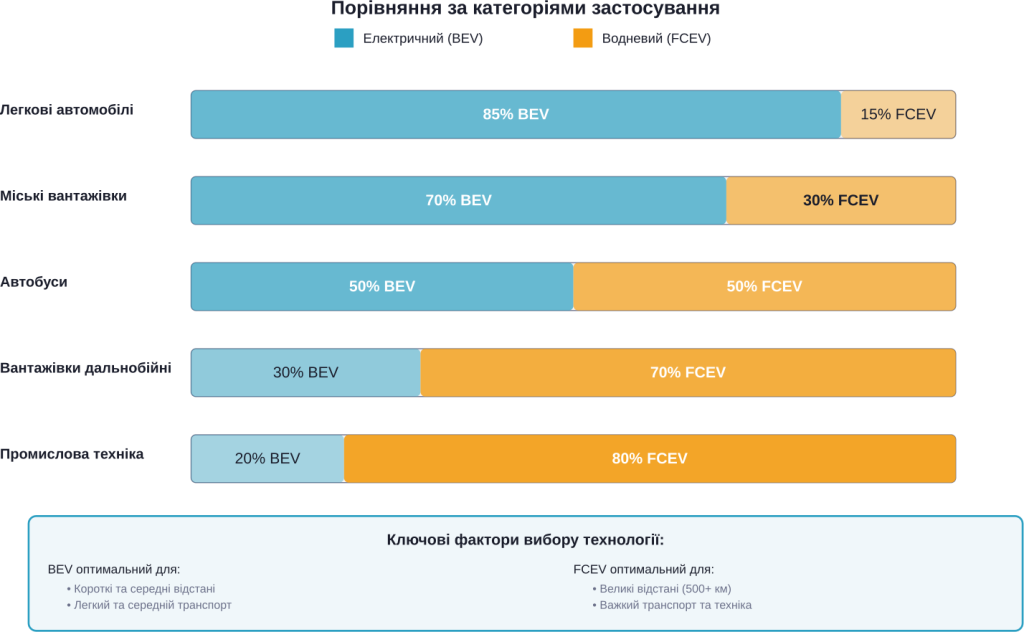
Passenger cars: electric vehicles are leading the way thanks to cost and infrastructure.
Medium- and heavy-duty vehicles: this is where hydrogen begins to demonstrate its advantages. According to the NREL Transportation ATB 2024, projections for medium- and heavy-duty (MDHD) vehicles show varying trajectories for cost and performance up to 2050.
Lorries, buses and other commercial vehicles require rapid recharging and a long range. Batteries for such applications are becoming too heavy and too expensive.
Environmental impact: which is actually more environmentally friendly?
Both technologies are marketed as ‘zero-emission’, but the reality is more complex.
Emissions during production
The production of lithium-ion batteries is an energy-intensive process. The extraction of lithium, cobalt and nickel has an environmental impact.
Hydrogen systems also generate industrial emissions — fuel cells use platinum and other rare metals.
Overall, both technologies produce higher emissions during manufacture than traditional cars, but make up for this during their operational life.
Emissions during operation
It depends on the energy source. An electric car charged using electricity from a coal-fired power station isn’t really that ‘green’.
According to IEEE research, in order to effectively reduce greenhouse gas emissions, it is necessary to increase the production of green hydrogen, which, as of 2021, accounts for less than 1 per cent of total production.
‘Grey’ hydrogen produced from natural gas generates significant CO₂ emissions during production. Only ‘green’ hydrogen produced by electrolysis using renewable energy is truly carbon-free.
Life cycle and recycling
Electric vehicle batteries can be given a new lease of life in energy storage systems once their capacity has dropped to 70–80 per cent.
Battery recycling is developing, but so far only some of the materials are being recovered. Recycling technologies are expected to improve significantly by 2030.
Fuel cells are also suitable for recycling, particularly for the recovery of precious metals such as platinum.
Integration with power systems
Both technologies have a role to play in future energy systems, but in different ways.
Hydrogen as an energy storage medium
According to IEEE SmartGrid, hydrogen is gaining momentum as a key energy source in the transition to low-carbon energy systems. Hydrogen can be used as an energy source in fuel cells to generate electricity.
Hydrogen can be produced when there is a surplus of renewable energy (for example, wind at night or sunshine during the day) and stored for long periods.
This solves one of the biggest problems facing renewable energy — the instability of generation.
Electric vehicles as a distributed battery
Vehicle-to-Grid (V2G) technology enables electric vehicles to feed energy back into the grid during periods of peak demand.
Imagine millions of electric vehicles as a giant distributed battery that stabilises the electricity grid.
This concept is particularly attractive for the integration of renewable energy, which is characterised by variable output.
Approaches to integration
According to the IEEE, the integration of hydrogen electrolysers and fuel cells into the grid presents both opportunities and challenges.
Hydrogen requires significant investment in production, storage and transport. Electrolysis consumes a huge amount of electricity.
Electric vehicles can overload local distribution networks if a large number of people charge them at the same time. The infrastructure needs to be upgraded.
Future prospects up to 2050
How will these technologies develop over the coming decades?
Forecasts for electric vehicles in
According to the NREL Transportation ATB 2024, the cost and performance projections for the vehicles presented show trends up to 2050.
Battery costs are expected to fall further. Solid-state battery technologies promise higher energy density, faster charging and a longer service life.
A power reserve of 800+ kilometres will become the standard for the mid-range segment by 2035.
Forecasts for hydrogen technologies
Reducing the cost of fuel cells and hydrogen storage systems is critical. NREL shows that assumptions regarding component costs and production volumes are gradually shifting from today’s small-scale production to mass production.
The development of green hydrogen depends on a reduction in the cost of renewable electricity and an increase in the efficiency of electrolysers.
Hydrogen is likely to fill the niche of heavy commercial vehicles, whilst electric vehicles will dominate the passenger car market.
A scenario for coexistence
The most likely scenario is not an ‘either/or’ situation, but the coexistence of both technologies.
Each will find its niche depending on the application, geography and economic factors. Hydrogen for heavy machinery and long-distance transport; electricity for private transport and urban applications.
According to the IEEE, hybrid energy storage systems that combine batteries and hydrogen could be the optimal solution for many applications.
| Factor | Electric (BEV) | Hydrogen (FCEV) | Winner |
|---|---|---|---|
| Energy efficiency | 70–80% (from source to wheels) | 25–30% (from source to wheels) | 🏆 BEV |
| Range | 250–600 km | 500–700 km | 🏆 FCEV |
| Refuelling time | 20–40 minutes (fast charging) | 3–5 minutes | 🏆 FCEV |
| ‘Fuel’ cost | 2–4 USD/100 km | 8–12 USD/100 km | 🏆 BEV |
| Infrastructure | Well-developed | Very limited | 🏆 BEV |
| Initial cost | Medium | High | 🏆 BEV |
| Productivity in cold weather | Reduced by 20–30% | Stable | 🏆 FCEV |
| Heavy commercial applications | Limited by battery weight | Promising | 🏆 FCEV |
| Emissions from fuel production | Depends on the source of electricity | Depends on the type of hydrogen | 🤝 Draw |
| Availability to consumers (2026) | Wide range of models | Very limited choice | 🏆 BEV |
How to choose the right technology for your needs
Now that you’ve learnt how to make the right choice, what should you do?
Estimate your typical journeys
If most of your journeys are between 50 and 100 km a day and you can charge your car at home, an electric car is the obvious choice.
But if you regularly need to drive 400+ km without any long stops, hydrogen might be the better option. Although it will be difficult to find a refuelling station.
Be realistic: how many times a year do you actually travel such distances? It might be cheaper to hire a car for those occasional long journeys than to pay extra every day for hydrogen technology.
Take a look at the available infrastructure
Have a look at the map of charging stations in your area. Are there any charging points near your home, work or usual routes?
When it comes to hydrogen, check whether there are any refuelling stations within a reasonable distance. In most parts of the world, the answer will be ‘no’.
The reality is that without infrastructure, even the best technology is useless.
Calculate the total cost of ownership
Don’t just look at the purchase price. Work out:
- Annual energy/fuel costs
- Maintenance and repairs
- Insurance (may be higher for new technologies)
- Possible government subsidies or tax relief
- Residual value over 5–10 years
Often, an electric car with a higher initial price turns out to be cheaper over a five-year period.
Bear your environmental goals in mind
If your carbon footprint is important to you, find out about the energy sources in your region.
An electric car powered by electricity from coal-fired power stations produces higher emissions than an efficient hybrid. But if your electricity comes from wind, solar or hydro power, the benefits are clear.
When it comes to hydrogen, the issue is even more pressing — only green hydrogen is truly carbon-free.

Challenges and barriers to implementation
Despite the promises, both technologies face serious obstacles.
Technical challenges
For electric vehicles, the main problem is charging times and battery degradation. Even the fastest charging methods cannot compete with the speed of refuelling.
Batteries lose their capacity over time. After 8–10 years of use, they may retain only 70–80 per cent of their original capacity.
For hydrogen, the main challenge is the efficiency of the entire supply chain. The production, compression, transport and conversion of hydrogen result in a loss of around 50–60 per cent of the initial energy.
Economic barriers
Cost remains a critical factor. According to NREL, the assumptions regarding the cost of fuel cells and hydrogen storage tanks are based on current low production volumes, which are gradually increasing to high production volumes.
Mass production will bring prices down, but this is a classic chicken-and-egg problem — without demand, there is no mass production; without low prices, there is no demand.
Infrastructure development requires investments running into billions. Who will foot the bill — governments, private companies or consumers?
Regulatory and political challenges
Different countries are setting different priorities. China is investing heavily in both technologies. Europe is favouring electric power for passenger cars and hydrogen for heavy industry.
The US has a fragmented approach, with varying levels of support at state level.
Standardisation is also an issue — different charging systems, different hydrogen pressures and different connectors make international roll-out more difficult.
Global examples and case studies of implementation
How do these technologies work in the real world?
Norway: a paradise for electric vehicles
Norway is a world leader in the adoption of electric vehicles, with the highest level of uptake in the world.
The secret to success: generous tax breaks, free parking, access to public transport lanes, and an extensive network of charging points.
What’s more, almost all the electricity comes from hydropower — truly zero emissions.
Japan: a focus on hydrogen
Japan has long supported the hydrogen economy. The country has invested billions in infrastructure and subsidies for hydrogen-powered cars.
But the results are mixed. Sales of hydrogen cars remain negligible compared with electric vehicles, even in Japan.
The focus is shifting towards heavy-duty transport and industrial applications, where hydrogen makes more sense.
California: a two-pronged strategy
California supports both technologies. It has the largest network of hydrogen refuelling stations in the US (although there are still fewer than a hundred of them).
Electric vehicles dominate the passenger car market, whilst hydrogen pilot schemes focus on port lorries and buses.
This is an example of a pragmatic approach — using each technology where it is most effective.
Conclusion: the future of mobility is about choice, not conflict
The ‘hydrogen versus electricity’ debate is often portrayed as a contest in which there must be a single winner. But the reality is far more complex.
Electric vehicles have already won the battle for passenger cars in most applications. The infrastructure is developing, prices are falling, and the choice of models is growing. For daily journeys over short and medium distances, with the option to charge at home, they are the obvious choice in 2026.
Hydrogen technologies are finding their niche in heavy-duty commercial applications where battery weight is an issue and rapid refuelling is critical. Heavy goods vehicles, port machinery, and potentially aviation and maritime transport — these are the areas where hydrogen holds promise.
According to data from NREL and IEEE, both technologies will continue to develop in parallel. Falling costs, technological breakthroughs and infrastructure development will shift the balance.
The most likely scenario by 2050 is a heterogeneous transport system in which different technologies coexist, each in its own optimal niche. Electricity for personal mobility and urban applications, hydrogen for heavy industry and long-distance transport.
For consumers in 2026, the advice is simple: if you’re looking for a personal vehicle and have access to charging infrastructure, go for an electric car. It’s cheaper, more convenient and more practical right now.
For most people, hydrogen is a matter for the future until the infrastructure reaches critical mass.
Ready to take a step towards a carbon-free future? Start by analysing your actual needs, check the infrastructure available in your region and calculate the total cost of ownership. The future of transport is already here — you just need to choose the right technology for your needs.
Frequently asked questions (FAQ)
Is hydrogen safer than petrol?
Hydrogen poses different risks to petrol, but not necessarily greater ones. Hydrogen disperses quickly in the air due to its lightness, which reduces the risk of fire compared to liquid fuel, which remains in a puddle. High-pressure tanks undergo rigorous endurance testing. Overall, when handled correctly, hydrogen is no more dangerous than traditional fuels, but it requires specialised infrastructure.
How much does it cost to replace the battery in an electric vehicle?
The replacement cost of electric vehicle batteries has fallen significantly in recent years and continues to fall. In 2026, a full battery replacement could cost between 5,000 and 15,000 USD, depending on the model and capacity. Many manufacturers offer a battery warranty covering 8–10 years or 150,000–200,000 km. Most batteries retain 70–80 per cent of their capacity after 10 years, so a full replacement is rarely needed.
Can you charge an electric car using solar panels?
Yes, and this is one of the most environmentally friendly ways to power an electric vehicle. A typical domestic solar installation with a capacity of 5–7 kW can generate enough electricity for a daily journey of 30–50 km. To achieve complete independence, a larger system and a home battery for energy storage are required. This increases the initial investment, but ensures the lowest long-term energy costs and complete independence from the grid.
How long do fuel cells last in hydrogen-powered cars?
Modern fuel cells are designed to have a service life of 10–12 years or approximately 240,000–300,000 km, which is comparable to the service life of electric vehicle batteries. Manufacturers provide warranties for fuel cell systems covering a period of 8–10 years. Fuel cell degradation occurs gradually through repeated start-stop cycles, as well as the effects of impurities in the hydrogen. Technologies continue to improve, and future systems promise a longer service life.
Can you convert a conventional car into an electric or hydrogen-powered one?
Technically, it is possible to convert a car with an internal combustion engine into an electric vehicle, and this is carried out by specialist companies. The cost of the conversion can range from 10,000 to 30,000 USD, depending on the vehicle and the desired range. Converting to hydrogen is considerably more complex and expensive due to the need to integrate fuel cells and high-pressure tanks. Generally speaking, conversion only makes sense for rare or specialised vehicles, as purchasing a new electric vehicle is often more cost-effective.
How does cold weather affect electric vehicles and hydrogen-powered cars?
Lithium-ion batteries lose a significant amount of their efficiency in the cold — range can be reduced by 20–40 per cent at temperatures below -10°C due to increased internal resistance and the need to heat the passenger compartment. Modern electric vehicles are equipped with battery heating systems, but this consumes additional energy. Hydrogen-powered cars perform more consistently in cold weather, as the fuel cells generate heat whilst operating, which maintains the system at an optimal temperature. This makes hydrogen a more attractive option for regions with harsh climates.
Which technology is better for the environment as a whole?
The answer is complex and depends on the energy source. An electric car charged using renewable energy (solar, wind, hydro) has the smallest environmental footprint over its life cycle. Green hydrogen produced by electrolysis using renewable energy is also environmentally friendly, but loses 50 per cent of its energy during production and conversion. If the electricity comes from fossil fuels, the benefits are less obvious. The key factor is the decarbonisation of the energy system, which makes both technologies truly environmentally friendly. At present, electric vehicles have the advantage in most regions.