

Table of contents:
Building an EV charging network is only the beginning. The real challenge starts once chargers are in daily use, serving drivers, processing thousands of charging sessions, and operating in different weather and network conditions.
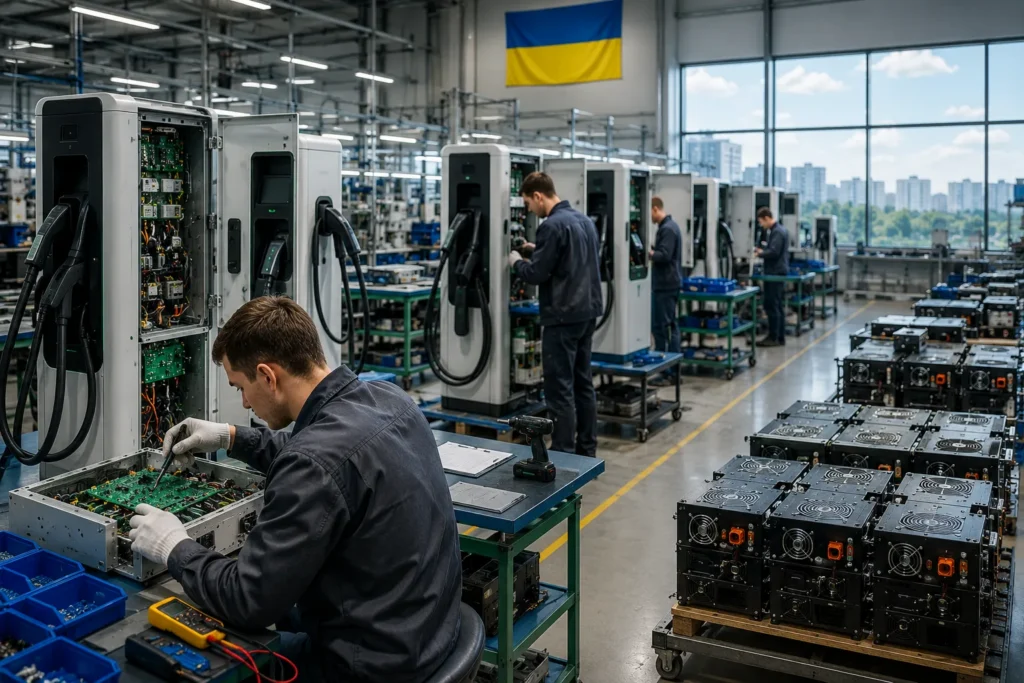
Many long-term expenses are influenced long before the first charger is installed. Manufacturing decisions affect hardware quality, firmware stability, component consistency, and quality control, all of which shape how often chargers require maintenance, how reliably they stay online, and how much time operators spend solving avoidable issues.
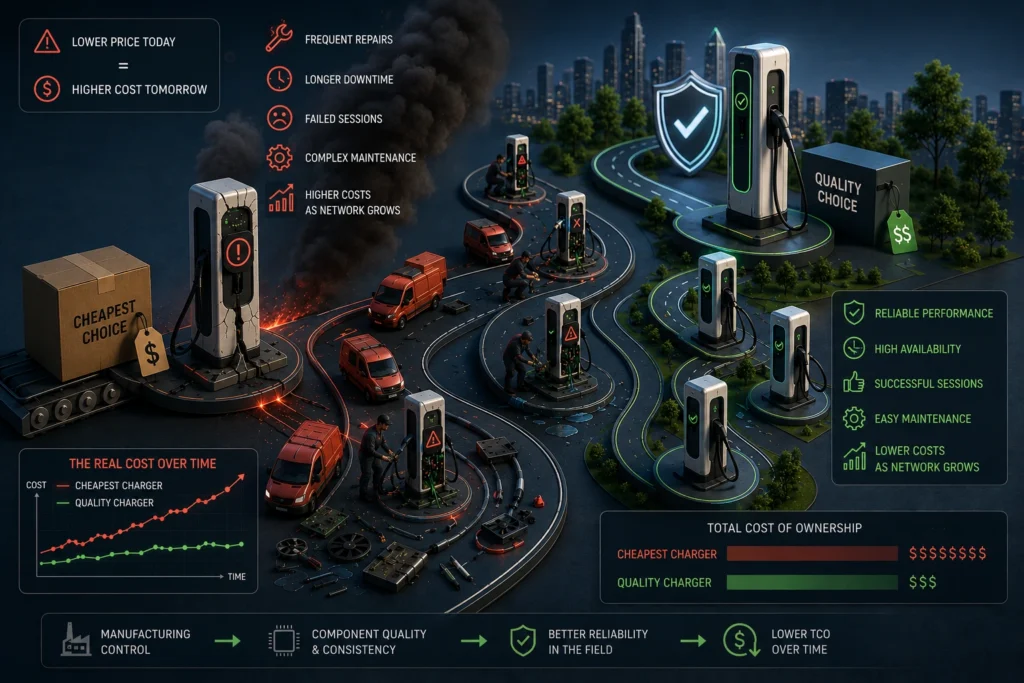
For charge point operators, lower manufacturing costs do not always translate into lower business costs. A charger that is inexpensive to produce may become far more expensive to own if it creates frequent service visits, failed charging sessions, or unexpected downtime. Understanding this connection helps businesses evaluate charging infrastructure based on its long-term value rather than its purchase price alone.
We remind you that you can purchase home and commercial charging stations in our store, as well as use public charging stations ECOFACTOR located throughout Ukraine. For convenient access to charging infrastructure, we recommend using our mobile app, available on iOS and Android.
The Purchase Price Is Just the Starting Point
Buying EV chargers is often treated as a one-time investment. Hardware is compared by power output, connector type, warranty, and price, and the lowest offer can look like the most sensible decision.
The reality is more complicated.
Once chargers are installed, the purchase price quickly becomes only a small part of the total cost of running a network. Electricity, maintenance, software updates, replacement parts, technician visits, and downtime continue to generate expenses throughout the equipment’s lifetime. Even small reliability issues can become expensive when they affect dozens of charging stations.
This is why experienced charge point operators look beyond the initial invoice. Two chargers with similar specifications and the same purchase price can create very different operating costs depending on how they were designed, manufactured, and tested.

Build Charging Infrastructure With Greater Control
The way charging equipment is designed, produced, and maintained can influence long-term operating costs and network performance. Alongside charging stations, ECOFACTOR supports charging infrastructure projects with hybrid inverters, battery systems, and solar panels, alongside digital tools available through its iOS and Android app and charging station map.
ECOFACTOR can help support charging infrastructure through:
- Solutions for commercial and public charging projects
- Energy systems that support long-term infrastructure planning
- Equipment designed for network growth and expansion
- Cables and accessories for installation and maintenance needs
Contact ECOFACTOR to discuss infrastructure solutions that support sustainable network development.
Why the Cheapest Charger Can Cost More Later
The manufacturing process influences far more than production costs. It affects how reliably a charger performs, how often it requires service, how well it communicates with the charging management platform, and how easy it is to maintain throughout its lifetime.
These differences may not be obvious during installation. A charger can pass commissioning and work normally for weeks before recurring faults begin to appear. As the network grows, those isolated issues become repeated maintenance tasks, additional support requests, and higher operating costs.
More Frequent Repairs
Weak manufacturing control usually shows up as small repeat failures, not one big breakdown. A connector wears too fast. A cable holder cracks. A communication module becomes unstable. A fan or relay fails earlier than it should.
Each issue means more than one replacement part. For a CPO, it can mean technician travel and labor, remote diagnostics before the visit, replacement parts and delivery time, warranty paperwork, temporary charger downtime, and support messages from drivers.
The problem is not only the single repair. It is the pattern. When the same type of fault appears across several chargers, maintenance stops being occasional and becomes part of everyday operations. That is where the low upfront price starts to lose its advantage.
Longer Charger Downtime
Downtime is expensive because the charger stops doing its job. It does not earn revenue, it frustrates drivers, and it weakens trust in the location.
The cause can be basic: poor sealing against moisture and dust, weak cable durability, unstable internal electronics, bad cooling performance, or incomplete production testing. There is another layer too. A charger can be powered on but still unavailable in the network. If it loses backend connection, misses status updates, or cannot recover after a communication drop, the driver sees the same result—charging does not work.
Better manufacturing control reduces these failures before the charger reaches the site. The charger should be tested as a working network device, not just as electrical hardware.
More Failed Charging Sessions
A failed session is not just a technical issue. It can mean a support ticket, refund, negative app review, or a lost customer.
Many failures come from firmware and communication problems: slow authentication, unstable OCPP messages, incorrect meter values, incomplete StopTransaction data, poor connector lock handling, or weak recovery after network drops.
This is why firmware validation belongs inside manufacturing control. The charger should be tested through full charging flows before shipment: start, charge, stop, report data, recover from faults. For CPOs, this matters because session reliability affects billing, roaming, customer support, and driver confidence.
More Complex Maintenance
Maintenance becomes expensive when every repair feels like a new puzzle. This happens when chargers from the same model have different component versions, unclear documentation, poor batch records, or spare parts that are hard to source. A technician arrives on site and only then discovers that the expected part does not fit or the fault does not match the documentation.
Good manufacturing control makes maintenance more predictable. Operators know which components are inside each charger, which firmware version is installed, and which spare parts are needed. That saves time in very practical ways: faster diagnostics, fewer unnecessary site visits, better spare parts stock, cleaner warranty handling, and shorter charger downtime.
For networks spread across Ukrainian cities and highways, this can make a real difference. Travel time alone can turn a small repair into an expensive job.
Higher Costs as the Network Grows
Small issues look manageable in a small network. One unstable charger, one repeated connector issue, or one firmware bug may not seem dramatic.
Scale changes everything. If the same issue affects 5 chargers, it is annoying. If it affects 50, it becomes a maintenance project. If it affects 500, it starts shaping the cost structure of the whole network.
This is where manufacturing consistency matters most. CPOs need chargers that behave the same way across different sites, weather conditions, grid conditions, and backend loads. Without that consistency, scaling becomes harder because every new batch can bring new problems. A growing network needs predictable hardware. Otherwise, expansion only adds more repairs, more support tickets, more spare parts, and more downtime.
How Better Manufacturing Control Changes the Situation
After the first years of operation, the pattern becomes clear: the cheapest charger is not always the one that costs less to run. Repairs, downtime, failed sessions, and slow maintenance all come from somewhere. Often, the root cause is not the site or the driver, but decisions made during production.
Better manufacturing control changes this by reducing the number of problems that reach the field in the first place. Reducing long-term costs does not start with cheaper components. It starts with building every charger the same way, across every production batch, so that components, assembly steps, and inspection rules stay consistent and chargers behave more predictably in the field.
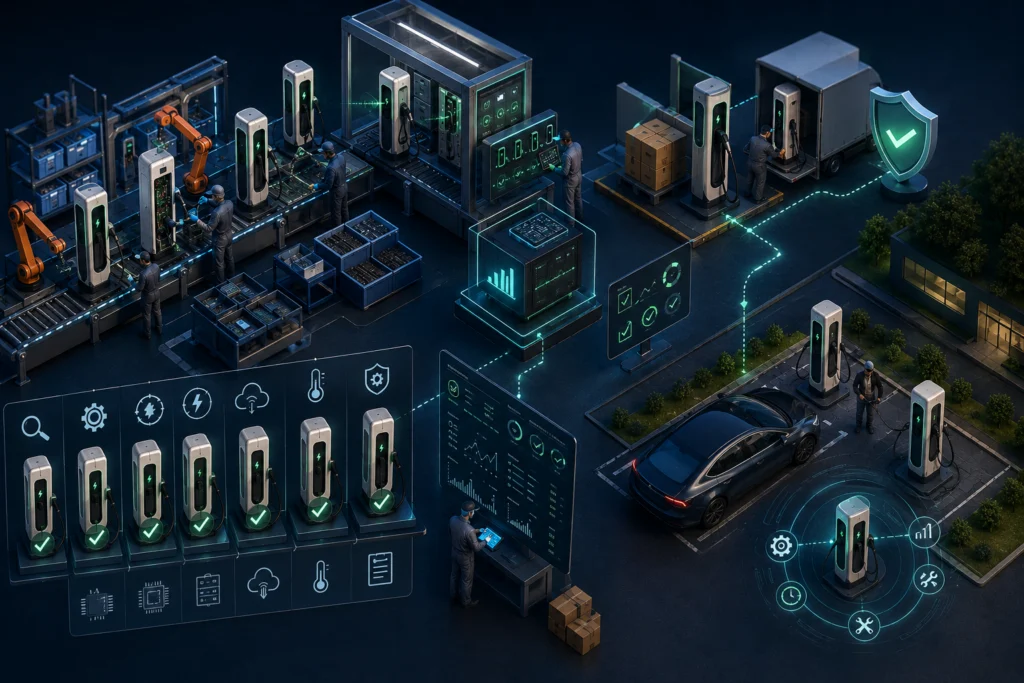
Strong manufacturing control connects engineering, production, and testing into one process. Instead of finding problems after installation, manufacturers catch them earlier through functional testing, firmware checks, communication testing, and real charging scenarios. Traceability matters too: if the manufacturer knows which components, firmware version, and production batch were used, repairs and warranty handling become much faster.
The result is not a charger that never fails. It is a charger that fails less often, behaves more consistently, and is easier to support throughout its lifetime.
What Good Manufacturing Control Should Include
Good manufacturing control is not one final inspection at the end of the line. It is a set of checks and decisions that reduce future problems before the charger reaches a site. For CPOs, these details matter because they influence how much time, money, and effort the network will need after installation.
The table below shows what to look for when evaluating how well a charger is manufactured.
| Manufacturing practice | Long-term benefit for CPOs |
|---|---|
| Component traceability | Faster diagnostics and warranty handling |
| Standardized assembly | Consistent performance across the network |
| Automated quality inspection | Fewer production defects |
| Functional testing | Lower risk of early failures |
| Firmware validation | More successful charging sessions |
| Backend communication testing | Better interoperability and remote management |
| Stress testing | Higher uptime under real operating conditions |
| Spare parts planning | Faster repairs and lower service costs |
No manufacturer can guarantee that equipment will never require maintenance. Charging stations work in demanding environments and are expected to operate every day for years. The difference is how many problems reach the field in the first place and how quickly they can be resolved when they do occur.
Frequently Asked Questions
Why should CPOs care about manufacturing control?
Manufacturing control has a direct impact on operating costs. Chargers built with consistent components, validated firmware, and proper testing are less likely to require unexpected repairs, experience downtime, or generate failed charging sessions.
Can a lower-priced charger still be a good long-term investment?
Yes, if it is manufactured to a high standard. Purchase price alone does not determine long-term value. Reliability, maintenance requirements, firmware quality, and spare parts availability often have a greater impact on the total cost of ownership.
How does manufacturing affect charger uptime?
Many uptime issues begin before installation. Component quality, assembly consistency, environmental protection, and production testing all influence how reliably a charger performs in everyday conditions and how well it recovers from faults.
Is firmware part of manufacturing quality?
Absolutely. Modern EV chargers rely on firmware for communication, charging sessions, billing data, and remote management. Validating firmware before deployment helps reduce support requests and improves charging reliability from the first day of operation.
What should businesses look for when comparing charger manufacturers?
Look beyond technical specifications. Ask how the chargers are tested, whether production is standardized, how firmware is validated, whether components are traceable, and how spare parts and warranty support are managed. These factors often have a greater influence on long-term operating costs than the purchase price itself.
Final Thoughts
Manufacturing control rarely receives the same attention as charging speed, power output, or purchase price. Yet it has a lasting effect on the cost of running an EV charging network.
Every production decision, from component selection to firmware testing, influences what happens after installation. Better manufacturing control helps reduce repairs, limit downtime, improve charging session reliability, simplify maintenance, and make network expansion more predictable.
For charge point operators in Ukraine, where charging infrastructure continues to grow across cities, highways, logistics facilities, commercial properties, and residential developments, these factors become increasingly important. Choosing charging hardware should not be based only on the initial price. Understanding how the equipment is designed, tested, and manufactured can make a measurable difference to operating costs for years to come.