


Table of contents:
Growing an EV charging network sounds simple until the number of stations starts climbing. What worked for five chargers rarely works for fifty. Manual processes become harder to manage, maintenance requests pile up, billing gets more complicated, and keeping every charger online turns into a daily challenge.
Successful growth is not about installing more hardware as quickly as possible. It is about building the right operational foundation from the beginning. With reliable software, smart planning, and clear processes, charge point operators can expand across more locations while keeping costs under control and delivering a consistent experience for drivers.
In this article, we’ll look at what helps charging networks grow without creating unnecessary complexity behind the scenes.
We remind you that you can purchase home and commercial charging stations in our store, as well as use public charging stations ECOFACTOR located throughout Ukraine. For convenient access to charging infrastructure, we recommend using our mobile app, available on iOS and Android.
Growth Exposes Weak Operations
Adding more charging stations is usually seen as a sign that a network is moving in the right direction. More locations mean better coverage, more charging sessions, and more opportunities to serve EV drivers. Yet many charge point operators discover that growth brings a different challenge. The bigger the network becomes, the harder it is to keep everything running smoothly.
The first few charging stations are relatively easy to manage. Teams know every site, maintenance can be coordinated manually, and operational issues are often solved with a phone call or a quick software update. That approach works for a while.
Once a network expands across cities, regions, or even countries, those same routines begin to slow everything down. Hundreds of charging sessions happen every day, new locations come online regularly, different tariffs need to be maintained, and technical issues can appear at multiple sites at once. Without a solid operational foundation, growth starts creating more work instead of more value.
For the Ukrainian market, this is becoming increasingly relevant. Charging infrastructure continues to expand across retail properties, logistics hubs, residential developments, workplaces, and public roads. Building new locations remains important, but keeping every existing charger operating reliably has become just as important.
Why Small-Network Management Stops Working
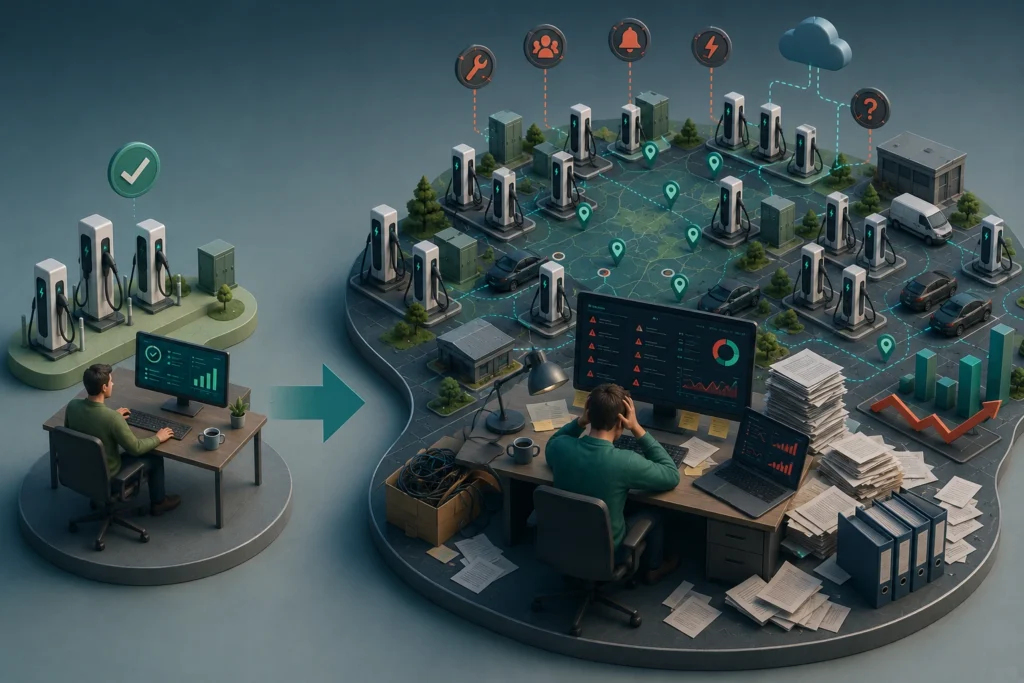
There is no exact moment when a charging network becomes difficult to manage. Complexity builds gradually.
A team responsible for ten chargers might spend only a small part of the day checking charger status, updating tariffs, answering customer questions, or reviewing charging sessions. Double the number of chargers, add several new locations, introduce different hardware models, and suddenly those same tasks consume most of the working day.
The challenge is not that each activity becomes harder. The problem is that there are simply more of them happening at the same time. Many operators experience similar growing pains: charging stations spread across multiple locations, different pricing structures for different sites, increasing numbers of registered users, more maintenance requests, larger volumes of charging data, and higher expectations from drivers and site owners.
At this stage, spreadsheets, manual reporting, and disconnected software begin creating unnecessary delays. Expanding the network without changing the way it is managed often leads to higher operating costs and slower response times. Growth should increase the value of the business, not the amount of manual work required to keep it running.

Simplify Network Growth With ECOFACTOR
As charging networks grow, operators often need reliable infrastructure, accessible information, and scalable solutions. Alongside charging stations, ECOFACTOR supports charging networks with hybrid inverters, battery systems, and solar panels. Through the iOS and Android app and charging station map, drivers can also access charging information more easily.
ECOFACTOR can help support network growth through:
- Infrastructure solutions for expanding charging networks
- Energy technologies for integrated charging projects
- Tools that improve access to charging locations
- Cables and accessories for operational support
Contact ECOFACTOR to discuss solutions for scaling charging infrastructure more efficiently.
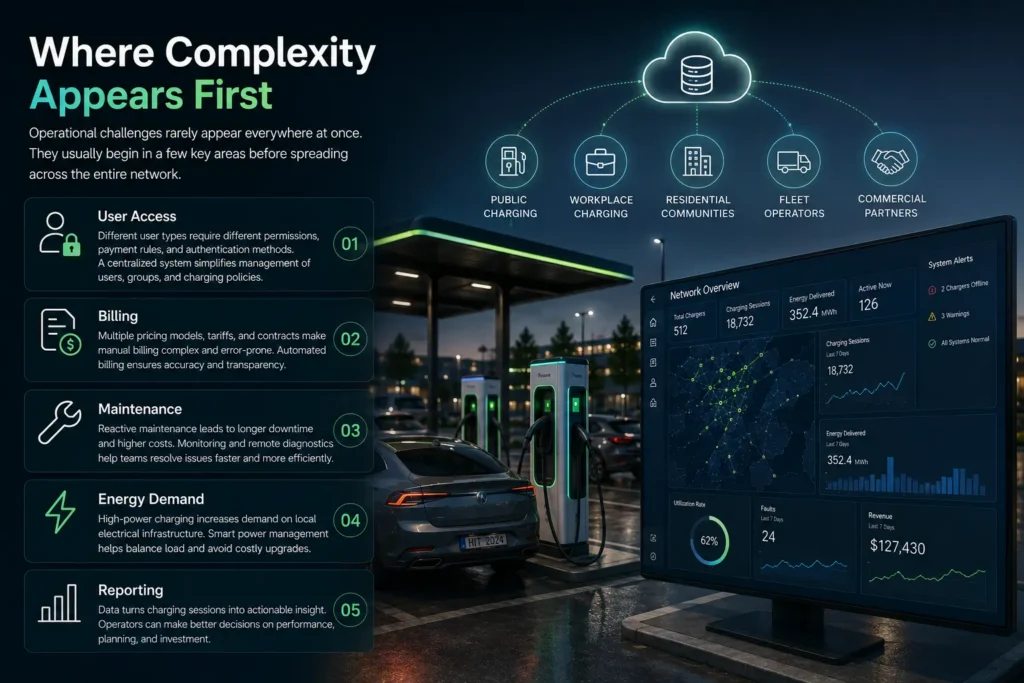
Where Complexity Appears First
Operational challenges rarely appear everywhere at once. They usually begin in a few key areas before spreading across the entire network.
User Access
Managing access becomes more complicated as networks serve different types of users. Public charging, workplace charging, residential communities, fleet operators, and commercial partners may all require different permissions, payment rules, and authentication methods. Managing those settings individually quickly becomes inefficient.
A centralized system allows operators to organize user groups, permissions, and charging policies without creating separate workflows for every location.
Billing
Billing often becomes one of the first operational bottlenecks. A small network may only require one pricing model. A larger network rarely operates that way.
Different locations may have different electricity costs, parking policies, customer agreements, or charging tariffs. Manual invoice reconciliation becomes increasingly difficult as charging sessions grow into the thousands each month. Automated billing reduces administrative work while helping operators maintain transparent pricing for drivers.
Maintenance
The more charging stations a network operates, the less practical reactive maintenance becomes. Waiting for users to report problems often means chargers remain unavailable longer than necessary. Field technicians may travel to sites only to discover issues that could have been diagnosed remotely.
Continuous monitoring and remote diagnostics allow maintenance teams to prioritize visits based on actual equipment condition instead of assumptions.
Energy Demand
Power management becomes significantly more important as DC charging expands. Several high-power chargers operating simultaneously can create substantial demand on local electrical infrastructure. Without proper energy management, operators may face expensive grid upgrades or unnecessary limits on network capacity.
Dynamic load balancing and intelligent power distribution help sites make better use of available electrical capacity while supporting more charging sessions.
Reporting
As networks grow, data becomes one of the most valuable operational assets. Operators need answers to practical questions every day: which locations are busiest, which chargers experience repeated faults, where additional charging capacity should be installed, and which sites generate the strongest financial performance.
Reliable reporting turns thousands of charging sessions into information that supports better operational and investment decisions.
Build the Network Around One Management System
Keeping a growing charging network organized is not about adding more software. It is about making sure every operational task works together instead of separately.
As networks expand, operators have to manage chargers across multiple locations, process thousands of charging sessions, monitor equipment, handle payments, update pricing, and support different groups of users. Trying to do that with disconnected tools eventually creates more work than the network itself.
Keep Hardware Choices Flexible
Every charging network changes over time. New locations may need different power levels, connector types, cabinet formats, or payment setups. A retail site in Kyiv does not have the same requirements as a logistics depot outside Lviv or a residential complex in Odesa.
This is why hardware flexibility matters from the beginning. If the management system only works with one manufacturer’s chargers, every future expansion becomes narrower than it should be. Operators may have to choose equipment based on software limitations rather than actual site needs.
Open standards such as OCPP help avoid this problem. They allow compatible chargers from different manufacturers to work within one management system. For a growing CPO, that means more freedom in procurement, easier upgrades, and less pressure to replace equipment that still works.
Automate Billing Before It Becomes a Problem
Billing can look simple at the start. One location, one tariff, one payment flow. Then the network grows, and suddenly there are different site owners, parking rules, user groups, peak hours, fleet agreements, and promotional rates.
This is where manual work starts to break down. A few corrections per week may not seem serious, but at scale they turn into disputes, refunds, missing revenue, and messy reporting.
Automated billing should help operators manage tariffs by location, user group, or time of use, payment processing, invoices, and transaction records, and clear reporting for revenue, refunds, and completed sessions. Drivers get clearer pricing, and the business gets cleaner financial data.
Use Live Monitoring to Protect Uptime
A charger should not be offline for half a day before the operator finds out. That sounds obvious, but it still happens when networks rely too heavily on driver complaints or occasional manual checks.
Live monitoring gives operators a continuous view of what is happening across the network. If a charger disconnects, a session fails, or the same fault appears repeatedly, the team can respond before the issue spreads into a wider service problem.
Remote diagnostics make this even more useful. Some problems can be fixed without sending a technician to the site. When a visit is needed, the service team already has a clearer idea of what to check. That saves time, reduces unnecessary trips, and helps keep chargers available when drivers need them.
Turn Network Data Into Investment Decisions
Every charging session leaves a trace. Over time, those traces show where the network is strong, where it is underused, and where money is being left on the table.
Operators should regularly review utilization, session length, and peak charging hours, revenue, downtime, and repeated charger faults, and sites that need expansion, redesign, or pricing changes. For Ukrainian CPOs and site owners, this kind of data matters because capital has to be used carefully. Expansion should follow proven demand, not assumptions. The network itself can show where the next investment makes sense.
Manage Energy Before Grid Capacity Becomes a Limit
Adding chargers is easier than adding power. This becomes clear very quickly when DC fast charging enters the picture.
Several high-power chargers working at the same time can place serious pressure on a site’s electrical connection. In Ukraine, where commercial sites, retail centers, logistics hubs, and roadside locations may all face different grid conditions, simply asking for more capacity is not always the fastest or most affordable option.
Smart energy management helps operators use available power more carefully. Dynamic load balancing, power sharing, scheduled fleet charging, and battery storage can all reduce pressure on the grid connection while keeping the site useful for drivers. The strongest sites are not always the ones with the biggest connection on paper. Often, they are the ones where power is managed well.
Plan Sites for the Next Expansion Stage
A charging site should not be designed like the first installation is the final one. Demand changes too quickly for that.
Planning for future expansion does not mean installing every charger immediately. It means leaving enough space, electrical logic, and physical access so additional chargers can be added later without rebuilding the site from scratch.
Good planning should cover space for future charging bays and vehicle movement, cable routes, electrical capacity, and connection points, and maintenance access and safe traffic flow around the site. These details may seem small during the first phase, but they become expensive when ignored. A phased site plan gives the operator room to grow without turning every expansion into a construction project.
Make the Driver Experience Consistent Across Every Location
Drivers do not care how complicated the network is behind the scenes. They care whether the charger is available, whether the price is clear, whether the session starts, and whether they can leave without frustration.
A growing network can easily become inconsistent. One site has clear pricing, another does not. One charger starts through the app, another requires a different process. One location shows live availability, another shows outdated status. These details may look minor from the operator’s side, but drivers remember them.
Consistency comes from having the same operational standards across the network. Availability data should be accurate. Payments should work predictably. Session information should be easy to understand. Support should not depend on which location the driver happens to visit. When the experience feels familiar from one site to the next, drivers are more likely to trust the network and use it again.
Why Every New Site Should Be Easier Than the Last
A growing charging network should not feel like starting from zero with every new location.
After the first few projects, operators should already have a clear template: how the site is assessed, which chargers fit different use cases, how the CPMS is configured, how tariffs are added, how testing is done, and who responds when something goes wrong. The location may change. The process should not.
A fleet depot, a shopping center, and a residential complex will have different charging patterns, but the operating logic can stay consistent. This makes expansion faster, reduces mistakes, and keeps reporting clean across the whole network.
New sites should become easier because the operator already knows which technical checks are needed before installation, how chargers are connected, tested, and monitored, and which support and maintenance steps follow after launch. For CPOs in Ukraine, this matters a lot. The market is growing, but every project still has to be built carefully. A repeatable process helps expand faster without turning each new site into a separate operational puzzle.
Frequently Asked Questions
When should a CPO start thinking about scaling operations?
Earlier than most expect. Once a network expands beyond a few locations, manual billing, maintenance, and reporting can quickly become difficult to manage. Putting the right systems in place early makes future growth much easier.
Is it better to use chargers from one manufacturer or different brands?
It depends on your goals. Using OCPP-compatible chargers gives operators more flexibility to choose the right hardware for each project while managing everything through one Charge Point Management System.
How does a CPMS help as a charging network grows?
A CPMS brings charger management, monitoring, payments, user access, and reporting into one platform. This reduces manual work and gives operators a clear view of the entire network instead of managing each site separately.
Why is live monitoring important for large charging networks?
Without live monitoring, operators often discover problems only after drivers report them. Real-time alerts and remote diagnostics help identify issues sooner, reduce downtime, and make maintenance more efficient.
Can a charging network grow without upgrading the electrical connection every time?
In many cases, yes. Technologies such as dynamic load balancing and power sharing help distribute available capacity more efficiently, allowing operators to add chargers without immediately increasing grid capacity.
What is the biggest mistake when expanding an EV charging network?
Treating every new site as a completely new project. Standardized processes for planning, commissioning, monitoring, and maintenance make expansion faster, more consistent, and easier to manage over time.
Final Thoughts
Scaling an EV charging network is not just about installing more chargers. Each new site adds users, payments, maintenance tasks, energy demand, and support requests.
The networks that grow well are the ones built around clear operations. One management platform, flexible hardware, automated billing, live monitoring, smart energy control, and practical site planning all reduce the risk of daily chaos.
Growth should make the network stronger, not harder to manage. When every new site builds on what the operator has already learned, expansion becomes cleaner, faster, and easier to control.