

Table of contents:
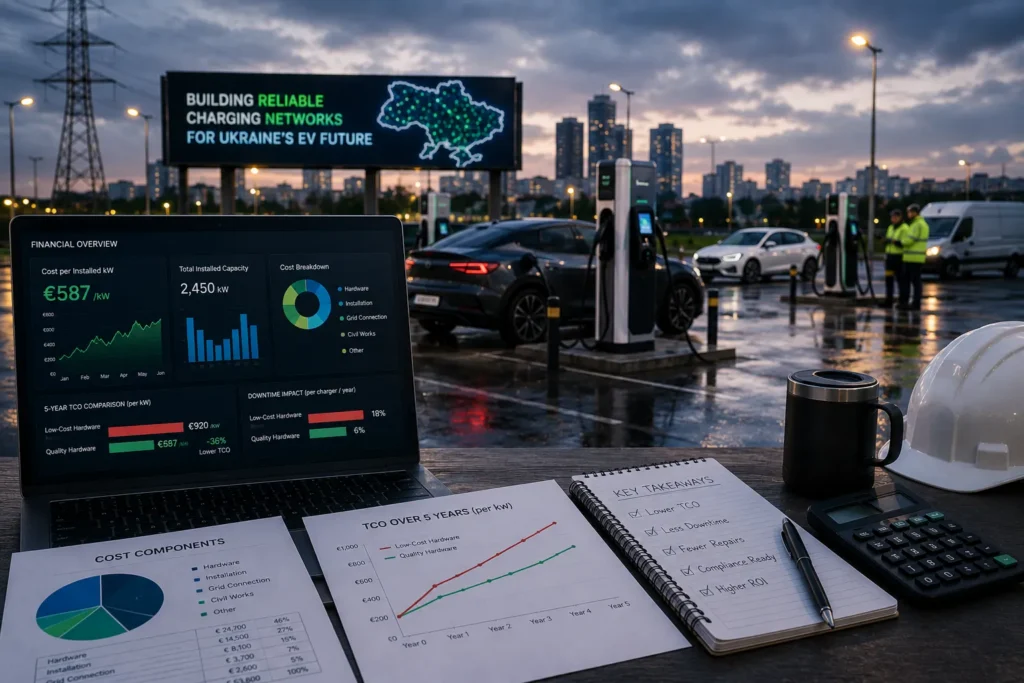
Buying an EV charger based on price alone can be an expensive mistake. The hardware itself is only one part of the investment. Installation, maintenance, software, energy use, downtime, repairs, and future upgrades all add to the real cost of running charging infrastructure.
That is why businesses increasingly look at Total Cost of Ownership, or TCO, instead of focusing only on the initial purchase price. A charger that costs less today may require more service visits, create more downtime, or become difficult to expand as charging demand grows. In many cases, those hidden costs quickly outweigh the money saved upfront.
In this article, we’ll look at what TCO actually includes, why it matters when comparing charging solutions, and what businesses should evaluate before choosing EV charging hardware.
We remind you that you can purchase home and commercial charging stations in our store, as well as use public charging stations ECOFACTOR located throughout Ukraine. For convenient access to charging infrastructure, we recommend using our mobile app, available on iOS and Android.
What TCO Really Means in EV Charging
The price on a quotation is easy to compare. TCO is not. When businesses evaluate charging equipment, the first number they usually see is the hardware cost. It is tempting to assume that two chargers with similar specifications will cost roughly the same to own. In practice, they often do not.
Total Cost of Ownership, or TCO, looks at the complete financial picture over the life of a charging project. Instead of asking, “How much does this charger cost to buy?”, it asks, “How much will this charger cost to install, operate, maintain, and eventually replace?”
That difference changes how investment decisions are made. A charger that saves a few thousand euros during procurement may generate much higher expenses over the next five to ten years through maintenance, software subscriptions, downtime, inefficient energy use, or expensive upgrades. On the other hand, a higher-quality solution can recover its higher purchase price by reducing everyday operating costs and avoiding disruptions that affect drivers and businesses alike.
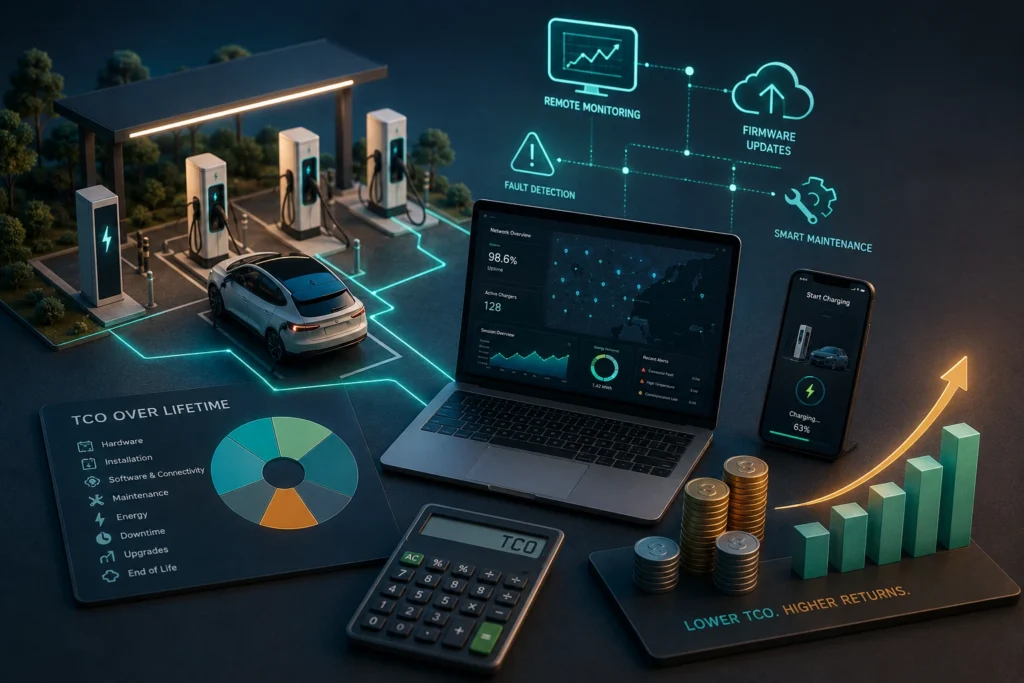
A typical EV charging TCO model includes several categories of cost: hardware and accessories, installation, commissioning, and civil works, electrical infrastructure and grid connection, electricity and demand charges, software, connectivity, and payment services, preventive maintenance and repairs, downtime and lost revenue, and end-of-life replacement or decommissioning. Each category may seem manageable on its own. Together, they determine whether a charging project delivers the expected return over the coming years.
Why the Purchase Price Tells Only Part of the Story
Imagine two DC fast chargers with similar power output. The first costs less, making it the obvious winner during procurement. The second has a higher upfront price, but includes more reliable components, better remote diagnostics, longer warranty coverage, and software designed to simplify maintenance.
On installation day, both chargers look almost identical. The difference appears later.
If the lower-cost charger requires more technician visits, experiences longer outages, or cannot be upgraded as charging demand grows, its operating costs begin to climb. Every repair adds labor costs. Every offline hour reduces revenue. If spare parts take weeks to arrive, drivers may choose another charging network instead.
The more expensive charger may avoid many of those costs simply by operating reliably and allowing most issues to be diagnosed remotely before a site visit is even necessary. That is why procurement teams increasingly compare solutions over their expected service life rather than selecting the lowest purchase price.
A simple comparison illustrates the difference.
| Cost factor | Lower-cost hardware | Higher-quality hardware |
|---|---|---|
| Initial purchase | Lower | Higher |
| Maintenance visits | More frequent | Less frequent |
| Downtime risk | Higher | Lower |
| Remote diagnostics | Often limited | Usually more capable |
| Software updates | May require manual work | Often managed remotely |
| Expansion options | Can be limited | Typically easier to scale |
| Long-term ownership cost | Often higher | Often lower |
The purchase price is fixed on the day the equipment is ordered. Almost every other cost continues throughout the life of the charging station. That is exactly why TCO has become a more useful decision-making tool than hardware price alone.
Where Long-Term Costs Usually Come From
Many charging operators discover that the charger itself represents only part of the project budget. Once infrastructure is installed, operating expenses begin to accumulate month after month.
Some costs are expected. Electricity, routine inspections, and software subscriptions are part of normal operation. Others are much harder to predict, especially when equipment reliability was not considered during procurement.
Installation and Electrical Infrastructure
Installing a charger is often more expensive than placing the unit on a concrete pad. Projects may require trenching, cable installation, distribution boards, transformer upgrades, protective equipment, communications hardware, permits, and commissioning. If infrastructure has to be rebuilt later because additional charging capacity was not considered from the beginning, the second construction phase can cost almost as much as the first.
Maintenance and Field Service
Every physical intervention has a cost. A technician’s travel time, replacement parts, diagnostics, and administrative work all add to operating expenses. Chargers that support remote monitoring and diagnostics allow many issues to be identified before dispatching a service team, reducing unnecessary site visits. The difference becomes much more noticeable as networks expand from a handful of chargers to dozens or hundreds.
Downtime
Downtime is often underestimated because it rarely appears as a direct invoice. Instead, it affects revenue, customer satisfaction, and operational efficiency. For public charging networks, every unavailable charger represents charging sessions that never happen. Drivers may simply move to another location and continue using that network in the future.
For fleets, downtime has a different cost. Vehicles may wait for charging, routes may need adjustment, and staff spend time solving operational problems instead of completing scheduled work. The financial impact grows quickly when reliability issues become recurring rather than occasional.
Software and Connectivity
Modern charging stations depend as much on software as hardware. Charge point management systems, payment services, firmware updates, user authentication, roaming, and monitoring all contribute to everyday operation. A low-cost charger that works only with proprietary software or offers limited integration options may create higher operating costs over time. Open standards and flexible management platforms often provide more freedom as business needs change.
Expansion and Future Upgrades
Charging demand rarely stays the same. A retail site that starts with four charging points may need eight within a few years. A logistics depot may gradually replace diesel vehicles with electric ones, increasing daily energy demand every year. Infrastructure designed with future expansion in mind usually requires fewer modifications later. Spare electrical capacity, scalable architecture, and compatible software help avoid expensive reconstruction projects that could have been anticipated during the initial installation.
Why Reliable Chargers Cost Less Over Time
Reliability is often discussed as a technical metric. From a business perspective, it is a financial one. A charger that operates consistently creates predictable revenue and requires fewer resources to manage. A charger that frequently goes offline costs money in ways that are not always obvious at first glance.
Consider what happens when a public charger stops working on a busy afternoon. Revenue from charging sessions disappears immediately, but that is only part of the story. Customer support receives complaints, technicians need to investigate the issue, and drivers who arrive at an unavailable charger may choose another network next time.
For fleet operators, the consequences can be even greater. Charging delays can affect vehicle availability, route planning, and delivery schedules. One failed charger may disrupt the work of several vehicles if they depend on the same location.
This is why many charging businesses monitor uptime as closely as they monitor revenue. Improving reliability is not only about providing a better charging experience. It is one of the most effective ways to reduce lifetime operating costs.
Not Every Failure Costs the Same
Some faults are resolved remotely in minutes. Others require replacement parts, technician visits, or temporary shutdowns. The longer a charger remains unavailable, the higher the cost becomes. A short software issue and a damaged connector may both appear as downtime in reports, but their financial impact is very different.
Businesses that respond quickly usually reduce both repair costs and lost income. That depends on several factors, including continuous remote monitoring, automatic fault notifications, fast access to replacement parts, and more. Reducing repair time is often just as valuable as reducing the number of failures.

Choose Long-Term Charging Solutions With ECOFACTOR
The total cost of charging infrastructure depends on more than the initial equipment purchase. Alongside charging stations, ECOFACTOR provides hybrid inverters, battery systems, and solar panels that can support long-term EV infrastructure development. Drivers can also access charging information through the iOS and Android app and use the charging station map to locate available charging points.
ECOFACTOR can support infrastructure projects through:
- Charging stations for long-term network development
- Energy solutions designed for evolving infrastructure needs
- Tools that help drivers access charging locations more easily
- Cables and accessories for everyday operation
Contact ECOFACTOR to discuss infrastructure solutions for long-term charging network development.
Charging Software Is Part of the Cost Equation
It is easy to think of charging software as the app drivers use to start a session. In reality, software influences almost every part of TCO.
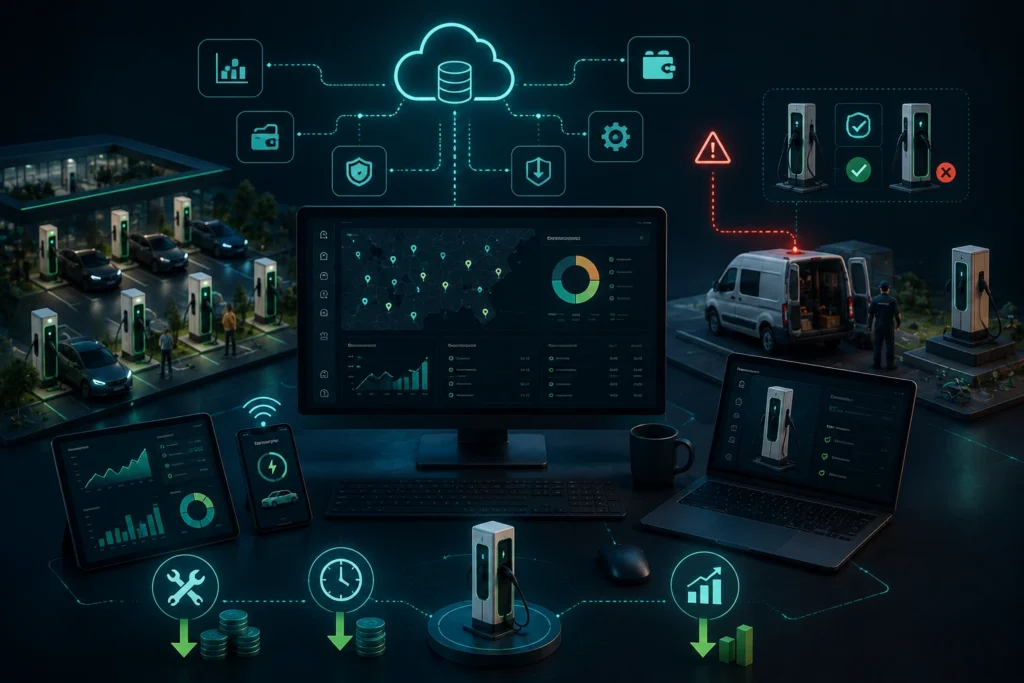
A CPO system helps operators monitor equipment, manage users, process payments, update firmware, collect operational data, and detect problems before they become service calls. Without these capabilities, even small charging networks become difficult to manage efficiently.
For example, remote diagnostics can identify communication problems, connector faults, or unusual charging behavior without sending a technician to the site. Firmware updates can improve performance or address security issues without interrupting normal operations for long periods. As networks expand, these functions become less of a convenience and more of a necessity.
Good software contributes to lower TCO by helping operators reduce unnecessary maintenance visits, resolve issues remotely whenever possible, monitor charger health across multiple locations, track utilization and energy consumption, schedule maintenance before failures occur, and manage mixed hardware through a single platform when supported by open standards. Choosing hardware that works with flexible management software can prevent expensive migration projects later if business requirements change.
Questions Worth Asking Before Comparing Quotes
Two proposals with similar hardware specifications may lead to very different ownership costs. Before making a purchasing decision, it helps to look beyond the equipment list and ask questions that reveal how the charging system will perform over time.
Some of the most useful questions include what the warranty actually covers and for how long, whether software updates can be performed remotely, whether the charger supports open standards such as OCPP, how spare parts are supplied if a component fails, what response time is expected for maintenance, whether most faults can be diagnosed remotely, how easily the site can be expanded in the future, which ongoing software or platform fees should be included in the budget, and what uptime targets the supplier typically supports.
These questions often reveal differences that are impossible to see from hardware specifications alone. In many cases, the most cost-effective charging solution is not the one with the lowest purchase price. It is the one that continues operating efficiently year after year while requiring fewer resources to keep the network running.
What TCO Looks Like in a Real Charging Project
Every charging site is different, but the pattern is often the same. The upfront purchase is only the beginning, while operating costs continue throughout the life of the infrastructure.
The example below illustrates how two projects can evolve over seven years. The numbers are simplified for comparison, but the trend reflects what many charging operators experience in practice.
| Cost category | Lower-cost solution | Higher-quality solution |
|---|---|---|
| Hardware purchase | Lower | Higher |
| Installation and commissioning | Similar | Similar |
| Software and connectivity | Moderate | Moderate |
| Maintenance and repairs | Higher | Lower |
| Downtime and lost revenue | Higher | Lower |
| Expansion and upgrades | Higher | Lower |
| Total cost after 7 years | Often higher | Often lower |
The biggest difference is rarely the purchase price itself. It is the accumulation of smaller costs that repeat every month or every year.
One additional service visit may not seem significant. Several unexpected repairs across multiple charging sites, combined with lost charging sessions and longer response times, create a very different financial picture. This is why many organizations review TCO over five to ten years rather than comparing procurement costs alone.
TCO Is Different for Every Business
There is no single formula that works for every charging project. A logistics depot operating electric vans every day has different priorities than a shopping center offering charging to visitors. A municipality managing public infrastructure faces different challenges than an office building with workplace charging.
The factors that usually influence TCO the most include daily charger utilization, electricity tariffs and demand charges, public versus private charging, expected network growth, service level requirements, local labor and maintenance costs, hardware reliability, and software capabilities.
For example, a charger that is used only a few times per week may never generate enough revenue to justify expensive features. On the other hand, a high-utilization charging hub can lose substantial income from even a few hours of downtime. That is why comparing projects without considering operating conditions often leads to misleading conclusions.
Frequently Asked Questions
What is included in the TCO of an EV charging station?
TCO covers much more than the charger itself. It includes installation, electrical infrastructure, software, electricity, maintenance, repairs, downtime, and, eventually, replacement or decommissioning costs.
Why isn’t the cheapest charger always the most affordable option?
A lower purchase price can be offset by higher maintenance costs, more downtime, limited software capabilities, or expensive upgrades later. Looking at the full lifecycle cost usually gives a more accurate picture.
How does charger downtime affect TCO?
Every hour a charger is unavailable can mean lost revenue, additional service costs, and frustrated drivers. For fleets, downtime may delay vehicle charging and disrupt daily operations, increasing overall operating costs.
Does charging software influence TCO?
Yes. A capable Charge Point Management System helps monitor charger performance, resolve many issues remotely, schedule maintenance, and manage energy more efficiently. These features can reduce both operating costs and downtime.
Should charging infrastructure be designed for future expansion?
In most cases, yes. Preparing a site for additional chargers during the initial installation is usually much less expensive than rebuilding electrical infrastructure a few years later when charging demand increases.
How can businesses reduce the TCO of EV charging infrastructure?
Choosing reliable hardware, using open standards, improving charger uptime, managing energy efficiently, and planning for future growth are some of the most effective ways to keep long-term ownership costs under control.
Final Thoughts
The lowest purchase price is easy to compare because it appears on the first page of every quotation. Total Cost of Ownership takes longer to evaluate, but it provides a much more accurate picture of what a charging project will actually cost over its lifetime.
Hardware is only one part of the investment. Installation, software, maintenance, electricity, reliability, downtime, and future expansion all influence the financial outcome. A charger that performs consistently, supports remote management, and adapts to future requirements often proves to be the more economical choice, even if its initial price is higher.
As EV charging networks continue to grow, TCO is becoming less of a financial exercise and more of a practical tool for making better infrastructure decisions. Businesses that consider the full lifecycle of their charging assets are generally in a stronger position to control costs, maintain reliable service, and expand their networks without unnecessary surprises.