

Table of contents:
Choosing an EV charging system is not only about buying hardware. It is a decision that affects how easily your network can grow, connect with other platforms, and adapt to new business needs over the next several years.
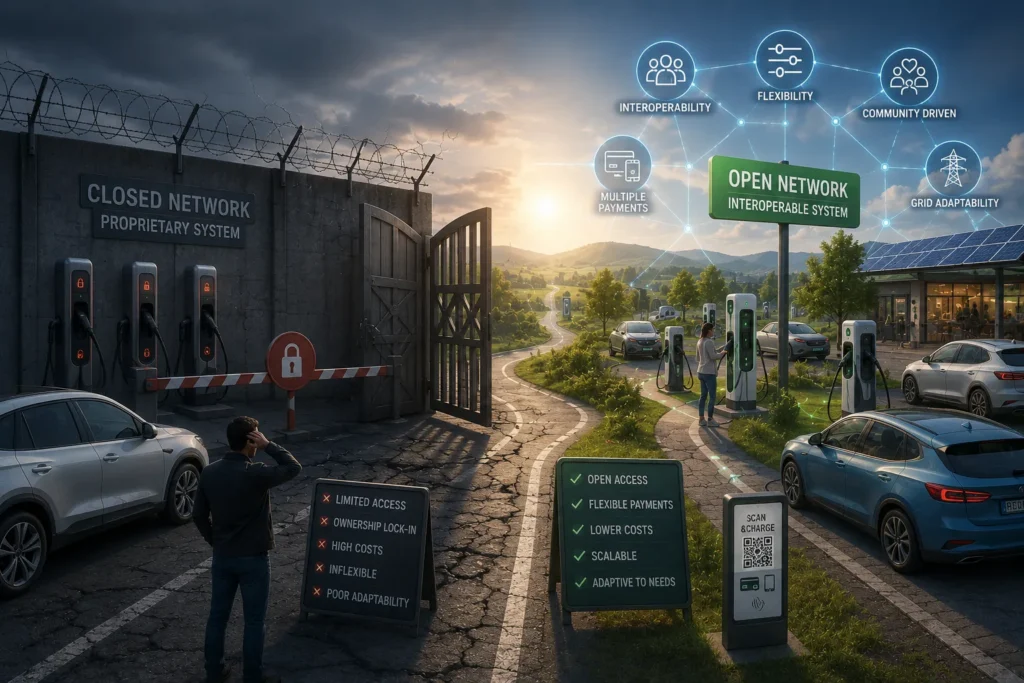
A closed system may seem like the simpler option at first. Everything comes from one supplier, installation is straightforward, and there is a single point of contact. The limitations usually appear later. As operators add more charging stations, introduce new payment services, connect with roaming platforms, or replace equipment, they often discover that their options are tied to one vendor.
Open energy markets work differently. They depend on interoperability, flexible software, and the ability to connect different technologies without rebuilding the entire infrastructure. For charge point operators, that flexibility has become an important part of keeping a charging network reliable, scalable, and ready for future requirements.
We remind you that you can purchase home and commercial charging stations in our store, as well as use public charging stations ECOFACTOR located throughout Ukraine. For convenient access to charging infrastructure, we recommend using our mobile app, available on iOS and Android.
The Two Common Types of EV Charging Systems
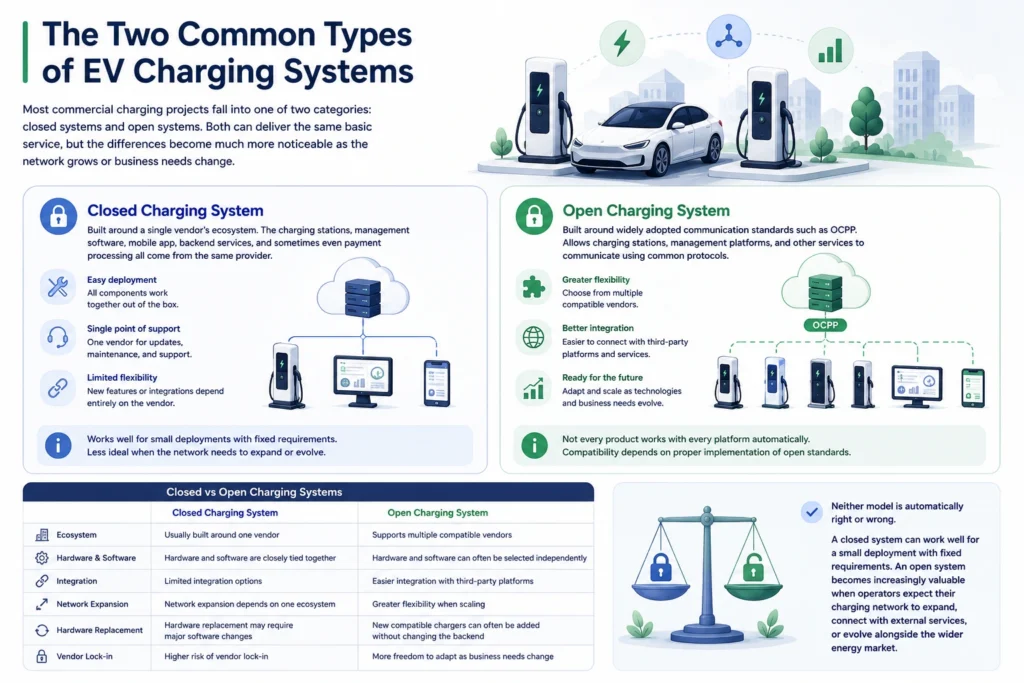
Most commercial charging projects fall into one of two categories: closed systems and open systems. At first glance, both can deliver the same basic service. Drivers plug in, charging starts, and payment is processed. The differences become much more noticeable as the network grows, new technologies appear, or business requirements change.
A closed charging system is built around a single vendor’s ecosystem. The charging stations, management software, mobile app, backend services, and sometimes even payment processing all come from the same provider.
This approach has some practical advantages during deployment. Installation is usually straightforward because every component is designed to work together. Operators have one supplier for technical support, software updates, and maintenance.
The challenge appears when business needs begin to change. Expanding to new locations, connecting with roaming platforms, adding different charger models, or introducing advanced energy management may depend entirely on whether the original vendor supports those features.
Open charging systems are built around widely adopted communication standards rather than a single manufacturer’s technology. Instead of locking operators into one ecosystem, they allow charging stations, management platforms, and other services to communicate using common protocols. One of the most important examples is OCPP, which enables compatible charging stations and Charge Point Management Systems (CPMS) to exchange operational data regardless of the hardware manufacturer.
An open system does not mean every product works with every platform automatically. Compatibility still depends on proper implementation. The key difference is that operators have far more flexibility when selecting hardware, expanding the network, or integrating additional services.
Closed vs Open Charging Systems
The differences between both approaches become clearer when viewed side by side.
| Closed charging system | Open charging system |
|---|---|
| Usually built around one vendor | Supports multiple compatible vendors |
| Hardware and software are closely tied together | Hardware and software can often be selected independently |
| Limited integration options | Easier integration with third-party platforms |
| Network expansion depends on one ecosystem | Greater flexibility when scaling |
| Hardware replacement may require major software changes | New compatible chargers can often be added without changing the backend |
| Higher risk of vendor lock-in | More freedom to adapt as business needs change |
Neither model is automatically right or wrong. A closed system can work well for a small deployment with fixed requirements. An open system becomes increasingly valuable when operators expect their charging network to expand, connect with external services, or evolve alongside the wider energy market.
Why Closed Systems Struggle in Open Energy Markets
EV charging no longer works as a separate piece of equipment in a parking lot. A charging network now has to connect with apps, payments, roaming, fleet tools, energy management, and support teams.
That is where closed systems start to feel heavy. They can work well at the beginning, but every new requirement depends on one vendor’s ecosystem.
Vendor Lock-In Limits Growth
In a closed system, hardware, software, app, and backend are usually tied together. That makes the first launch easier, but limits choices later.
If an operator wants to add chargers from another manufacturer, change the platform, connect a roaming partner, or use a new payment provider, the answer often depends on the original vendor. If the vendor does not support it, the operator waits, pays for custom work, or replaces more infrastructure than planned.
Integrations Become More Difficult
Charging sessions involve much more than delivering electricity. A modern charging network exchanges data with multiple services, including user authentication and access, payment processing, tariff management, remote monitoring, charging reports and analytics, fault notifications, fleet management platforms, and roaming services.
Open systems are designed to connect with different services through common standards. Closed systems are built mainly around their own ecosystem, making external integrations slower and less predictable. For a growing CPO, this can lead to practical challenges such as fewer payment options, limited roaming opportunities, more difficult reporting, and greater reliance on manual processes.
Scaling the Network Costs More
A setup that works for five chargers may not work well for fifty. As the network grows, operators need central monitoring, remote updates, tariff control, user management, maintenance alerts, and clear data across all sites. If every expansion step depends on one proprietary system, costs can rise quickly.
The problem is not only the price of chargers. It is the cost of being unable to choose the best hardware, software, or service for each new location.
Energy Innovation Moves Faster Than Closed Platforms
Charging infrastructure now has to work with load management, dynamic pricing, solar energy, battery storage, and future grid services. Closed platforms can support some of these features, but only when the vendor adds them. Open systems give operators more room to adapt as energy markets change.
For Ukraine, this matters. Businesses are building charging infrastructure in a market where demand, grid conditions, partnerships, and regulations are still developing. Flexibility is not a nice extra. It protects the project from becoming outdated too soon.
The Role of Open Standards
Open systems depend on common communication standards. The most important one in EV charging is OCPP.
OCPP allows charging stations and management platforms to exchange data even if they come from different vendors. The charger can send status updates, report faults, start or stop sessions, process user access, and support remote management through a compatible backend.
For operators, this means more freedom. They can choose chargers based on site needs, connect compatible hardware from different suppliers, keep one management platform while expanding, replace equipment without rebuilding the whole network, and reduce dependence on one vendor. Open standards do not make every integration automatic. Proper testing still matters. But they give charging networks a stronger base for long-term growth.

Build Flexible Charging Infrastructure With ECOFACTOR
The energy market continues to evolve, creating new requirements for charging infrastructure and energy management. Alongside charging stations, ECOFACTOR provides hybrid inverters, battery systems, and solar panels that can support different infrastructure strategies. Drivers can also access charging information through the iOS and Android app and charging station map.
ECOFACTOR can support infrastructure development through:
- Charging solutions for public and commercial projects
- Energy technologies for integrated charging ecosystems
- Equipment that supports network growth and adaptation
- Cables and accessories for long-term operation
Contact ECOFACTOR to discuss infrastructure solutions for changing energy and mobility needs.
How Open Systems Improve Daily Operations
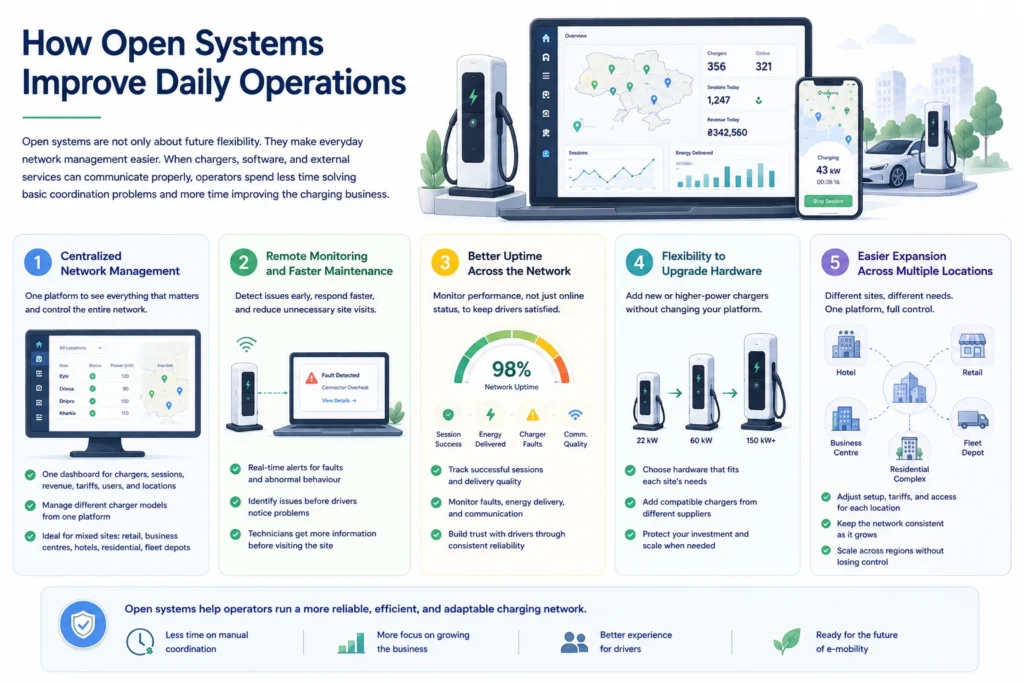
Open systems are not only about future flexibility. They make everyday network management easier. When chargers, software, and external services can communicate properly, operators spend less time solving basic coordination problems and more time improving the charging business.
Centralized Network Management
A growing network needs one clear place for control. Operators should be able to see charger status, sessions, revenue, tariffs, users, and locations without switching between several disconnected tools.
With an open system, different compatible chargers can be managed through one platform. This is especially useful for CPOs that operate mixed sites: retail locations, business centres, hotels, residential complexes, and fleet depots.
Remote Monitoring and Faster Maintenance
Many charger failures start small. A weak signal, a firmware issue, a connector fault, or an unstable power supply can affect charging long before the station fully goes offline.
Remote monitoring helps operators notice problems earlier. Instead of waiting for driver complaints, the team can see faults, session failures, and abnormal charger behaviour from the platform. That reduces blind spots and helps technicians focus on real issues faster.
Better Uptime Across the Network
Drivers judge reliability by one thing: whether charging works when they arrive. Open systems support better uptime because operators can track more than basic online status. They can monitor successful sessions, charger faults, energy delivery, and communication quality.
This matters for public charging in Ukraine, where trust is still being built. One failed session can make a driver avoid the same location next time.
Flexibility to Upgrade Hardware
Chargers will not stay the same forever. Some sites may need higher power. Some may need more connectors. Some equipment will age or become less efficient. In a closed system, hardware upgrades can force operators to stay with the same vendor or rebuild part of the software setup.
With an open system, operators have more freedom to add compatible chargers from different suppliers while keeping the existing management platform.
Easier Expansion Across Multiple Locations
Each site has different needs. A hotel does not use chargers the same way as a logistics depot. A shopping centre has different peak hours than a residential complex.
Open systems make it easier to adjust the setup for each location without losing central control. Operators can choose suitable hardware, manage tariffs, monitor performance, and keep the network consistent as it expands.
Choosing a Charging System for Long-Term Growth
A charging system should be judged by how well it will serve the business after the first year, not only by how simple it looks at the start.
Before choosing hardware or software, operators should check whether the system supports OCPP, whether chargers from other manufacturers can be connected later, whether remote monitoring is included, whether tariffs can be changed from the platform, whether payments, roaming, and reporting are supported, whether firmware management is available, whether the system can scale across different site types, and what happens if the vendor changes pricing, support, or product strategy. These questions help avoid expensive surprises. A cheaper closed setup can become costly if every future change depends on one supplier.
Frequently Asked Questions
Are closed EV charging systems always bad?
No. A closed system can be enough for a small private project with simple needs. The risk grows when the network needs integrations, new hardware, roaming, advanced monitoring, or expansion across different locations.
Why does OCPP matter for EV charging networks?
OCPP helps charging stations and management platforms communicate even when they come from different vendors. It gives operators more freedom to choose hardware, manage chargers remotely, and avoid being tied to one supplier.
Can open systems improve charger uptime?
Yes, especially when they include proper monitoring. Operators can track charger status, faults, session success, and communication issues from one platform. That helps teams respond faster and reduce avoidable downtime.
What should Ukrainian businesses check before choosing a charging system?
They should check OCPP support, hardware compatibility, remote monitoring, payment options, tariff control, roaming readiness, maintenance tools, and the ability to scale across different site types.
Why are open systems better for growing CPOs?
Growing CPOs need flexibility. Open systems make it easier to add chargers, connect partners, manage several locations, upgrade hardware, and adapt to new energy market requirements without rebuilding the whole network.
Final Thoughts
Closed charging systems can still work for simple projects with fixed needs. The problem starts when the market around them becomes more open, connected, and demanding.
EV charging in Ukraine is moving in that direction. Businesses need infrastructure that can grow across locations, work with different services, support reliable uptime, and adapt to future energy requirements.
Open systems give operators that room. They reduce dependence on one vendor, make expansion easier, improve daily management, and keep more options available as the market changes.