

Table of contents:
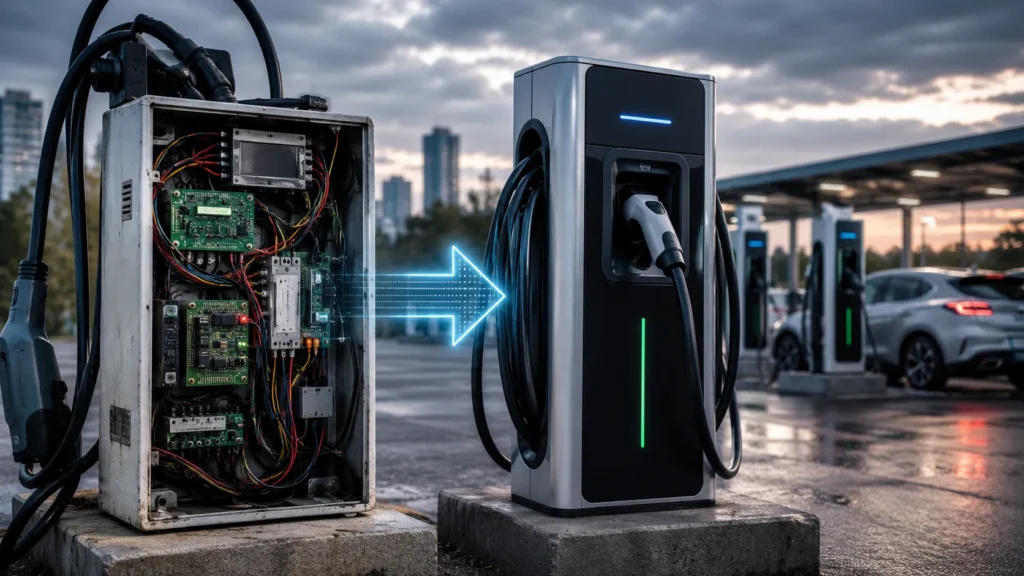
When many charging networks were first built, using a custom hardware stack seemed like the right choice. It gave operators tight control over hardware, software, and network management in one package. As EV charging has grown, though, those same systems have become harder to expand, update, and connect with new technologies.
Today, more CPOs are looking for ways to keep their infrastructure flexible instead of being tied to a single hardware ecosystem. This shift is not about following trends. It is about making everyday operations easier while keeping future upgrades within reach.
We remind you that you can purchase home and commercial charging stations in our store, as well as use public charging stations ECOFACTOR located throughout Ukraine. For convenient access to charging infrastructure, we recommend using our mobile app, available on iOS and Android.
Why Custom Hardware Once Made Sense
A decade ago, the EV charging industry looked very different. There were fewer charger manufacturers, fewer software platforms, and fewer standards that everyone agreed to follow. Many charge point operators chose a custom hardware stack because it solved a practical problem at the time.
Instead of combining products from different suppliers, operators could buy a complete package from one company. The charger, management platform, payment system, firmware, and support all worked together from the start. That reduced integration work and gave operators a single point of contact when something needed attention.
For networks with only dozens of chargers, this model often worked well. Installation was straightforward, support was centralized, and operators did not have to think about compatibility between multiple vendors. The approach offered several advantages during the early growth of EV charging: one supplier for hardware and software, simplified installation and commissioning, unified technical support, consistent user experience, and fewer compatibility questions during deployment.
At that stage, few people expected charging infrastructure to evolve as quickly as it has. Charging power increased, new communication standards appeared, payment methods expanded, and software capabilities became far more advanced. What once felt like a stable long-term investment began changing every few years.
What Changed as Charging Networks Grew
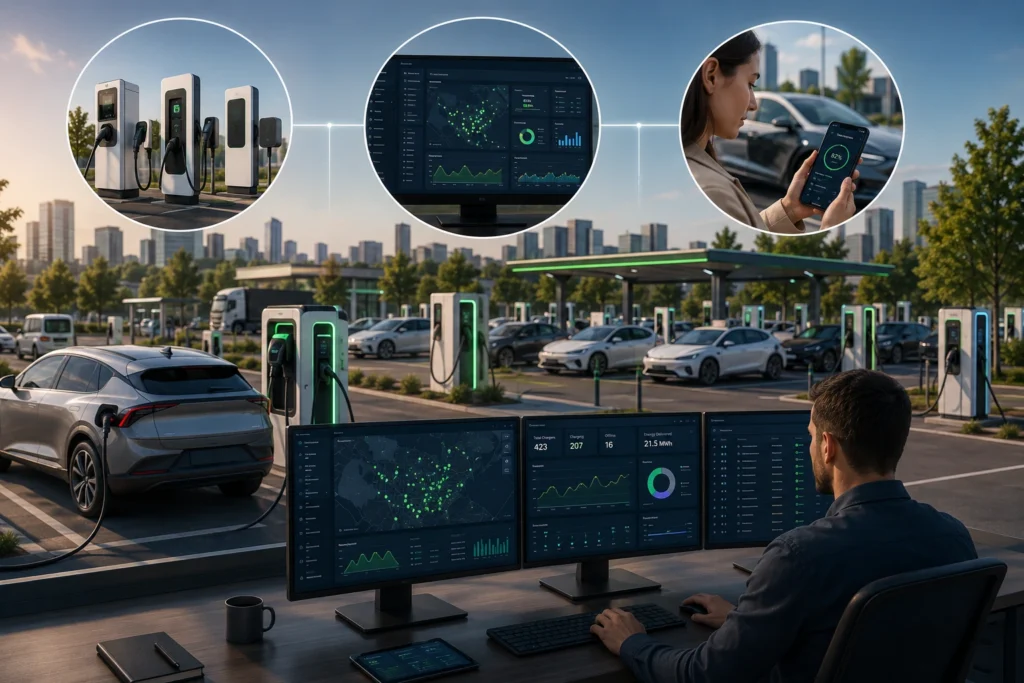
Building the first charging station is very different from operating hundreds of them. As networks expand, every decision affects future maintenance, operating costs, and the ability to introduce new services.
Many CPOs eventually discover that a hardware stack designed for a small deployment becomes much more restrictive once the network covers multiple cities or countries. Several industry changes have pushed operators toward more flexible infrastructure.
More Charger Manufacturers Enter the Market
The number of EV charger manufacturers continues to grow. AC chargers, DC fast chargers, ultra-fast charging systems, depot charging solutions, and residential products all serve different purposes. Very few operators want every charger in their network to come from the same supplier.
One manufacturer may offer excellent AC charging stations for offices, while another specializes in high-power charging for highways. A third could provide charging systems designed specifically for commercial fleets. Using the best equipment for each project often makes more sense than forcing every location to use identical hardware.
Software Has Become More Important
Years ago, the charger itself was the main product. Today, software plays an equally important role. Operators rely on Charge Point Management Systems to monitor charger status, collect operating data, update firmware, manage users, control pricing, generate reports, and coordinate maintenance.
As these platforms become more capable, many CPOs prefer software that works with multiple hardware brands rather than software that only supports one manufacturer’s products. That flexibility makes it easier to introduce new chargers without rebuilding the entire network.
Customer Expectations Continue to Rise
Drivers rarely think about the technology behind a charging session. They simply expect everything to work: the charger starting quickly, payment succeeding, charging speeds matching what was advertised, and the mobile app displaying accurate availability.
Delivering that experience depends on much more than hardware quality. It requires reliable software, stable communications, remote diagnostics, and efficient maintenance processes. As networks become larger, operators often invest more heavily in these operational tools than in proprietary hardware features.
Where Custom Hardware Starts Creating Problems
Custom hardware stacks do not suddenly stop working. The challenges usually appear gradually. An operator may want to install chargers from another manufacturer but discover they cannot integrate with the existing management platform.
A firmware update may depend entirely on the original supplier’s development schedule. Replacing a failed component may require ordering proprietary parts that have long delivery times. None of these issues are critical on their own. Together, however, they make expansion slower and operations more expensive.
Scaling Takes More Planning
Every charging project is slightly different. A retail parking area has different requirements than a logistics depot. Apartment buildings operate differently from public charging hubs. Bus depots have different power demands than office car parks.
A closed hardware ecosystem may not offer the right equipment for every situation. If operators must stay within one product family, compromises become more common. Open hardware strategies provide more room to adapt. Instead of asking whether a particular charger fits the existing ecosystem, operators can focus on selecting the equipment that best matches the site’s technical and business requirements.
Vendor Lock-In Becomes More Noticeable
Vendor lock-in is one of the most common reasons operators reconsider their infrastructure strategy. When hardware, software, and cloud services are tightly connected, changing one part often means replacing everything.
This affects decisions such as adding chargers from another manufacturer, moving to a different management platform, introducing new payment services, integrating energy management software, and expanding into new business models. Instead of choosing the solution that best fits a project, operators may find themselves limited by decisions made years earlier.
Maintenance Depends Too Much on One Supplier
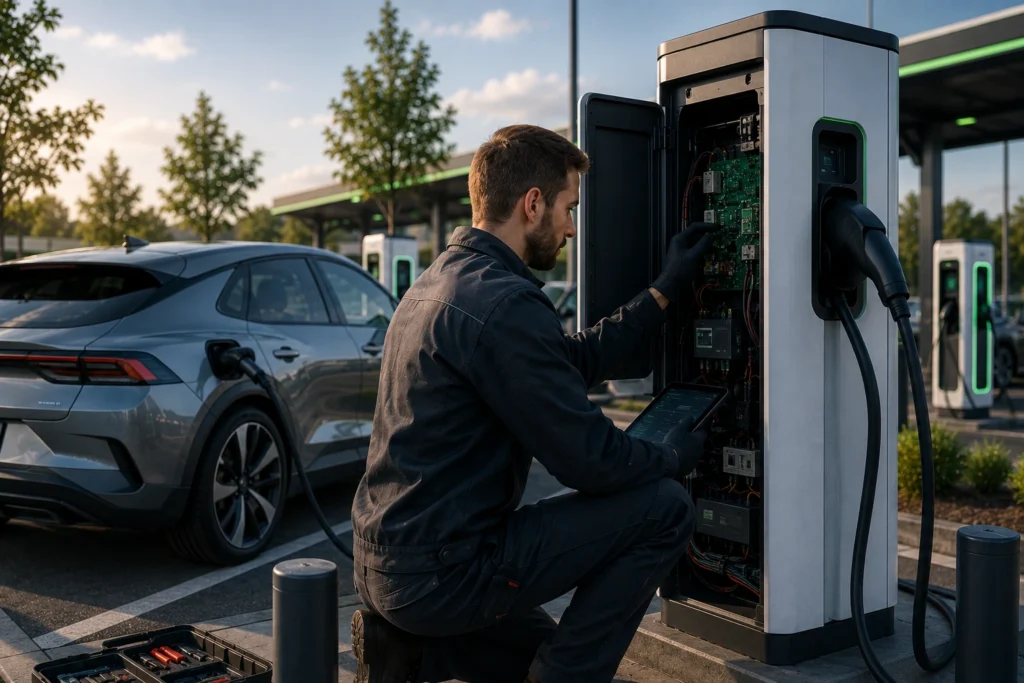
Maintenance becomes more complicated when every part of the charging network depends on a single vendor. If a charger develops a fault, operators may have to wait for proprietary replacement parts or specialized technicians. Firmware updates and bug fixes also depend on the manufacturer’s schedule, leaving CPOs with little control over when issues are resolved.
This approach may work for a small network, but the challenges become more noticeable as the number of charging stations grows. Delays at one location can affect customer satisfaction, operating costs, and network availability across multiple sites. Many CPOs prefer infrastructure that gives them more options. When hardware follows open standards, maintenance can become more flexible because operators are less dependent on one supplier for every repair, update, or expansion.

Simplify Charging Infrastructure With ECOFACTOR
Many charging network operators look for solutions that are easier to deploy, maintain, and expand over time. Alongside charging stations, ECOFACTOR provides hybrid inverters, battery systems, and solar panels that can support different EV infrastructure strategies. Through the iOS and Android app, drivers can also use the charging station map to find available charging locations.
ECOFACTOR can help support charging projects through:
- Charging stations for commercial and public charging networks
- Hybrid inverters for energy management applications
- Battery systems for energy storage integration
- Cables and accessories for installation and operation
Contact ECOFACTOR to discuss solutions for current or future charging infrastructure projects.
Why CPOs Are Looking at Open Systems
Moving away from a custom hardware stack does not mean rejecting integrated solutions altogether. It reflects a different way of planning charging infrastructure.
Instead of choosing one supplier for everything, many operators want the freedom to combine reliable hardware, flexible software, and services that best fit each project. This approach reduces dependence on one vendor and makes it easier to adapt as charging technology continues to evolve.
Hardware and Software Can Be Chosen Separately
In an open ecosystem, hardware and software do not have to come from the same manufacturer. A CPO might choose one brand of DC fast charger for highway locations, another supplier for workplace charging, and manage both through the same Charge Point Management System. This allows operators to select equipment based on performance, cost, availability, or site requirements rather than software compatibility alone.
Separating these decisions also gives operators more flexibility in the future. If they decide to introduce new chargers or change management software, they are less likely to replace working infrastructure simply because the ecosystem is closed.
OCPP Makes Mixed Networks More Practical
Open Charge Point Protocol, better known as OCPP, has made this flexibility possible. OCPP provides a common communication standard between chargers and management platforms. While integration still requires testing and proper implementation, it gives CPOs a realistic way to build networks using hardware from multiple manufacturers.
Instead of designing the network around one supplier, operators can choose the most suitable charger for each location while keeping management centralized. For growing charging networks, this flexibility often becomes more valuable than having identical hardware everywhere.
CPMS Flexibility Matters More as Networks Grow
As a charging network expands, the management platform becomes one of its most important assets. A modern CPMS is used every day to monitor charger availability, manage pricing, schedule maintenance, process payments, collect operational data, and support drivers. The larger the network becomes, the greater the impact of these tools on everyday operations.
That is why many CPOs prioritize a management platform that supports multiple hardware brands. Software that can evolve independently of the chargers gives operators more freedom to expand, modernize, or introduce new services without rebuilding the entire network.
Modernizing Networks Without Full Replacement
Replacing an entire charging network is rarely the first option operators consider. If existing chargers are still reliable, replacing them simply to adopt different software can be difficult to justify. In many situations, migration allows CPOs to modernize the network while keeping much of the existing infrastructure in service.
What Re-Networking Means
Re-networking is the process of connecting an existing charger to a different Charge Point Management System instead of replacing the hardware. Rather than installing new charging stations, operators change the backend connection so the chargers communicate with another software platform. If the hardware supports open communication standards and passes compatibility testing, this can provide access to new management tools without major construction work.
Re-networking can help CPOs extend the service life of existing chargers, reduce capital investment, minimize downtime during upgrades, introduce new software capabilities more quickly, and upgrade the network gradually instead of replacing everything at once.
When Existing Chargers Can Stay
Keeping existing chargers often makes sense when the equipment is still technically capable and reliable. Operators may decide to retain hardware if it supports modern communication standards, continues to receive firmware updates, has available replacement parts, delivers reliable charging performance, and meets current operational requirements. In these situations, migrating to another management platform may provide many of the benefits of a new network without replacing working equipment.
When Replacement Still Makes Sense
Migration is not always possible. Some chargers rely on proprietary communication methods, no longer receive software support, or cannot meet today’s cybersecurity requirements. Others have reached the point where repair costs and downtime outweigh the value of keeping them in service.
Replacement is often the better option when the charger has reached the end of its service life, spare parts are no longer available, security requirements cannot be met, the hardware cannot integrate with modern management platforms, or repair and maintenance costs continue to increase. The decision is rarely based on age alone. Instead, CPOs compare the long-term cost of maintaining existing equipment with the investment required for new infrastructure.
Custom Stack vs Open System vs Hybrid Model
There is no single approach that works for every charging network. The right choice depends on the operator’s priorities, the size of the network, and long-term business plans.
| Consideration | Custom Hardware Stack | Open System | Hybrid Model |
|---|---|---|---|
| Hardware choice | One manufacturer | Multiple manufacturers | Combination of both |
| Software | Usually tied to hardware | Independent where supported | Depends on implementation |
| Expansion | Limited by vendor ecosystem | Greater flexibility | Moderate flexibility |
| Migration | Often more difficult | Usually easier | Varies by architecture |
| Future upgrades | Vendor dependent | More options available | Balanced approach |
| Best suited for | Smaller or standardized deployments | Growing multi-site networks | Operators with mixed infrastructure |
Each model has strengths. Some operators prefer a fully integrated solution because it simplifies procurement and support. Others value the flexibility of open systems, while many large CPOs gradually adopt a hybrid approach that combines existing infrastructure with newer, more open technologies.
Frequently Asked Questions
Does moving away from a custom hardware stack mean replacing all chargers?
Not necessarily. If the existing chargers support open communication standards and remain reliable, many CPOs can migrate to a different management platform without replacing the hardware. The best approach depends on the condition and capabilities of the equipment.
What is the biggest advantage of an open charging ecosystem?
Flexibility. Operators can choose chargers from different manufacturers, adopt new software when needed, and expand their networks without being tied to a single vendor’s products or roadmap.
What is re-networking in EV charging?
Re-networking means connecting an existing charging station to a different Charge Point Management System. Instead of installing new hardware, the charger is configured to communicate with another backend platform, provided it supports the required standards.
Can older EV chargers support modern software?
Some can, while others cannot. Much depends on the charger’s hardware, firmware support, and communication capabilities. In some cases, a firmware update is enough. In others, the hardware may be too limited to meet current operational or cybersecurity requirements.
Why are open standards like OCPP important?
OCPP helps chargers and management platforms communicate even when they come from different manufacturers. This gives CPOs more freedom when expanding their networks, selecting hardware, or changing software providers.
Are custom hardware stacks still a good choice?
They can be. A custom stack may suit smaller or highly standardized deployments where one supplier manages the entire solution. For larger or growing networks, many operators prefer open systems because they offer more flexibility over the long term.
Conclusion
Custom hardware stacks helped establish many of today’s EV charging networks. They simplified deployment at a time when charging technology was less mature and hardware choices were limited.
The industry has changed. Networks are larger, software plays a much bigger role, cybersecurity requirements continue to grow, and operators increasingly expect the freedom to choose the best hardware for each project.
That is why more CPOs are moving toward open systems. The goal is not to replace working chargers unnecessarily. It is to build infrastructure that can adapt over time, support different hardware, and give operators more control over how their networks grow.
For companies planning charging infrastructure in Ukraine, this flexibility is becoming an important part of long-term investment. Choosing equipment that can evolve alongside the market may prove just as valuable as selecting the right charger today.