

Table of contents:
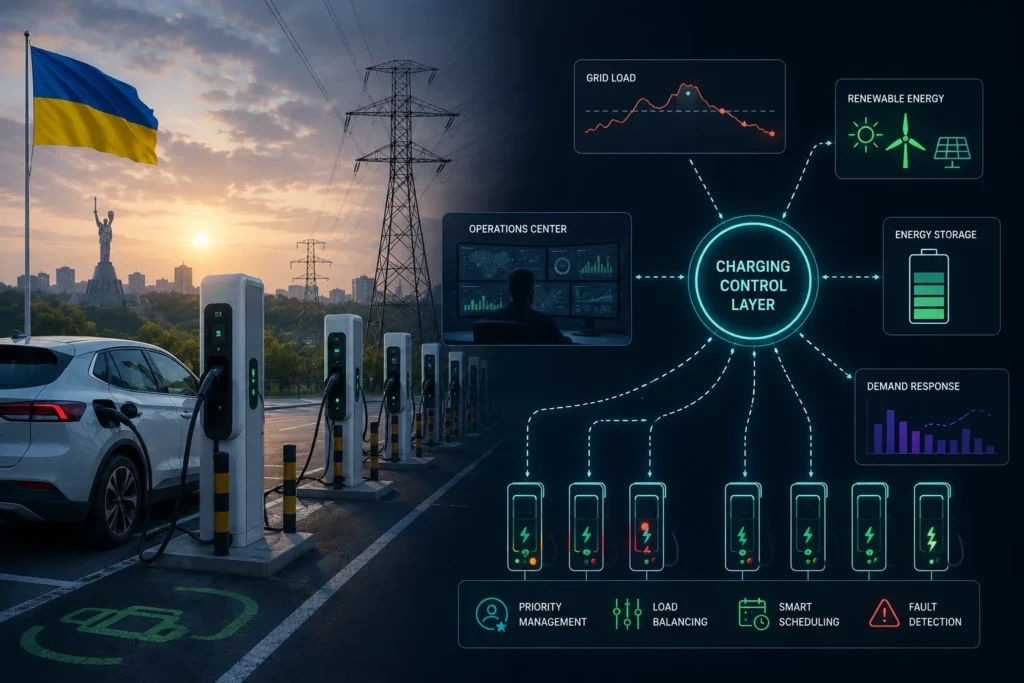
Installing EV chargers is only the beginning. Once a utility starts managing dozens or hundreds of charging points, the bigger challenge becomes keeping everything connected, balanced, and running reliably. Chargers need to communicate with each other, respond to grid conditions, report problems, and support drivers without creating unnecessary pressure on the electrical network.
That is where a control layer comes in. Instead of treating every charger as a separate device, it brings the entire charging network together. Utilities gain one place to monitor performance, manage energy use, respond to faults remotely, and make informed decisions as the network expands. Hardware delivers electricity, but the control layer is what turns individual charging stations into a coordinated system.
We remind you that you can purchase home and commercial charging stations in our store, as well as use public charging stations ECOFACTOR located throughout Ukraine. For convenient access to charging infrastructure, we recommend using our mobile app, available on iOS and Android.
Why Utilities Need More Than Charging Hardware
For many utilities, EV charging starts with hardware. The first projects usually focus on choosing charging stations, planning electrical capacity, and connecting sites to the grid. Those decisions matter, but they are only the foundation.
As charging networks expand, another challenge appears. A utility is no longer managing a few charging stations. It is managing thousands of charging sessions, different vehicle types, changing electricity demand, software updates, customer support, and grid conditions that shift throughout the day.
That is why modern charging infrastructure needs more than reliable hardware. It needs a control layer that connects every charger into one operational system. A charging station can deliver electricity, but it cannot coordinate an entire network by itself. Without centralized management, utilities quickly discover that adding more chargers also adds more complexity.
The Problem With Managing Chargers One by One
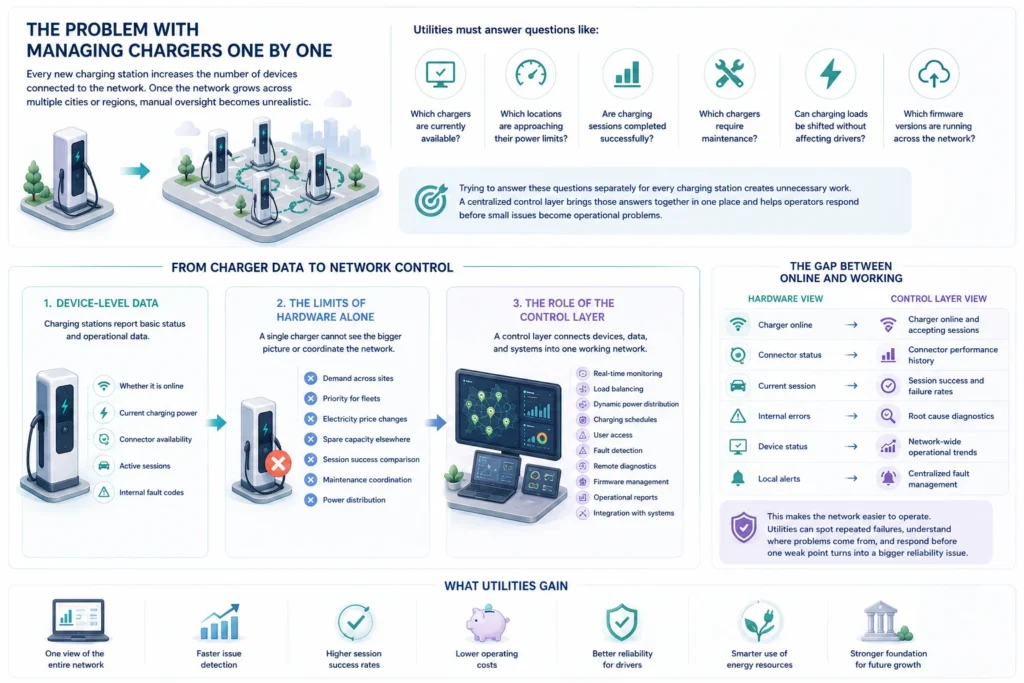
Every new charging station increases the number of devices connected to the network. Each one generates operational data, requires monitoring, receives firmware updates, communicates with backend systems, and occasionally develops faults.
When only a handful of chargers are installed, these tasks remain manageable. Once the network grows across multiple cities or regions, manual oversight becomes unrealistic.
Utilities must answer questions like which chargers are currently available, which locations are approaching their power limits, whether charging sessions are completed successfully, which chargers require maintenance, whether charging loads can be shifted without affecting drivers, and which firmware versions are running across the network.
Trying to answer these questions separately for every charging station creates unnecessary work. A centralized control layer brings those answers together in one place and helps operators respond before small issues become operational problems.
From Charger Data to Network Control
A charging station can report data, but data alone does not manage a network. For utilities, the difference matters. Once charging infrastructure grows across several sites, operators need to see not only whether a device is online, but whether charging is actually working, where demand is rising, and which problems need action first.
Device-Level Data
Charging stations are built to deliver power safely and communicate their own basic status. That is already a serious job, especially for DC chargers and busy public or fleet sites.
A charger can usually report whether it is online, current charging power, connector availability, active sessions, and internal fault codes. This helps operators understand what is happening at the device level. But device-level information is not the same as network control.
The Limits of Hardware Alone
A single charger does not provide the wider operating picture. It does not show how much demand is building across nearby sites, which fleet vehicles need priority, whether electricity prices are changing, or whether another location has spare capacity.
It also does not coordinate maintenance, compare session success rates across the network, or distribute available power between dozens of chargers. That gap becomes more important as utilities move from isolated charging points to connected energy assets. Once chargers influence electricity demand across several locations at the same time, the network needs a layer that can make decisions beyond one device.
The Role of the Control Layer
A control layer sits above the hardware and connects charging stations, management software, energy systems, and operational data into one working system. It does not replace the charger. It gives the utility a way to coordinate the whole network.
It helps with real-time charger monitoring, load balancing across sites, dynamic power distribution, charging schedules, user access, fault detection, remote diagnostics, firmware management, operational reports, and integration with utility systems. Instead of checking separate dashboards or waiting for drivers to report problems, operators get one view of what is happening across the network.
The Gap Between Online and Working
One of the hard lessons in EV charging is that a charger can look available and still fail the driver.
The charger may be online, but the session may not start. The connector may appear available, but failed attempts may be increasing. A dashboard may show no major alarm, while drivers keep facing the same charging problem at the site. That can happen because of communication errors, firmware issues, connector faults, payment problems, vehicle-to-charger compatibility, or gaps between the charger and backend platform.
A control layer gives utilities a more complete view.
| Hardware View | Control Layer View |
|---|---|
| Charger online | Charger online and accepting sessions |
| Connector status | Connector performance history |
| Current session | Session success and failure rates |
| Internal errors | Root cause diagnostics |
| Device status | Network-wide operational trends |
| Local alerts | Centralized fault management |
This makes the network easier to operate. Utilities can spot repeated failures, understand where problems come from, and respond before one weak point turns into a bigger reliability issue.

Add More Control to EV Charging Infrastructure
As EV charging networks expand, utilities often need more than physical charging equipment to manage daily operations effectively. Alongside charging stations, ECOFACTOR supports charging infrastructure with hybrid inverters, battery systems, and solar panels, alongside digital tools available through its iOS and Android app and charging station map.
ECOFACTOR can help support charging projects through:
- Infrastructure solutions for commercial charging networks
- Energy systems that complement charging operations
- Tools that improve visibility across charging locations
- Cables and accessories for installation and maintenance
Contact ECOFACTOR to discuss solutions for managing EV charging infrastructure more effectively.
How a Control Layer Actually Helps Manage Energy Demand
Electric vehicle charging introduces a new type of electricity demand. Unlike many traditional loads, charging sessions can often be shifted within available parking time. A vehicle that remains connected for six hours may only require two hours of charging. A control layer makes charging more flexible by coordinating when and how quickly vehicles receive power.
Dynamic Load Balancing
Available electrical capacity is distributed between chargers instead of assigning maximum power to every connector simultaneously. If one vehicle needs less power or finishes charging, the system can redirect capacity to other vehicles without overloading the site.
Scheduled Charging
Charging sessions begin during lower-demand periods while ensuring vehicles are ready before departure. This helps utilities avoid unnecessary peaks and makes better use of hours when the grid is under less pressure.
Fleet Prioritization
Vehicles with earlier departure times or lower battery levels receive priority over those remaining parked longer. For depots, buses, municipal fleets, or service vehicles, this keeps charging aligned with real operating schedules instead of treating every vehicle the same.
Demand Response Support
Charging power adjusts automatically in response to utility demand events when appropriate. Instead of disconnecting chargers completely, the control layer can reduce or shift load while still keeping essential charging available. For utilities, this means charging becomes another controllable energy resource rather than an unpredictable electrical load.
Less Maintenance Work Through Remote Control
Sending technicians to every charger is expensive. It is often unnecessary as well. Many operational issues can be investigated remotely if operators have access to detailed diagnostics, firmware management, and charging session information.
A modern control layer allows operators to restart chargers remotely, review fault logs, update firmware, monitor software versions, verify communications, identify recurring faults, and track maintenance history. Not every problem can be solved remotely. Physical damage still requires onsite work. However, remote diagnostics help maintenance teams arrive prepared instead of beginning every visit with basic troubleshooting. That shortens repair times and reduces unnecessary service visits.
Software Updates and Open Standards
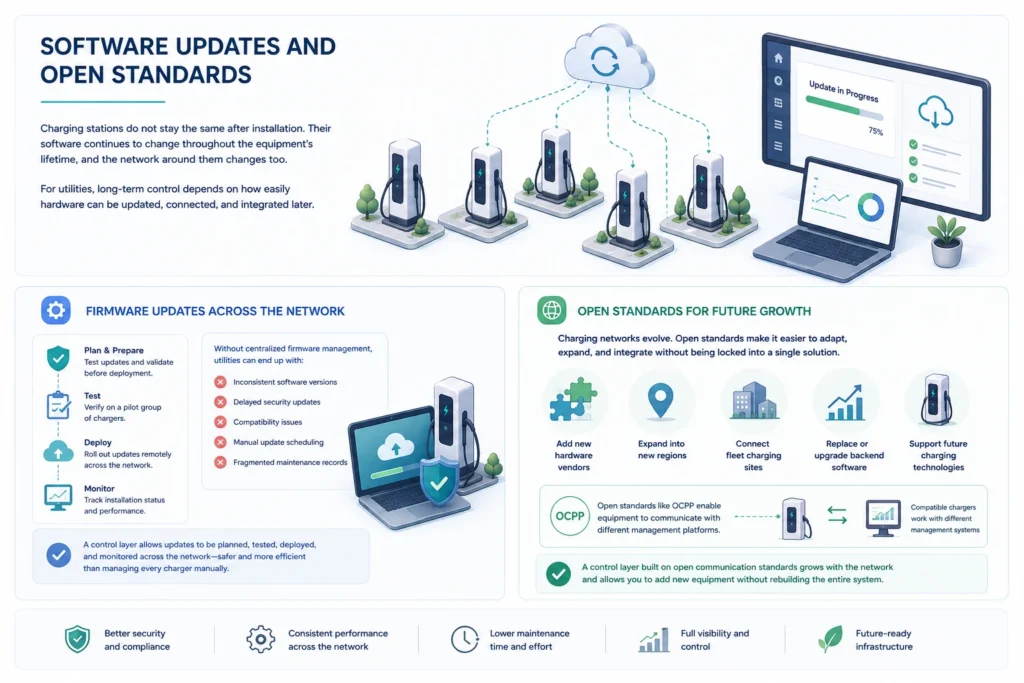
Charging stations do not stay the same after installation. Their software continues to change throughout the equipment’s lifetime, and the network around them changes too. For utilities, this means long-term control depends not only on the hardware installed today, but on how easily that hardware can be updated, connected, and integrated later.
Firmware Updates Across the Network
Security patches, communication improvements, protocol updates, payment features, and energy management tools often arrive through firmware updates. If every charger is updated manually, the process becomes slow, uneven, and difficult to track.
Without centralized firmware management, utilities can end up with inconsistent software versions, delayed security updates, compatibility issues, manual update scheduling, and fragmented maintenance records. A control layer allows updates to be planned, tested, deployed, and monitored across the network. That is much safer than treating every charger as a separate device, especially when infrastructure includes different models, sites, and installation years.
Open Standards for Future Growth
Charging networks rarely stay unchanged. Utilities may add new hardware vendors, expand into new regions, connect fleet charging sites, or replace backend software as the market develops.
Open standards make those changes easier to handle. Protocols such as OCPP allow compatible chargers to communicate with different management platforms instead of locking the utility into one closed system. This gives utilities more flexibility when they need to expand infrastructure, replace hardware, introduce new software, integrate fleet charging, or support future charging technologies.
A control layer built around open communication standards can keep growing with the network. It allows utilities to add new equipment without rebuilding the whole system around one manufacturer.
Where Utilities Need a Control Layer Most
Public charging is only one part of a modern charging network. Utilities increasingly work with municipal charging projects, commercial customers, apartment developments, workplace charging, logistics operators, electric bus depots, and corporate fleets.
Each environment has different charging behavior, operating hours, and energy priorities. Managing them separately creates additional complexity. A centralized control layer allows different charging environments to operate under one management system while applying different charging policies where needed. That provides consistency without removing operational flexibility.
What to Check Before Expanding a Charging Network
Utilities planning new charging projects often spend considerable time comparing charger specifications. That remains important, but operational questions deserve equal attention.
Before expanding, it is worth confirming whether the management platform can monitor every charger from one interface, support dynamic load balancing, perform remote diagnostics, manage firmware updates, integrate with existing utility systems, support OCPP-compatible hardware, generate operational reports, scale without major software changes, and manage both AC and DC charging infrastructure. These questions become increasingly important as networks move beyond pilot projects and become long-term infrastructure.
Frequently Asked Questions
What is a control layer in EV charging?
A control layer is the software that connects charging stations into one managed network. It helps utilities monitor chargers, balance power, schedule charging, perform remote diagnostics, and manage the entire system from a single platform.
Can a utility operate a charging network without a control layer?
It can, but only on a small scale. As the number of charging stations grows, manual monitoring becomes difficult. A control layer helps automate daily operations and gives operators a clearer view of the network.
How does a control layer improve charging reliability?
It does more than check whether a charger is online. It tracks charging sessions, detects faults, collects diagnostic data, and helps operators identify problems before they affect more drivers or vehicles.
Does a control layer help reduce electricity costs?
Yes. By supporting features such as dynamic load balancing and scheduled charging, it helps avoid unnecessary demand peaks and makes better use of available electrical capacity.
Why is OCPP important for utilities?
OCPP allows compatible charging stations to communicate with different management platforms. That gives utilities more freedom to expand their networks or introduce new hardware without replacing the entire software ecosystem.
Is a control layer useful only for public charging?
No. It can manage public chargers, fleet depots, workplace charging, residential installations, and municipal projects from the same platform. Different sites can follow different charging rules while remaining part of one network.
Conclusion
The first generation of EV charging focused mainly on installing enough chargers. The next stage is about operating those chargers efficiently.
Utilities already manage electricity generation, transmission, and distribution through centralized control systems because coordinated management improves reliability and resource allocation.
EV charging is following the same path. Individual charging stations remain essential, but they deliver the greatest value when they operate as part of a coordinated system that continuously monitors performance, balances energy, supports maintenance, and adapts to changing demand.
As Ukraine continues expanding public and commercial charging infrastructure, utilities have an opportunity to build networks that are easier to operate from the beginning. Hardware will always remain the physical foundation, but long-term performance increasingly depends on the software layer that connects every charger into one manageable network.