

Table of contents:
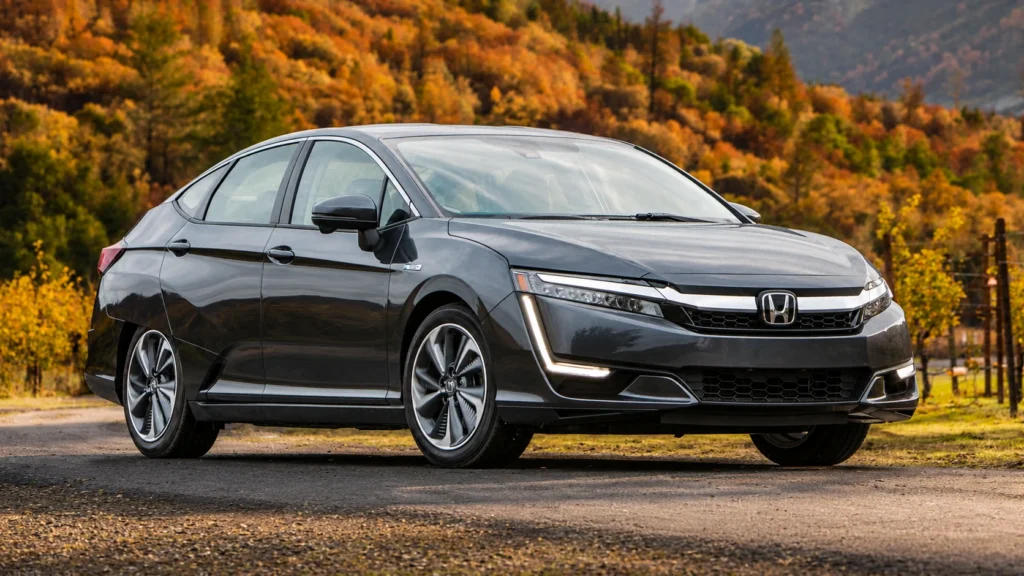
The Honda Clarity is available in two electrified versions — the Plug-in Hybrid (PHEV) and the all-electric model. Both models require regular charging, but the charging infrastructure in Ukraine has its own particularities.
Let’s take a look at the practical aspects of the charges for Ukrainian owners of these cars.
We remind you that you can purchase home and commercial charging stations in our online storeand also use the public charging stations ECOFACTORcharging points located throughout Ukraine. For convenient access to charging infrastructure, we recommend using our mobile applicationwhich is available on iOS and Android.
Honda Clarity models: what you need to know about charging
According to Honda’s technical documentation, the Clarity is available in several variants. Two of these are relevant to the Ukrainian market:
- The Clarity Plug-in Hybrid (PHEV) combines an electric motor with a 1.5-litre petrol engine. The battery provides an electric range of a certain distance. Once the battery is depleted, it operates as a conventional hybrid.
- Clarity Electric — a fully electric version with an electric range. Supports DC fast charging.
| Parameter. | Clarity PHEV | Clarity Electric |
|---|---|---|
| Power reserve (EV) | Electric power reserve | Electric power reserve |
| AC socket | Type 1 (J1772) | Type 1 (J1772) |
| Fast DC charging | Not supported | CCS Combo 1 (SAE J1772 Combo) |
| Home charging time | Several hours | Several hours |
Connector types and compatibility in Ukraine
This is where the nuances of the Ukrainian market come into play.
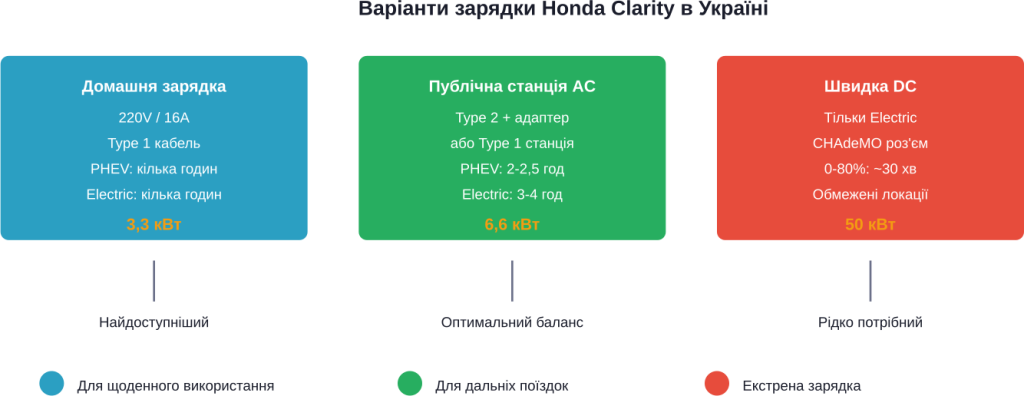
The Honda Clarity uses Type 1 (J1772) for slow AC charging. This is an American standard, which differs from the European Type 2. Most charging stations in Ukraine are designed for Type 2, so you will need an adapter or a special cable.
In accordance with the IEC 62196 standard, Type 1 supports single-phase charging up to 7.4 kW — this is sufficient for the Clarity. Energy losses during transmission amount to around 10 per cent, which is typical for all electric vehicles.
Fast DC charging
According to Honda’s technical documentation, the Clarity Electric supports fast charging via the CCS Combo 1 (SAE J1772 Combo) connector. The Japanese version of the Clarity PHEV (JDM) supports CHAdeMO, but the US version of the PHEV does not support fast charging.
Home exercise: practical solutions
Most owners charge their Clarity at home. Here’s what you need to know.
Charging the Honda Clarity Electric from a standard 220V socket (3.3 kW) takes around 11–12 hours. A full charge from a 110/120V socket can take up to 19–20 hours.
Installing a home charging station is a process that requires a professional approach. For safe and efficient operation, it is important to ensure the correct power supply and appropriate connection. Tesla recommends that the installation be carried out by a qualified electrician to avoid possible problems with overloading or malfunctioning of the charging station.
Equipment for home use
You’ll need a Type 1 cable with a plug suitable for Ukrainian sockets, or a Type 2 to Type 1 adapter, if you plan to use public charging points. Some owners buy portable chargers with adjustable current — which is handy for travelling.
Home charging stations must comply with electrical safety requirements, including protection against overloads, in accordance with national standards. It is recommended that a separate circuit breaker of the appropriate rating be installed for the charging point.
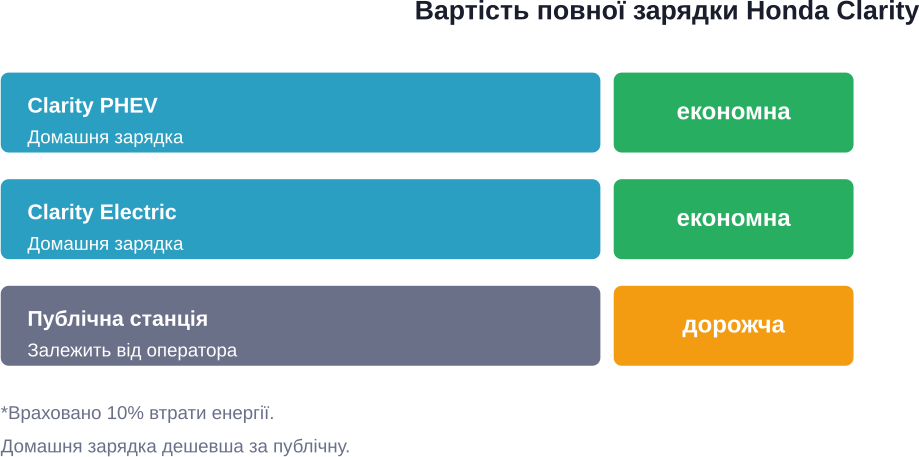
Public charging stations in Ukraine have different tariffs depending on the operator and location. While some charging stations are free of charge (for example, in some shopping malls or workplaces), others may charge per kWh or per time of use. On average, charging at public stations will cost more than at home, but it’s a convenient option when you’re in the city or travelling.
The charging station infrastructure in Ukraine is rapidly developing, especially thanks to companies such as
In Kyiv, Lviv, Odesa and other major cities, there are charging stations with a power output of 11–22 kW. The Honda Clarity PHEV’s on-board charger has a power output of 3.7 kW, whilst the Clarity Electric version has an on-board charger with a power output of 6.6 kW (AC) and supports up to 50 kW (DC).
The cost of public charges depends on the operator and the region.
ECOFACTOR’s infrastructure and expertise for Honda Clarity owners
When it comes to charging the Honda Clarity in Ukraine, we fully understand that it all boils down to two things — compatibility and accessibility. That is why we at ECOFACTOR are developing a network of solutions across the country and manufacturing our own charging stations that meet industry standards. For urban locations and car parks, we offer AC stations up to 44 kW, whilst for motorways and high-traffic areas, we provide DC stations up to 420 kW. If you have a Clarity Electric with fast-charging capability, you can look for suitable charging points with CHAdeMO or CCS; and for the Clarity PHEV with Type 1, we can help you find the right cable or adapter to ensure a hassle-free experience when using public charging infrastructure.
We have also developed a mobile app for iOS and Android for drivers, which simplifies everything to just a few taps, and an operator platform for owners. Our interactive map shows the location of stations, connector types, power output and port status in real time. This is particularly important for Clarity owners who need to check in advance for compatibility with Type 1 or the availability of fast charging. In the app, you can start a charging session, view your charging history and monitor your costs. To be honest, we don’t like complicated processes ourselves, so we’ve tried to make the interface as simple as possible.
Another area we focus on is our online shop. There you can buy mobile chargers, inverters and accessories, including cables and adaptors, which are often needed by Honda Clarity owners in Ukraine. If you’re planning to install a wallbox at home, we can help you choose a charging station suited to your mains supply and usage patterns. It’s important to us that charging isn’t a source of stress, but a natural part of everyday life, whether you’re driving a PHEV in the city or an electric car for your daily commute.
Optimising charging time and battery health
Keep the charge level between 20–80% for maximum battery life. Constantly charging to 100% or discharging to zero accelerates degradation.
Temperature affects performance. At low temperatures, charging times may increase; this can be mitigated by warming the battery before charging. Clarity has a thermal management system, but extreme cold still reduces performance.
Use Econ mode for city driving — it optimises energy recovery during braking. According to user reviews, this adds 5–10 per cent to the range.
Incentives and savings in Ukraine
Owners of electric vehicles and plug-in hybrids in Ukraine are exempt from paying road tax. In addition, reduced rates of import duty apply to electric vehicles.
Some towns and cities provide free access to municipal charging points or discounted parking for electric vehicles.
Common problems and their solutions
The most common problem is finding a Type 1 charger or a high-quality adapter. Cheap adapters can overheat or limit the power output. Look for certified devices with overload protection.
The second issue is winter range. Electric cars can lose range at low temperatures due to cabin heating and battery cooling. PHEVs are more advantageous in this respect — they always have a backup petrol engine.
If charging stops prematurely, check the temperature of the cable and the connector. Overheating triggers the safety mechanisms.
Conclusion
The Honda Clarity is a practical choice for Ukrainian conditions, but requires careful planning of charging. The PHEV is more versatile thanks to its petrol engine, whilst the Electric is more economical for regular short journeys.
The Home Exercise kit meets 90 per cent of most owners’ needs. Investing in a Type 2 to Type 1 adapter and a high-quality cable will pay for itself within a few months.
Are you planning to buy a Clarity, or do you already own one? Check the availability of charging stations along your usual route and consider installing a home wallbox for maximum convenience.
Frequently asked questions
How much does it cost to fully charge a Honda Clarity in Ukraine?
Charging the Clarity PHEV at home is significantly cheaper than using public charging points. The Clarity Electric is significantly cheaper to charge at home than at public charging points.
Do you need an adapter to charge the Clarity at Ukrainian charging stations?
Yes, the Honda Clarity has a Type 1 (J1772) connector, whilst most Ukrainian charging stations use Type 2. You’ll need a Type 2 to Type 1 adapter, or you’ll have to look for the few charging stations with a Type 1 connector.
How long does it take to charge a Honda Clarity PHEV?
Charging the Honda Clarity PHEV from a 220V socket takes around 5–6 hours.
Does the Honda Clarity support fast charging?
Clarity Electric supports fast charging via the CCS Combo 1 (SAE J1772 Combo) connector.
What is the electric range of the Honda Clarity?
The Clarity PHEV has an electric range that varies depending on driving conditions. The Clarity Electric has an electric range, but this may be reduced in cold conditions during winter.
How does the cold affect the charging performance of the Clarity in winter?
At low temperatures, charging times may increase due to the need to pre-warm the battery. The power reserve is reduced in cold conditions due to the heating of the passenger compartment and the battery’s performance characteristics. It is recommended to charge the battery in a warm garage whenever possible.
Can you set up a home charging station for the Clarity?
Yes, installing a wallbox reduces the charging time for Clarity Electric vehicles. A separate circuit breaker with the appropriate capacity, in accordance with IEC 61851 standards, is required. The charging point must support a Type 1 connector or be used with a Type 2 to Type 1 adapter.