

Table of contents:
Electric vehicle charging is becoming part of everyday life, but every new charger adds demand to the electricity grid. As charging networks grow, simply installing more charging stations is no longer enough. The way those stations use and manage energy matters just as much.
Solar-based EV charging offers more than clean electricity. When combined with battery storage and smart energy management, it can reduce pressure on the grid, make better use of locally generated power, and improve the reliability of charging sites. Instead of acting only as electricity consumers, charging stations can become valuable energy assets that support both network operators and the wider power system.
This article explains how solar-powered charging works as a grid asset, where it delivers the greatest value, and what businesses should consider when planning future-ready EV charging infrastructure.
We remind you that you can purchase home and commercial charging stations in our store, as well as use public charging stations ECOFACTOR located throughout Ukraine. For convenient access to charging infrastructure, we recommend using our mobile app, available on iOS and Android.
What Makes Solar EV Charging a Grid Asset
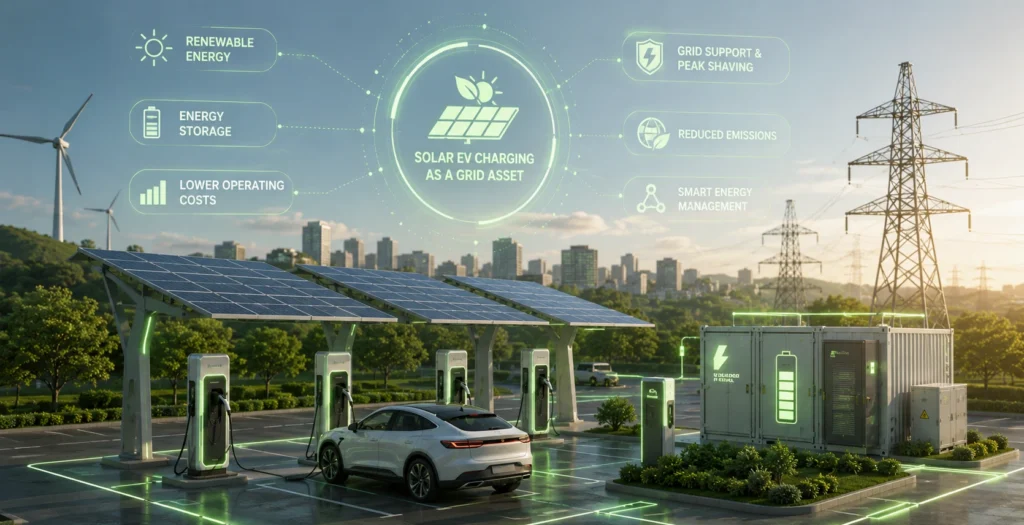
Installing solar panels above an EV charging site is no longer just a way to produce renewable electricity. With the right combination of charging stations, battery storage, and energy management software, a charging location can actively support the electricity network instead of simply drawing power from it.
That difference matters as EV adoption grows. Every new charging point increases electricity demand, especially during busy hours when people return home, shopping centres fill up, or commercial fleets begin charging after daily routes. If every charger relies entirely on the grid at the same time, local distribution networks may require expensive upgrades long before they reach their physical limits.
Solar-based charging changes that picture. Instead of importing every kilowatt-hour, part of the energy is generated where it is used. Combined with battery storage, surplus solar energy can be saved for later and released when charging demand increases. Rather than becoming another source of peak demand, the charging site becomes part of the solution.
For Ukraine, where energy resilience has become just as important as sustainability, this approach offers practical value. Businesses can lower operating costs, improve energy independence, and reduce pressure on local electricity infrastructure without compromising charging availability.
The Parts That Make the System Work Together
Solar charging works best when several technologies operate as one connected system. Looking at the charging station alone does not explain why these sites can support the grid.
A typical installation may include photovoltaic (PV) panels that generate electricity during daylight, AC or DC EV charging stations, battery energy storage systems, inverters that convert and manage power flow, energy management software, and connection to the public electricity grid.
Each component has a different role. Solar panels produce electricity whenever sunlight is available. Chargers deliver power to vehicles. Batteries store excess generation for later use. The management platform decides where electricity should go based on demand, battery status, charging sessions, electricity prices, and grid conditions.
Instead of following one fixed path, electricity constantly moves to where it creates the greatest value. For example, during a sunny afternoon with few charging sessions, excess solar energy may charge the battery. Later that evening, when several vehicles arrive simultaneously, the battery can supply part of the required electricity instead of drawing everything from the grid.

Explore Solar-Powered Charging Solutions With ECOFACTOR
Solar-powered charging infrastructure is becoming part of broader conversations about energy resilience and long-term grid development. Alongside charging stations, ECOFACTOR provides solar panels, hybrid inverters, and battery systems that can support different charging and energy scenarios. Drivers can also use the iOS and Android app and charging station map to access charging locations.
ECOFACTOR can support solar-powered charging projects with:
- Charging infrastructure for commercial and public deployment
- Solar energy technologies for integrated charging sites
- Energy storage solutions for additional flexibility
- Cables and accessories for installation and maintenance
Contact ECOFACTOR to discuss solar-powered charging solutions for future infrastructure projects.
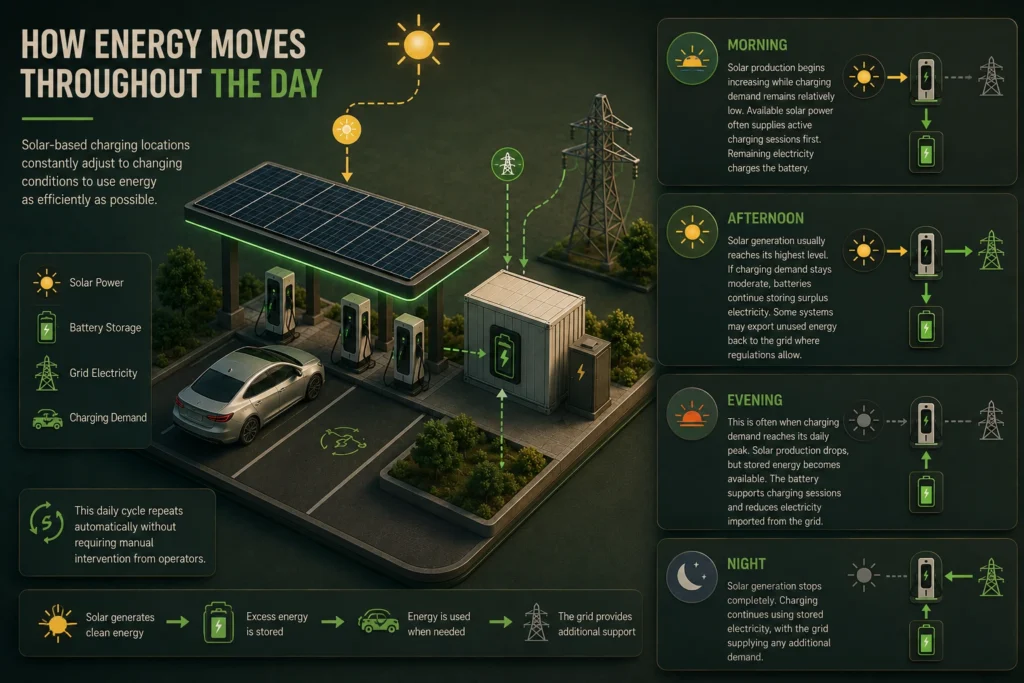
How Energy Moves Throughout the Day
Unlike traditional charging sites, solar-based charging locations constantly adjust to changing conditions.
Morning. Solar production begins increasing while charging demand remains relatively low. Available solar power often supplies active charging sessions first. Remaining electricity charges the battery.
Afternoon. Solar generation usually reaches its highest level. If charging demand stays moderate, batteries continue storing surplus electricity. Some systems may export unused energy back to the grid where regulations allow.
Evening. This is often when charging demand reaches its daily peak. Solar production drops, but stored energy becomes available. The battery supports charging sessions and reduces electricity imported from the grid.
Night. Solar generation stops completely. Charging continues using stored electricity, with the grid supplying any additional demand.
This daily cycle repeats automatically without requiring manual intervention from operators.
Why Grid Support Matters for Charging Networks
Many people think about charging stations one site at a time. Electricity operators see something different. Hundreds or thousands of chargers connected across one region create a completely new demand profile.
Without proper management, several issues may appear: local transformers becoming overloaded, electricity demand spiking during evening hours, network expansion becoming necessary sooner, operating costs increasing because of demand charges, and charging reliability declining during peak periods.
Solar generation alone reduces part of this pressure. Battery storage extends that benefit beyond daylight hours. Smart energy management coordinates both resources so charging demand becomes smoother instead of creating sudden peaks. This approach is often called peak shaving, but its practical result is simple: less stress on local electricity infrastructure.
Combining Solar, Battery Storage, and Smart Energy Management
One technology rarely solves every operational challenge. Solar panels generate electricity only when sunlight is available. Battery storage shifts that electricity to another time. Energy management software decides how to use every available kilowatt-hour. Separately, each technology offers value. Together, they become much more effective.
Imagine a retail location where customers charge vehicles throughout the day. During lunchtime, solar panels produce enough electricity for both the building and charging stations. Rather than sending surplus generation back to the grid immediately, batteries store part of it. Later, after sunset, shoppers continue arriving. Instead of importing all charging power from the grid, the system combines battery energy with grid electricity, reducing peak demand while maintaining charging performance.
Without software coordinating these decisions, the system would lose much of its potential.
Where Solar-Based Charging Delivers the Greatest Value
Not every charging location benefits equally from solar generation. Sites with predictable daytime activity usually achieve the strongest results.
Examples include shopping centres, supermarkets, hotels, office buildings, logistics depots, business parks, and municipal parking facilities. These locations often combine available roof space or parking areas with regular vehicle traffic during daylight hours.
Fleet operators represent another interesting case. Delivery vehicles frequently return according to planned schedules, making charging demand easier to predict. Energy management software can prepare battery storage before charging begins, improving overall efficiency.
Comparing Traditional and Solar-Based Charging Sites
Neither approach completely replaces the other. Most commercial charging sites continue operating as grid-connected systems. The difference is that solar and storage reduce how much the grid must provide at any given moment.
| Feature | Traditional Grid Charging | Solar-Based Charging with Storage |
|---|---|---|
| Main electricity source | Public grid | Solar, battery, and grid |
| Peak demand | Higher | Lower |
| Energy flexibility | Limited | High |
| Local renewable generation | No | Yes |
| Backup capability | Depends on the grid | Possible with battery systems |
| Grid dependence | High | Reduced |
| Operating costs | More sensitive to electricity prices | Better control over long-term costs |
Planning a Solar Charging Project for Long-Term Value
Installing panels is only one decision among many. Businesses planning solar-powered charging should evaluate several factors before choosing equipment.
Questions worth answering include how many charging sessions are expected each day, when vehicles usually arrive, whether daytime charging is more common than overnight charging, how much roof or parking space is available, whether the charging network will expand in the future, whether battery systems are part of the first phase or a later upgrade, and how energy will be monitored and managed.
Designing the system around expected charging behaviour usually produces better results than sizing solar panels alone. A charging network should remain flexible enough to support future chargers, higher charging power, and additional battery capacity without requiring major reconstruction.
Why Software Is Becoming Just as Important as Hardware
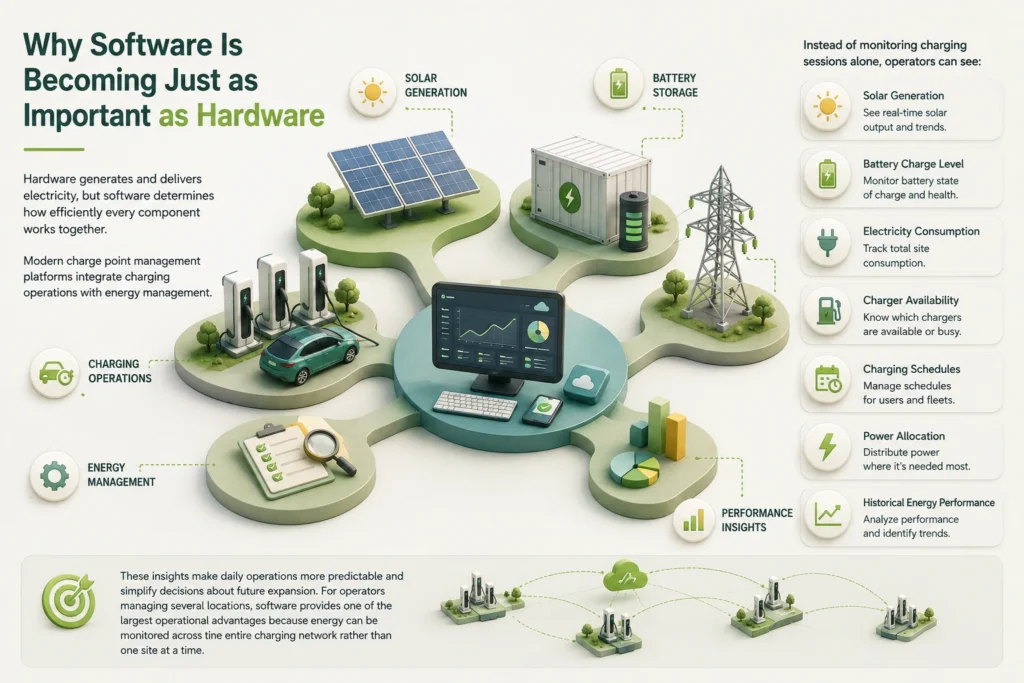
Hardware generates and delivers electricity, but software determines how efficiently every component works together.
Modern charge point management platforms increasingly integrate charging operations with energy management. Instead of monitoring charging sessions alone, operators can see solar generation, battery charge level, electricity consumption, charger availability, charging schedules, power allocation, and historical energy performance.
These insights make daily operations more predictable and simplify decisions about future expansion. For operators managing several locations, software provides one of the largest operational advantages because energy can be monitored across the entire charging network rather than one site at a time.
Frequently Asked Questions
Can a solar-powered charging station work without the electricity grid?
It can, but only if it has enough solar generation, battery storage, and equipment designed for off-grid operation. Most commercial charging sites stay connected to the grid because it provides backup during long periods of low solar production or high charging demand.
Why is battery storage important for solar EV charging?
Solar panels only generate electricity during the day. Battery storage keeps excess energy for later, allowing charging stations to continue using solar power after sunset or during cloudy weather. It also helps reduce peak demand on the grid.
Is solar EV charging suitable for fast DC chargers?
Yes, although fast chargers often require more power than solar panels can supply on their own. In most cases, solar generation, battery storage, and the grid work together to provide stable charging while lowering overall electricity consumption from the grid.
Which businesses benefit most from solar-based EV charging?
Sites with regular daytime parking usually see the greatest value. That includes shopping centres, hotels, office buildings, logistics depots, fleet operators, residential complexes, and public parking facilities where vehicles remain parked long enough to make good use of locally generated energy.
Does solar charging reduce electricity costs right away?
It usually lowers electricity purchases from the grid, but the overall return depends on factors such as charging demand, solar production, battery capacity, and local electricity tariffs. The biggest savings often appear over the long term as energy prices change.
Can existing EV charging stations be upgraded with solar panels and batteries?
In many cases, yes. Existing charging sites can often be expanded with solar generation, battery storage, and energy management software without replacing the charging stations themselves. The exact approach depends on the site’s electrical capacity and available installation space.
Final Thoughts
Charging infrastructure is gradually becoming part of the wider energy system rather than standing beside it.
A charging station that only consumes electricity places continuous demand on the grid. A charging site equipped with solar generation, battery storage, and intelligent management behaves differently. It generates electricity, stores energy, adjusts consumption, and supports more balanced power use throughout the day.
For Ukraine, this direction has practical significance. Growing EV adoption, changing electricity demand, and the need for resilient infrastructure make local energy generation increasingly valuable. Businesses investing in charging today are not simply choosing hardware. They are deciding how those sites will operate for years to come.